Don Rosa was not the last to attempt a grand, epic biography of Scrooge McDuck, as we have seen. Well, the fact is less well-known, but neither was he the first. As Rosa himself admits, he drew considerable inspiration from a 1974 book called An Informal Biogrpahy of Scrooge McDuck, the work of one Jack L. Chalker who would go on to become a pretty successful science-fiction writer a few years down the line. I've finally obtained it for myself, and it is well worth the read, if only because it's very nicely written.

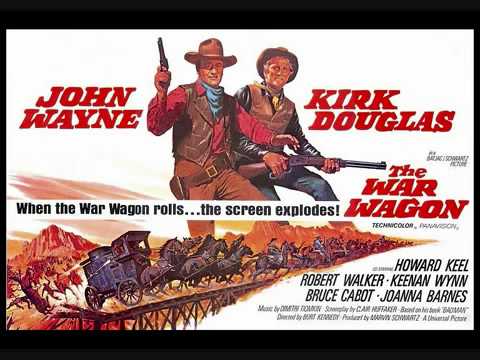
It's quite a lovely cover, this. It obviously plays with the fact that for copyright reason — as a preface within the book itself bemoans — no actual images of Scrooge could be used to illustrate the book. In truth, I think the book was only authorized to see print because Chalker could legally claim that it was only a critical work, not a work of fiction.
Which I must stress is a blatant lie.
Taking its every cue from Sherlock Holmes enthusiasts' ‘Great Game’, wherein they pretend to be historians researching Holmes as a historical figure, the Informal Biography is written with the conceit that it is an in-universe biography, the work of a historian trying to document Mr McDuck based on the "secondary sources" that are the works of his official chronicler Mr Barks.
This is delightful, not only because it spices things up, but also because it allows the book to be fallible — if you think one of Chalker's ideas about Scrooge's life is nonsense, then that's no reason to throw out the book, it just means you have identified one of the instances in which Chalker-the-character obviously didn't look hard enough for the real answers. (I'm thinking, for a particularly conspicuous example, of the extremely curious blunder that is Chalker's assumption that Huey, Dewey and Louie are the sons of Donald's brother.)
The debts this (and, consequently, the L&T) owes to Sherlock Holmes exegesis is staggering — the tone in which the narrator treats the subject of the 'biography' is precisely the same cautious, falsely-detached respect — and Chalker owns it. The chapter about Goldie literally opens with a statement that “to Scrooge, she was always The Woman”, and just from that, as controversial as DuckTales 2017's decision to write Scrooge and Goldie's relationship as a modernized version of Sherlock & Irene (well, the pop vision thereof) might be, you can see just where they get it from.
It goes further, actually. Towards the end of Part 1, we find the following passage, riffing off Only a Poor Old Man's statement that Scrooge once made money training cormorants:
From Australia, Scrooge made his way north, into Indochina and China itself, where he became involved in the pearl trade. While there he discovered a special affinity for birds, and trained thousands of cormorants after learning their language. His most illustrious customer was a certain aged Oriental doctor who was often seen with cormorants in the years after—they became sort of a trademark. Later on he discovered that the doctor used cormorants trained by Scrooge for nefarious purposes, and was instrumental in the solution of the Adventure of the Trained Cormorants which, because of its unsatisfactory solution — the doctor escaped — and the illustrious reputations of all three men involved, still awaits elaboration in The Whole Art of Detection.
In other words, Chalker is outright declaring that his Scrooge exists in the same universe as Arthur Conan Doyle's Sherlock Holmes, and specifically as the Great Game-rooted pastiche collection The Whole Art of Detection. And further, he is very very strongly implying that Scrooge McDuck and Sherlock Holmes once teamed up to fight Doctor Fu Manchu.
…now, my good friend Joe Torcivia (among others) is notorious for slipping titles to nonexistent "bonus chapters" of the Life and Times of $crooge McDuck in his Disney scripts, and more power to him, but you can't beat that as unseen past Scrooge adventures go. You just can't.

So anyway, having acknowledged where this book came from, there remains to analyze what it went to. Because it is not merely the precursor to Rosa's L&T, but rather its template. One doesn't want to diminish Don Rosa's own scholarly work, and I'm sure he made sure to pore over all those Barks references once again on his own power before he worked out his own version of Scrooge's biography, but… the fact is that the Chalker version of events lines up astonishingly well with the Rosa rendition. There are, of course, a few differences here and there (in The Empire-Builder from Calisota, Scrooge uses his damnably slow car to reach Duckburg; in the Informal Biography, he buys it shortly after settling in Duckburg), but for every minor difference there are identical leaps of logic that one cannot call coincidences.
This, by the way, accounts for the suspicious similarities between the L&T and the DuckTales episode Once Upon a Dime, which were big enough that Rosa's protests of never having watched it failed to convince. The DT writers were borrowing from the same source, is all. The biggest smoking gun between Rosa and DT (the identical conflation of Scrooge's own Mississippi days with the 1870 steamboat race between his Uncle Pothole and Porker Hogg) is actually a Chalker invention.
There are, of course, also some marked differences. Chalker is reluctant to make stuff up, when it isn't ludicrous three-way literary crossovers, and so Scrooge's parents and sisters are nonentities. Borrowing from the classic Sherlock Holmes vision of a restrictive canon rather than expansive one, he also limits his sources to stories written and drawn by Barks, featuring Scrooge, and printed in Uncle Scrooge — that is to say that Scrooge backups in other books are null-and-void even if they're by Barks. Only somewhat less strange is his exclusion of the early Big Threes of Barks's Scrooge, Christmas on Bear Mountain, Voodoo Hoodoo and The Old Castle's Secret, which he holds to be 'obviously apocryphal' due to Scrooge's characterization.

This? Nah. Never happened. Totally irrelevant
to the Carl Barks canon. Don't be ridiculous.
And, much like with Rosa, Chalker has his little exceptions and quid pro quos. Like Rosa, he lets in the Vic Lockman-written The Invisible Intruder — and his stammered justifications for this 'crime' are, I think, trying too hard: it's a Carl Barks-drawn story where we see Scrooge earn his #1 Dime, of sodding course you're not going to overlook it when writing a biography of Scrooge.
Way weirder than this very forgivable sidestep is the fact that, and for the life of me I cannot figure this out, this random Tony Strobl four-pager from 1964 (one which introduces a non-Goldie love interest for Scrooge, no less) makes the cut. I mean, I, myself, am delighted, because my personal Duck canon is a gigantic jungle that includes things like the DuckTales plush commercial from 1986 and the unlicensed Eastern European comic-strip where Mickey rivaled with Popeye for the affections of Betty Boop. In rhyme. …But in Chalker's draconian Canon, it's a bit jarring, is all.
So at any rate, this means that all the stuff about Castle McDuck isn't in Chalker — for Chalker, it's the intact Castle in Old Castle's Secret that is the aberration, and the ruins seen in Hound of the Whiskervilles that is the real thing; whereas for Rosa it's the reverse — and neither, of course, is the Bombie the Zombie plotline.
Amusingly, Chalker is on the other hand less quick to dismiss Scrooge's offhand mentions of improbable deals he made in the past: "that time he sold wind to Dutch windmills" is absolutely included in the Informal Biography's timeline of Scrooge's life. It almost saddens me that his claim that he learned to speak Bengali "when he was selling maps to Marco Polo" stretches Chalker's willing suspension of disbelief just a bit too far, I'd have loved to see him try to work that out. (It's not as though you couldn't imagine Scrooge getting embroiled with H. G. Wells's Time Machine, could you, Mr Sherlock Holmes vs Fu Manchu?)
The real big difference between the Scrooge and Don Rosa versions of Scrooge's life, however, is not in those details, but rather in the fact that Scrooge is already a millionaire when he arrives in the Klondike. Faced with the facts that Scrooge dug for diamonds in the Transvaal, and an offhand mention of his owning a diamond mine there in the present day, Chalker concludes that Scrooge successfully struck it rich there and then, and only continued living the sourdough life for a few years more because adventure is just in his blood.
Which… granted, it seems anticlimatic and weird and Wrong that Scrooge would make his money anywhere but in the Klondike (and Chalker tries to preserve some dignitiy for Scrooge's Dawson City days by declaring that this was where he became a billionaire), but on the other hand, one of the most questionable aspects of Don Rosa's L&T has always been the almost Donald levels of bad luck Scrooge is required to endure so that he can simultaneously not come across as incompetent for missing his ride to wealth several times over, and still not get rich in any of his adventures before the big one in White Agony Creek.
And after all, Scrooge is still traveling the world and adventuring in the 'present day', even though he's a billionaire many times over. No reason many of his "past" adventures couldn't have been in the same spirit, I suppose.

After wrapping up its biography of Past Scrooge, the book interestingly tries to hack together a working timeline of Barks's present-day Duckburg, most strikingly with the Beagle Boys. It mixes and matches and reorders freely, notably coming up with the amusing idea that the Beagle Boys' very first confrontation with Scrooge was Seven Cities of Cibola, a notion which is obviously wrong but also strangely fascinating. This section includes chapters on Scrooge, on his more morally dubious actions, and on the "big three" of his rogues gallery — the Beagle Boys, Magica De Spell and Flintheart Glomgold, in that order — followed by a rundown of other villains. Interestingly, Snake McViper (the Cattle King incarnation of the Pig-Faced Villain) is construed to be a member of the McViper clan from Mystery of the Ghost Town Railroad, even though those McVipers were dognoses, instead of being more reasonably rationalized as an alias of good old Argus McSwine.
This is also the book from which Don Rosa plucked his idea that Scrooge, Donald and HDL remained so alert and unchanged throughout Barks's stories (which must surely span several years) due to having taken a sip of the Fountain of Youth in That's No Fable!. Chalker, who, unlike Don Rosa, doesn't compress the Ducks' timeline into just the 1950's and accepts that Barks's stories took place over the 25-year period in which he wrote them, goes farther with his notion than Rosa ever dared to, and posits that in most of their appearances, Huey, Dewey and Louie are no longer children at all, but simply adults in unaging childlike bodies, accounting for their unusually mature attitude. It's a vaguely blasphemous notion, but as a nutjob fan theory I think I kinda love it.
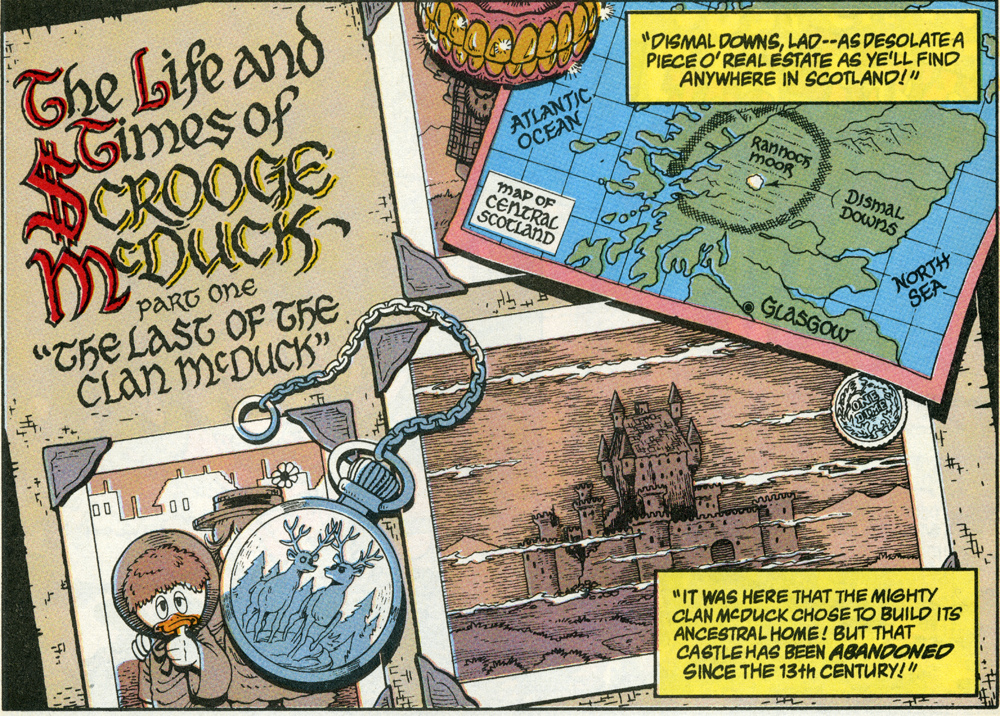
So… that's the Informal Biography. Vaguely infuriating in all sorts of ways (not least its tiresome annotations system), but it is the immediate missing link between Arthur Conan Doyle and Don Rosa, and the importance of that cannot be underestimated. Plus, it's a fun read. As fun as the L&ToSMD? Probably not (except for that bit about Dr Fu Manchu, which, but holy hell I want to read that). But fun.
Post-Scriptum
- As you can see from the cover above, the title is An Informal Biography of Scrooge McDuck. Why every second-hand dealer on the Internet refers to it as just Informal Biography of Scrooge McDuck, I cannot tell you.