Showing posts with label Disney. Show all posts

Friday, 19 July 2019

“The Nutcracker and the Four Realms”

Disney are really scrapping the bottom of the barrel of potential live-action remakes with this one, aren't they? Not a bad thing, mind. The Nutcracker Suite sequence in Fantasia was so aggressively impossible to turn into a live-action picture in the copy-and-paste way of Beauty and the Beast or The Lion King that the filmmakers would be forced, not just bound but forced, to come up with some creative ideas, if they had to be dragged there kicking and screaming. 

So I thought going into it.

Well… 

…oh dear. 


The thing with 2018's Nutcracker and the Four Realms is that it looks magnificent, and the world and plot-hooks are quite nice, and original, and all. The biggest complaint I have with it on paper is that the Nutcracker is an utter non-entity, whose meager relevance to the plot does not even remotely warrant his getting first billing in the title. But as a story, it's fine. 

So the synopsis is alright. Clockwork kingdom, key, mice, life-giving machine for turning toys into recognizable British actors, yes, yes, all good. 

But the script… oh, the script… I don't think I've ever seen a script quite this unfathomably incompetent. Every word that comes out of the characters' mouth is beyond clichéd, and that goes double for the "morals" the movie keeps pushing — we are in literal "all that you need is in here… and this box contains only a mirror" is a territory, folks. The pacing's also rubbish. Everything happens far too quickly; things like the Polichinelles are broughtback for the climactic battle in what is clearly meant to be one of these ‘everything from the first half of the movie comes back at the end’ kind of things, except they feel like they've just been introduced five minutes ago. Nothing has weight. Nothing has time to settle in. 

Also, for a movie pompously retitled The Nutcracker and the Four Realms, it is strangely uninterested in exploring said Four Realms; the only one we ever really see outside of brief flashbacks is the derelict Realm of Amusements. 

There is, of course, a twist villain. She's a reasonably good twist villain, mind, as these things go, but I just thought I'd throw this out there. Disney, stop with the twist villains already. That is an order. And while, as I admitted, it is well-executed, the concept of this one is just… really? It thinks it's way cleverer than it is. “Ooh, the Sugar-Plum Fairy is the villain! Betcha didn't see that coming!” Well, no, I didn't, because it's idiotic. God

The cast is a mixed bag. The curiously named Mackenzie Foy is what you expect from the female lead in this sort of movie; perfectly adequate; doesn't make too strong an impression either; but you can't blame her for this because the role is so very very blandly written. Keira Knightley is hammily marvelous as the Esmé Squalor-esque Sugar Plum. Helen Mirren and Morgan Freeman, the two main 'name actors', are given barely enough material to make an impression, but they acquit themselves of it quite well. The same cannot be said of poor Richard E. Grant, whose role would already be a paltry cameo were he not encased in a frankly ludicrous make-up job. Jack Whitehall and Omid Djalili (as the dumbly-named guards Harlequin and Cavalier) are, meanwhile, a wholly unfunny comic duo. 

And as for our very nominal male lead Jayden Fowora-Knight (the Nutcracker, here named Phillip), well, the truth is that he's pretty damn awful. He's blander than the screenplay itself, if that's possible. He's such a forgettable slice of nothing that, as of this writing, despite being the male co-star in a 130-million-dollar Disney extravaganza, he doesn't have a Wikipedia page. There's not even a redlink on the cast list of Wikipedia's page on The Nutcracker, which, for the Wikipedia-illiterate, would indicate that the lack of the relevant page is not unnoticed and will be fixed soon. No. Nothing. No one cares enough.

Add to that the fact that James Newton Howard's score is completely clueless as to how to handle the demand to quote and riff on Tchaikovsky's original ballet suite, and so opts to do it as little as possible. 

Really, the visuals and the cleverness of the concepts (when not too impaired by the daftness of the execution) are the only things the movie can rely on. Fortunately, the concepts are clever, and the visuals are breathtaking, so watching The Nutcracker and the Four Realms is still a mostly positive experience. By God it's infuriating, though. 

Post-Scriptum:
  • I am seriously wondering if they cast Richard E. Grant as the Ice King for no other reason than because they thought it would be funny for an actor famous for his "icy delivery" to play the part. If so… good try, but Steven Moffat got there before you, and did it much better. 
  • The end credits are just Misty Copeland dancing to Tchaikovsky within some fancy (but minimalistic) sets and lighting, and that would have been a way better movie. 

Saturday, 11 May 2019

“Alice the Whaler”

There is no cliché more annoying in the annals of Disney history than It all started with a mouse, because it really didn't.

…No, wait, scratch that, there is no cliché more annoying in the annals of Disney history than starting an article about pre-1928 Disney by refuting the It all started with a mouse dogma. But then again, here were are. So.

For those who do not know, the first Walt Disney cartoon was actually a hugely uninspiring animated newsreel created for a backwater cinema theater belonging to some fellow by the name of Newman. Only the pilot of that series remains, under the title of Newman Laugh-o-Gram. After his contract with Newman ended, Walt Disney took the Laugh-o-Gram brand to greener pastures and created a cycle of off-kilted fairy tale adaptations under this title. Among the characters developed therein was an adventurous black cat, later known as Julius. 

Then things took a turn for the ambitious as Disney's growing band of ragtag artists took on the massively more ambitious project of the Alice Comedies, a series where a live-action girl by the name of Alice traveled about in an animated landscape. The series reintroduced Julius the Cat in its third episode (Alice's Spooky Adventurewatch it here), beginning the long-running tradition of shared characters as Disney jumped from one series to another — Julius tied the Laugh-o-Grams to Alice, and Peg-Leg Pete, introduced in the 15th episode of Alice will later brige the gap with Oswald the Lucky Rabbit and Mickey Mouse. And if you want to keep playing that game, the Skeletons from Episode 1 of Silly Symphonies recurred in the Mickey short The Haunted House , though in this case the timeline is flipped. Not to mention, of course, that it's a fairly straightforward line from Mickey to Donald to DuckTales

But I digress. The first few Alice episodes played with the notion that the animated segments would just be dreams or tall tales of Alice, and had bookend segments in live-action; while these segments are pretty darn fun in their own right, it was clearly the cartoon bits that people wanted to see more of, so the framing devices were jettisoned pretty quickly to just cut to Alice having wacky adventures in the cartoon setting, whose reality was no longer in doubt. 

I am a big fan of the Alice Comedies — not only is the animation as good and inventive as anything Disney did back in the 1920's and early 1930's (there is an imagination in the early black-and-white stuff that very much rivals what Warner Bros. was doing by the mid-1930's), but the various child actresses to have portrayed Alice are some of the best of their kind. For lack of serious dramatic moments to examine I can't truly name them among the very best of child actors, but there is no denying that Virginia Davis is one of my favorite child actresses of all times. And Dawn O'Day, Margie Gay and Lois Hardwick were no slouches either (with the latter perhaps coming closest of the lot to recapturing the same charming magic as Virginia Davis). 

What's more, Alice and Julius have much more chemistry as costars than many comedy duos from the era, or at least, a much more interesting kind of chemistry. You don't have “the dumb, slow one” and “the long-suffering wily one”, or even a duo of fools; instead, Julius is a goof, but more in the way of an overconfident boy than an idiot (his age is never clarified, but the fact that he's just as much of a kid as Alice is, I think, enshrined by the fact that clearly we're not supposed to feel weird about it in Spooky Adventure when he proposes to her on a whim), while Alice has more spunk but less courage, and is the more inventive one of the two, acting towards Julius kind of like a more cunning younger sibling who feels responsible for her silly big brother, but doesn't want to let on to him that she's the one taking care of him rather than the other way around. 

But good things sometimes, sadly, come to an end. (I would have said ‘always’ as the proverb requires, but Mickey Mouse's about as old and it certainly hasn't.) So today, after this gaudily long intro, let's have look at the last Alice Comedies short — or, rather, the last available one, because the actual last short in the series is unavailable to the public and the one before that is missing form the archives. 


From 1927, Alice the Whaler is one of the Lois Hardwick picture, not that you could tell, for she is not in it very much. Jumping right into the criticism, this is the big issue of this third-to-last hurrah for the Alice and Julius duo, namely that they have their movies stolen from under them. From the title, this is supposed to be about Alice going on a whaling trip, presumably with Julius as first mate; and nominally that's what this is, except that what you'd expect to take up the whole cartoon, namely the actual business of Julius and Alice whaling, starts less than one minute before the end and is left without a resolution. Julius is on-screen for all of 10 seconds, and does not, at any point, interact with Alice,fares slightly better; she gets something like, oh, 30 seconds. Yes, they are 30 delightful seconds of Lois Hardwick hamming up as she alternates between dancing a sailor's jig and pretending to be Captain Ahab, but there is no getting around the fact that 30 seconds of a six-minute cartoon is a pretty slim share for what is supposed to be (and clearly has it in her to be) the main character. 

That's 40 seconds accounted for of the slim 6:14 runtime — what else? Not very much of substance as you'll have gathered. The crew of varyingly-anthropomorphized animals goof off and laugh at each other's silliness. Some of these gags are good (there is a great bit with a wholly non-anthropomorphic goat who, presumably thanks to experience in mountainous areas, remains perfectly balanced as it stands on the deck, no matter how many times the ship threatens to flip over), mind you, but it's all very insubstantial. 

The most interesting thing is no doubt that three characters are given particular attention in all fo this; one is a monkey whom the animators clearly liked way more than I do, but the others are a cohort of mischievous mice wearing shorts and nothing else, and a fat bully of a cat, the ship's cook. It's hard — nay, impossible — to look at it and not see shades of Steamboat Willie; if we accept David Gerstein's argument that Steamboat Willie was not meant to reimagine the thus-far ursine Peg-Leg Pete as a cat, but rather feature a separate “cat bully” character called Terrible Tom, then it might be worth it to consider the hypothesis that ‘Tom’ debuted much earlier than usually reckoned. 

All this makes Alice the Whaler an extremely typical 1920's cartoon, and an extremely poor send-off for the brilliantly inventive Alice Comedies, sidelining the main characters as it does; but a typical 20's cartoon is still a nice enough watch if you've got five minutes, and it does feature a strange glimpse of the future. And also Lois Hardwick dancing a sailorman's jig, and guys, I'm telling you, she's adorable. So go on then! Scroll back up and watch it!…

Post-Scriptum: 
  • …Unless you prefer to forego the modern Alexander Rannie rescoring and go with the earlier 1930's Raytone Films rescoring. I linked to the Rannie version earlier because the picture quality (and, of course, sound quality, on a purely technical level) was better, but this is the more period-accurate one, certainly. Both orchestrations have their strengths; take your pick. 
  • I didn't address the obviously-problematic-to-modern-ears matter of the story's being about, well, whaling. That's because the cartoon itself doesn't care very much about being about whaling; it's just an excuse to put the characters on the boat. It's true that some harm does come to a whale (and a mother at that) in the last thirty seconds, though. Pretty nasty stuff, but then again, this is a series where in Pete's debut, Julius had his tail cut off with a sword while Pete himself ended up skewered on a big metal rod cast adrift at sea. I think the whale would have been fine if the series had lasted long enough for it to make a return appearance.

  • It has recently occurred to me that Alice Comedies' being in the public domain means Pete probably should be too, if only in his bear design. Hmmm. 
  • It has further occurred to me that combining said public-domain-ness of the series and my griping about the lack of a proper Alice finale, the world is ripe for me to write an achingly nostalgia-filled novel where an adult Alice reunites with Julius and they return to Spookville where they first met to fight bad guys together. This is no joke, folks, I'm gonna write this someday, and it's going to be great. 

Wednesday, 20 March 2019

“Fun? What's That?”

Carl Barks! The Good Duck Artist! I like him. Not as stratospherically as some people — I admire his influence on Disney comics at large, and I don't deny that he's a good writer and good artist, but he's not my favorite Disney author in either capacity. Still! A master of his craft he was, and having particularly liked a random story of his when I reread it yesterday, I thought to myself, Aristide, the world must know. Or at least I thought something vaguely in that direction. 


This is Fun? What's That?, from 1959, one of 'em short-form Scrooge/Gyro team-ups. Scrooge/Gyro isn't a very common ‘pairing’, but here and elsewhere it works rather well; showing that this is Barks and not some less ‘involved’ writer, Fun? What's That? is particularly concerned with drawing parallels between Scrooge & Gyro, implicitly justifying putting them in a story together. 

The concept of the story, as a seasoned reader could arguably deduce from the title alone, is that Scrooge and Gyro half-heartedly attempt to “have fun” the way normal people do, forbidden from inventing/doing money-related things. This is as the case may be prompted by an amusing misunderstanding at Dr Quacker's (Dr Quacker is a dognose, not an anthropomorphic duck, which feels a bit odd when he's got ‘Quack’ in his name; could Barks really have chosen a 'Quack' name purely based on the slang meaning, without taking a step back to consider that this was a duck story?), where he accidentally hears the Little Helper's buzzing instead of Gyro's heartbeat, and concludes that poor Gyro has ‘Puckeritis of the Pipeline’. He proceeds to send him off to the countryside, considering it his only chance. (I wonder, did the writer of the DuckTales Classic episode Scrooge's Last Adventure have this story in mind?)


Scrooge, who in a brilliant cheapness gag had been waiting for someone with the same symptoms as him (in this case, Gyro) to come along and pay for a consultation so he doesn't have to, tags along. Various sequences ensue (beach, bowling alley, and finally camping trip), during which Gyro and Scrooge can barely stop themselves from inventing things and counting things, respectively. The characterization of Scrooge as borderline-OCD like this is a bit odd, but kinda charming. 


(By the way, did you notice that Yogi Wisenik here — ah, Barks and the naming of incidental characters — is a human? The female fortune tellers in You Can't Guess and The Dainty Daredevil are also humans, which suggests that for some reason, the publisher's ban on human characters didn't extend to soothsayers. Huh. Wonder why.)

Barks appears to be treating the story as a Gyro one where Scrooge happens to tag along as a sidekick, and Barks Gyro story means background gags with the Little Helper. Those are always charming and endearing; you can see an example of the usual fare in the ‘yogi’ panel above. But it's more than background gags here: the Helper ends up playing a rather big role in the camping sequence. For example, Scrooge puts him to rather undignified use cooking sourdough biscuits (incidentally letting us readers know that the Helper's bulb-head produces signifcant heat; every day, something new!):


(I love, love, love this sequence more than I can articulate, with Scrooge's casual, cheerful abuse of the Helper, and the Helper's private grumbling, which I'll note is not enough to overwhelm his sense of duty about Being Helpful: note that despite the ‘Gripe, Gripe’-ing, he makes no attempts to extract himself from the dough.)

There's also his displaying the ability to flash brighter than usual at will, an ability he uses to chase all sorts of creatures out of the cave where Scrooge and Gyro are spending the night, and though I'm not convinced either by the idea that half these creatures would be sleeping together in the same cave, or the idea that bright lights would be enough to scare some of these off, it too is very charming.


He displays the same ability again after being, I kid you not, swallowed by a goddamn bear, and it goes from charming to surrealistically awesome. 


I'm not usually that much of a fan of whenever Barks drags bears into his stories — the way he draws them is always slightly unappealing to me — and somehow, that bear on the right, above, still looks more like an overweight wolf to me than a bear — but this sequence is nevertheless extremely funny to me. Don't know about you lot. 

Anyway, of course, they eventually decide “screw this, we're going back to work” (this makes more sense for Scrooge than it does for Gyro, who is still, by the story's logic, under the impression that he's suffering from a potentially-fatal heart disease; but oh well). All in good fun. 

So all in all, the story is predictable in concept and 'plot', from start to finish; but the execution, owing to Barks's talent, makes it into an extremely entertaining read, with a choice part for the Little Helper (always a plus) and an interesting, if not super-complex, venture into Scrooge and Gyro's psychologies. I fully recommend it. 

Post-Scriptum:
  • This is the panel where Scrooge and Gyro decide to go back to work. Focus on Gyro's line — is this all secretly a prequel to Picnic? Well… not quite, obviously. But you gotta figure that Gyro's attempts to improve camping will go significantly like his attempts to improve picnics in that other great Barks story. 


Saturday, 2 March 2019

“The Woes of a Shopping Supervillain”

So is this the “much better Disney comic than My Second Million” that I mentioned in that review? Eh… maybe. To be honest, when I wrote that promise into the post, I had made a resolve to review some good Disney comic, just to wash the foul taste off my mouth; I didn't have any particular story in mind. This will do. (The title is mine, and more of a placeholder than anything else. I know it's not that good, okay? Still, it, too, will do. …I have to think up a lot of these not-too-awful titles when I create pages for untitled stories on the $crooge McDuck Wiki, so let's all hope I'm not too terrible at it as I feel like I am.)

This is, more than anything else, a reaction to GeoX's year-and-a-half-years-old review of Romano Scarpa's The Blot's Double Mystery, where he contrasted Scarpa's “dignified” treatment of Merril De Marris and Floyd Gottfredson's hooded mastermind with the supposedly slapdash, devil-may-care attitude of American comics in the same period. To this end, he called up this one-pager. 


Now, that one-pager is, yes, freaking awful for a Phantom Blot story. The Blot is supposed to be a sinister criminal mastermind with inscrutable motives. None of that comes across above; the joke would be fine with most any other Disney comic villain (though it would work best, in my opinion, if it was Pete trying to imitate Mickey), but A), the Blot is not some insecure shmuck who'd have to prove ot himself that he can whirl a lasso as well as a random cowboy just because he came across said cowboy in the street; B), the Blot is scarily competent at everything he does, and it goes against everything that makes him memorable for him to be done in by his own clumsiness. 

But I think GeoX cherry-picked his example very egregiously. First, it's kind of sneaky to pick an inside-cover one-pager, since even Carl Barks's Scrooge inside-cover-one-pagers often do things with everyone's favorite feathered plutocrat that don't quite gel with his usual characterization. But even setting that aside… sure, few of the vintage American PB comics were masterpieces, but they were usually much better than this. 

Therefore I call to the stand another more-or-less-randomly-selected PB one-pager (this is from Issue 6 of his solo comic series from the 1960's). 


First things first, it's funny; certainly funnier than the earlier story, because the moment you bring a lasso into a slapstick one-pager, you kinda know what's gonna happen, whereas here—testing pens? Huh? The page really can keep you guessing. So the punchline works more smoothly. 

And it also demonstrates a much better grasp of the Blot and his personal mythos: the conceit of the gag is in fact to wonder precisely how it is that the Blot produces those splotches of ink that form his calling card, since getting a pen to blot in real life on purpose isn't all that easy. Though I imagine it might be somewhat funny, in an absurd way, to someone who only knows that the Phantom Blot's nickname is “the Blot”, it really draws most of its comic effect from knowledge of the Blot's calling card, which isn't restated here. Therefore, hurrah for continuity! 

Furthermore, while the Blot's peculiar manners are essential to the comedy, this doesn't come at the cost of making him bumbling and incompetent, as in the previous one-pager — though it'd be a stretch to call his presence here “threatening”. After all, his demand seems incomprehensible to the salesperson above, but it's not actually stupid or insane from the reader's point of view, since we know precisely why the Blot would need such a thing. So, hurrah again, this time for not making your criminal mastermind an idiot!

Add to this some lovely art from Paul Murry (I.N.D.U.C.K.S. sadly does not know who wrote the thing), and you have proof positive that even in comedic one-pagers, the Americans of yore absolutely could get the Blot right and maintain his dignity. I'll grant you that Darkenblot or The Big Fall, this is not. But that doesn't mean it's not a lot of fun to read. 

Post-Scriptum: 
  • Reading this, I come to realize how good a pastiche Joe Torcivia's childhood-fancomic-turned-background-gag, where the Blot, robbing a museum, ended up lingering too long in front of an exhibit of Victorian Ink Blots and getting nabbed by Chief O'Hara as a result, and which he imagined as another inside-cover one-pager for The Phantom Blot, would have been. It was already a pretty neat gag in itself, but further kudos still, Joe!
  • Did you notice the saleswoman is a human? Albeit a four-fingered one. You rarely see those in Mouse Disney comic, unless they're a “crossover character” like Madam Mim or Grimhilde. 
  • Why yes, the above coloring of the (originally black-and-white) one-pager is by me. Never say I am not devoted to giving the readers of this blog a thorough, lush artistic experience. 

Sunday, 25 November 2018

“Mirror Mirror”

Mirror Mirror is a DuckTales fanfiction written by a fan going by “soulful-sin” (fanfiction writers usually have just the silliest name; this isn't a special case). More precisely, its appeal lies in that it is a crossover of sorts between the classic Duck universe and DuckTales 2017

(An unrelatd, but also very entertaining, fanmade take 
on the ‘Webby meets Webby’ premise.)


The basic plot is that the 1987 version of Webby Vanderquack is dared by the triplets to touch a creepy old mirror Scrooge has in his archives. Naturally, the mirror turns out to be a cursed artifact, which transports her to alternate dimension — a strange world where the boys have different personalities, where it's already the 21st century, and where she is herself a strong, independent adventurer rather than the meek little girl who has to stow away if she wants to go on any adventures at all with Scrooge and the boys. The mirror then gets shattered, trapping Webby in the DT17 universe, and Scrooge has to make a deal with Magica De Spell to repair it. 

The story certainly has a lot going for it. 

For one thing, all the characters, from both series, are written perfectly in-character (it's impossible not to hear Louie-17 as Bobby Moynihan or Scrooge-87 as Alan Young), and the crossover unfolds very nicely. The story manages to make you care about classic-Webby even with the other, universally-considered-more-interesting Webby running around at the same time. Both worlds are, in general, rendered very faithfully — with the irritating, borderline-inexplicable exception that Duckburg is persistently misspelled as “Duckberg”. 

Soulful-sin also tentatively takes a stab at a possible return of Lena De Spell, which may not be the most imaginative, but allows for emotional stuff between her and Webby. (For good or ill, the story has a lot of ‘emotional stuff’. No romance per se, though the author stated their love of the Webby/Lena pairing elsewhere, but just general angst.)

There are, I think, two blunders in this story's conceit, beyond the fact that the writing, while solid, is not quite of professional quality. The first is a surprising absence of the humor so essential to both DuckTales series' appeal. The second is that, forced to acknowledge DT17's Della plotline, Soulful-sin felt compelled to clarify Della's fate in the prime timeline as well, and it has nothing whatsoever to do with… anything. Not only is Family Ties ignored (which is odd, considering its very clear parallels with the DT17 story), but the Mirror Mirror version implies that Scrooge was indeed adventuring with Della around the time of the triplets' birth, a blatant DT17 contamination that in no way fits the classic timeline. 

Still, the DuckTales fanfiction community isn't exactly of Harry Potter level in scale, and we should take what we can get. Mirror Mirror is definitely on the upper end of Duck fanfiction as it exists for now, and if you've ever wondered what the two worlds crashing into each other might look like, and don't mind a healthy helping of sappy angst, it's a pleasant enough read.

Ye Olde Post-Scriptum

Three other weird decisions by Soulful-sin that I fail to understand: 17-Magica swears a lot (though it's never taken down word for word; we're just told 'she cursed', 'she said a string of very bad words Mrs Beakley certainly wouldn't approve of', etc.). Classic-Scrooge is orders of magnitude less wealthy than 17-Scrooge……er, why? And finally, there are repeated reference to this post-Shadow War story taking place in 2017, as opposed to the canonical 2018. No idea why. Since there was a Christmas episode halfway through the season, one would presume it was obvious that the year's changed, but apparently not to Soulfun-sin. 

Saturday, 17 November 2018

“Storkules in Duckburg”

Well, whadayaknow? Our next review still has to do with Hercules! Kind of.


This latest episode of DuckTales 2017 isn't the best, but definitely ends up on the better side of the series' decidedly hit-and-miss episodes. Also, I'm not qualified enough to be sure (having never seen the film myself), but I think Ghostbusters enthusiasts may particularly enjoy it. The structure seems very similar.


This episode is primarily about Bobby Moynihan's Louie Duck, which I like. My ranking of the DT17 kids is probably {{Webby > Louie > Huey > Dewey}} — in a show where Scrooge's adventurousness is upped both to ape Don Rosa and to avoid accusations of excessive pro-capitalism, Louie is the one who is most often allowed to be amusingly greedy and miserly. Not that he's just Young-Scrooge, of course — he's much more of a spender and bon viveur than his great-uncle. But the point is, I like Louie. And this episode provided a good character arc for him, as he learns the realities of what being a businessman means, concretely. 


But, of course, Chris Diamantopoulos's Storkules (introduced last season in The Spear of Selene) is the other focus of the episode. He's amusing, although beyond Diamantopoulos's skillful scenery-chewing, and the repetitive gags you can squeeze out of his hero-worship of Donald, I'm not entirely sure what he brings to show that Launchpad didn't. Don't get me wrong, this repeat appearance was fun (I do believe I liked him better here than I did in Spear), but I'm undecided on the ending's implication that Storkules is going to become a semi-regular in Duckburg like Gyro or Fenton. 


It is amusing to see the gag of the Ancient Greek characters relating info through ornate jars carry on from Spear, however. I wonder if the whole thing is a direct allusion to the manner of the narration of Disney's Hercules, or if it's more-or-less-coincidental. 


And he third big thing in the episode (and I know it's all beginning to sound like a lot, but if there's one thing to say for Storkules in Duckburg, it's that it's well-written; all of this comes together very nicely) are, of course, the Harpies. Their designs seem to be a mix between Romano Scarpa's Harpies, Carl Barks's Larkies, and the DuckTales Classic redesign of the latter. 

Far from the verbose oddball-gourmets of Barks, and despite their wearing jewelry, they are here reimagined as nonsentient monsters who single-mindedly try to steal what their victims love most. It's not a bad concept for a DuckTales monster, and I'll give props to the writers for making them agents of the Gods' wrath like they were in the original myths, as opposed to independent agents… but I have two problems with this. 

The first is that, come on, you can't introduce most-prized-possession-seeking monsters into Duckburg (nay, in McDuck Manor!!) and not have them go after the Lucky Dime. The second is that, well, the chatty comic Larkies are iconic and for good reason, and this feels like another Gyro Gearloose situation — the new version's neat, but has diddly-squat to do with the equally-neat original and spoils an opportunity to see them in animation. 

Still, I did like them on their own terms, as I said; and if it had to happen to one particular Barks monster, best it be them than, say, Smorgasbord, since we did see relatively accurate Barksian Harpies in the 1987 series. 


In terms of easter-eggs and mythology-gags (on which DuckTales 2017 has always heavily rely to garner the goodwill/forgiveness of comic-fans), the sharp-eyed may notice, among the portraits in Donald's houseboat, a variation on Barks's famous Tiny-Boat Composition that we have seen iterated over and over and over with a variety of characters and backgrounds, though I'll be darned if I have any idea what it's called;


…one of Storkules's crates bears the words “Donald Fan Art” (marking what is probably the first in-universe use of the word 'fan art' in Ducklore, though I could be wrong); Cape Suzette is mentioned (though I don't know if that still counts as an easter-egg at this point); and, most importantly, the entire climax has the Harpies lift Donald's Houseboat into the air, in a repeat of what they did with the Argo in Barks's Golden Fleecing. I'm a big fan of this, being a big fan of flying boats in general. (You can blame my younger self's repeated viewings of Peter Pan and Return to Neverland.)


Another thing I'd like to note, though it's highly subjective, is that DuckTales 2017's world (call it the 2017 Continuum, Earth-17, whatever) is finally beginning to feel organic. The episode features the returns of Funso's Fun-Zone, Dewey Dew-Night, the aforementioned Cape Suzette, driving that can only be attributed to an unseen Launchpad, cameos by Miss Quackfaster, Glomgold and Officer Cabrera… and where in The Shadow War such things felt like "special winks to the audience" (hey, remember this? and this? and that thing?), here it all mostly all felt natural. Perhaps it's just time, or perhaps the screenwriters are getting better at screenwritin'; probably a little bit of both. Their treatment of Donald is certainly improving, at least, pointing towards the skill-honing hypothesis. 


Beyond that, this episode has all of DuckTales 2017's usual strengths: lively character animation, as seen in the particularly-memorable screenshot above; great voice acting all-around; witty banter. The score continues to be reliable, even if I didn't pick out any particular heights, unlike in the previous episode, The Ballad of Duke Baloney, which had one of the best soundtracks in the series yet (rivaled only, I think, by that of The Shadow War). 

Unless you find the DuckTales 2017 nephews obnoxious (in which case you'd better wait for the Scrooge-centric Christmas episode we've been promised… looks like it'll be a hoot!), I'm definitely recommending this episode. 

Mandatory Post-Scriptum:

…Does Webby look cute in her "1950's family man" outfit, or what? 

Sunday, 21 October 2018

“The Most Dangerous Game Night”

(Note how skillfully I deny this title its aggravating faux-clever punctuation. I may like it overall, but DuckTales 2017 has many flaws, and the usually-terrible titles are one of them. There's been very few decent ones so far.)

So being a Duck fan, I have dutifully followed Disney's attempt at doing to the Disney Comics Unvierse what all the big boys with their superhero comics are doing to theirs — e.g., make a reboot that brings in the fans of the original but liberally changes characters and tone to draw in a fresh audience. 

DT17 is strange and occasionally-irritating, but it's very well-made, often funny, sometimes moving, and it's clear from Francisco Angones's blog that the people involve care. Unlike brave, unfortunate GeoX over at Duck Cartoons Revue, I don't have to force myself to watch new episodes. 

Case in point, the Season 2 opened that dropped in yesterday, The Most Dangerous Game Night.


This was… a weird episode to begin a new season with. For one thing, it's your standard 25-minutes fare, whereas the Season 1 pilot, the abysmally-titled Woo-oo!, was double-length. This is unfortunate, as the DuckTales 2017 writers tend to do much better with double-length episodes than regular ones — Woo-oo! and The Shadow War, to me, were probably among the best (if not the best) of Season 1, simply because the plots didn't feel quite as rushed as they usually do. 

Moreover, it hardly sets up anything at all. It has some character development for Louie, true, but that comes to a natural (and well-enacted) conclusion by the episode's close. Aside from the ill-defined monsters-of-the-week that are the Gyropuddlians, a tribe of microscopic cavemen living in McDuck Manor, the episode features only the established cast. Complete, it must be said, with Donald Duck, which bodes well for this season (as Donald was much too often absentee in the previous one). 

Speaking of the whole cast, refreshingly, the episode remembered to include Duckworth. This show's version of Duckworth, as you may recall, is a ghost, and in this episode they're drawing more on the consequences of the "ghost butler" idea than they are doing anything with Duckworth's general character… but to be fair, his brief, ghost-gags-based appearance was funny. As is his relationship with Mrs Beakley, continued from their brief interaction in his first episode. 

As for Gyro, it is necessary, if you want to get anything out of him at all, to accept that he is not Gyro in this show, but rather his evil twin-brother from another dimension. Seriously, dye his hair pink and you'd pretty much get a slightly-more-subdued Mad Ducktor.

Mad Ducktor being Gyro's very own, delightfully-insane Mr Hyde
from a series of Italian Duck Avenger adventures. Look him up. And let's hope
the (sigh) Fresh And Modern folks, somewhere in the inscrutable
recesses of their heretic skulls, find the inspiration to bring him 
to American shores while doing him justice. 


In this episode, his determination to become the God-King of the Gyropuddlians using his Micro-Phone/shrinkray is a particularly stark contrast to Gyro's attitude, never anything but kindly, towards the Microducks when he crossed their path in the DuckTales Classic episode where they appeared. But as far as this "megalomaniac mad-scientist barely held in check" character goes, the writers and actor wring a lot of humor out of him, here and elsewhere. 

Modulo the villainous tendencies, this episode even dispenses with Gyro's cool, 'snooty' Season 1 and brings back some of the joyful exuberance of his comic self. This iteration of DT17 Gyro may not be the Gyro we usually know, but it's not hard to imagine him starring in Think-Box Bollix or Hobblin' Goblins

…Oh, I figure I should probably say something about that opening scene. 


The Indiana Jones ripoff as Scrooge & Co. retrieve the Idol of Cibola is obviously a nod to the fact that the similar sequence in Barks's Seven Cities of Cibola inspired the opening scene of Indiana Jones and the Raiders of the Lost Ark. So this adaption of the Cibola tale (albeit brief) that redesigns things to look more like their Indiana Jones counterparts is bringing things amusingly full-circle. 

Thing is, the novelty of this was largely lost on me, as it was, I think, on most other Disney comic fans. That Barks's treasure-hunt stories directly inspired Spielberg & Lucas for Indiana Jones is, I suppose, kind of cool to those who first hear it, but it is "entry-level trivia" for Disney comics afficionados, of about the same level as "Barks kept drawing scripts for Disney comics even after he retired" or "the Phantom Blot's face is meant to look like Walt Disney's……… probably?". 

Still, I suppose it will have looked clever and witty to new viewers brought to Duckdom by DuckTales 2017 and who are only now starting to catch up on their classics and the associated lore. This is a joke for which I just wasn't the intended audience.

As for the "woah — wait-what? — aaaaah!" joke that goes with it, it is, in itself, well-executed, and it furthers Louie's character arc in the episode, but… people, showing amusing self-awareness about the medium like this would work better if every single adventure story you've done so far wasn't already full of that sort of ironic self-awareness. For God's sake, on his very first adventure in Episode 1 of Season 1, Dewey was already acting casual about a "basic death-trap". 

…and that's a wrap on my review of The Most Dangerous Game Night. I'll be back soon with more. 

Thursday, 18 October 2018

“The Case of the Sinister Robot”

And our mystery Disney comic is The Case of the Sinister Robot!

Told ya you wouldn't guess.


Also known as W MM 113-02 to the alien tome of eldritch lore that is the INDUCKS database, The Case of the Sinister Robot is a 1967 story from Walt Disney's Mickey Mouse #113, reprinted in #202 of the same. History has forgotten the name of its writer, as it often does when that writer wasn't someone people care about (like Carl Barks) or someone too blinkin' weird to ever be confused with anyone else (like Vic Lockman). 

The story is extremely obscure, as are most 1960's Mickey Mouse stories, especially those not drawn by Paul Murry, which is extremely unfair; nothing against Murry, individually, but Strobl here does just as good in his own style. I stumbled upon it (get used to that phrase, I “stumbled upon” most of the stuff I'm going to be reviewing here) quite recently and found it quite delightful. It's very 1960's, very goofy, but also a compelling sci-fi story in its own right. 

The best way I can describe it is, its plot is a house of cards standing on a table of clichés, but heck, are the cards pretty. 

The introduction sets up a nice and looney mystery as Mouseton is wracked by all mechanical devices going nuts. 


This culminates in gravity itself failing, and Mickey, Goofy and Chief O'Hara wading to the Mayor's office like astronauts in space. (Most puzzling is the Chief's line that he thought Mickey might know what's going on — Mickey solves the crazy occurrences, but he's rarely behind them…) 

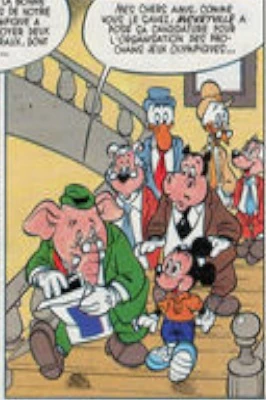
The Mayor himself is not characterized very strongly — but then, he never is — the most you can say about the Mayor of Mouseton as a character is that he was a pink elephant for some reason in a couple of 1980's stories. Duckburg's Pig-Mayor, he is not. But while the Mayor himself is just a random mustached dognose, we do get a very amusing picture of the scientists and authorities he has gathered to solve the problem, where both the unknown writer's dialogue, and Strobl's art, really shine. 


Who would dare to look at that panel and call Strobl a "mediocre cartoonist" (which seems to be everyone's unspoken opinion of him, if they have one at all)? Props, also, to the coloring department. Not always the most competent lot at the time, and they do inexplicably dye Chief O'Hara's hair brown here, but the choice of colors for the costumes of the scientist flows very well, and the reddish-brown mustache for Mustache Guy in the middle is perfect

I mentioned Unknown Writer earlier, and again, what a shame it is that we don't know who that guy was. This story's premise is amusing enough, but it's the execution that makes it shine: "machines going backwards" could be played by-the-book with no particular punch, but the fast pacing allows it to really hit its mark. I did not expect to laugh out loud at an American, 1960's Mickey Mouse comic book, but Unknown Writer proved me wrong. 


And at the same time, he develops a good mystery. It begins with not-Doctor-Syclocks here, mysteriously unaffected by the anti-gravity ray, who manages to shake off Mickey and the police…


…features the input of Shamrock Bones (a character who was funnier in theory than in practice, I often find, but here he doesn't overstay his welcome)…

(I dig the orange-and-green colors cheme for his checkered suit. Much more memorable than the usual Sherlock-Holme-brown. Also, notice: "peformed" instead of "performed". It's a credit to Disney comics that this is the only time I ever saw a blatant typo in a Disney speech balloon.)

…and leads our heroes to the Mouseton City Dump, where the sci-fi portion of the story begins in earnest as a mysterious energy being absorbs surrounding junk and builds itself a robot body out of it. 

(…) 

The glowing-ball-of-energy form is cool, and never really explained; as for Kettlehead the Robot itself, it looks very distinctive, as do all the other robots in the story. 

After another rather cool bit where the entrance to the villain's typically 1960's, stainless-steel underground lair is inside a wrecked old car, Mickey and Goofy begin to look for the mad scientist behind the whole scheme, and finds that there isn't one. Instead, our antagonist is a robot himself, bearing the delightfully nonsensical name of “X - Y + 2”. Wounded in his honor after he was retired due to his computational system being faulty, X-Minus has turned his genius to the task of repurposing all human technology, driving all of mankind to madness. He then plans to take over. 

X-Minus is not actually the most interestingly-designed robot in the lair — it's telling that the cover for the story features his minion “0 = 4X”, and not himself — but he's very well-characterised. He's both clearly an insane robot, and a character rather than a mere bogeyman. 


(You have to admire how 0 = 4X is entirely about to disintegrate them, then Mickey says "you can't! that's murder!", and the robots just… opine and desist from any murderous intent. It's funny for how unexpected it is, and on top of that, it actually makes sense if you stop and ponder it. After all, we all know the Three Laws of Robotics ought to prevent our antagonistic androids from actually planning to destroy anyone — and we know that X-Minus is broken — so I propose that it seemed like a right plan to him because it genuinely did not register for him that disintegrating people was murder until Mickey pointed it out; at which point he remembered his programming and thought of something else.) 

I won't spoil it here, but the reveal of the Mysterious Not-Doctor-Syclocks from earlier is also very clever and creative, and something I don't think I've ever seen done with another fictional robot, so points for that. The final fate of X-Minus is also not bad, though the denouement in general feels a bit rushed. 

Oh, one also has to love X-Minus's "last words" before he's powered down:

(Said every ‘Doctor Who’ villain ever. Or they should)

And there you have it. 

The Case of the Sinister Robot seriously has all the qualities of the classic Gottfredson, Scarpa or Casty formula for a Mickey story: wacky goings-on - compelling mystery - interesting sci-fi concept behind it - snappy humor. Seriously, find a used copy or something, and give the thing a read. 

I don't care what preconceptions you may have about a 1967, Tony Strobl-drawn Mickey Mouse story. Read it. I promise you won't regret it. 

“The War Wagon”

The first thing about the 1967 John Wayne/Kirk Douglas vehicle The War Wagon   (yes, that pun was intentional, thank you)  is that it has o...