Showing posts with label Cartoon. Show all posts

Saturday, 11 May 2019

“Alice the Whaler”

There is no cliché more annoying in the annals of Disney history than It all started with a mouse, because it really didn't.

…No, wait, scratch that, there is no cliché more annoying in the annals of Disney history than starting an article about pre-1928 Disney by refuting the It all started with a mouse dogma. But then again, here were are. So.

For those who do not know, the first Walt Disney cartoon was actually a hugely uninspiring animated newsreel created for a backwater cinema theater belonging to some fellow by the name of Newman. Only the pilot of that series remains, under the title of Newman Laugh-o-Gram. After his contract with Newman ended, Walt Disney took the Laugh-o-Gram brand to greener pastures and created a cycle of off-kilted fairy tale adaptations under this title. Among the characters developed therein was an adventurous black cat, later known as Julius. 

Then things took a turn for the ambitious as Disney's growing band of ragtag artists took on the massively more ambitious project of the Alice Comedies, a series where a live-action girl by the name of Alice traveled about in an animated landscape. The series reintroduced Julius the Cat in its third episode (Alice's Spooky Adventurewatch it here), beginning the long-running tradition of shared characters as Disney jumped from one series to another — Julius tied the Laugh-o-Grams to Alice, and Peg-Leg Pete, introduced in the 15th episode of Alice will later brige the gap with Oswald the Lucky Rabbit and Mickey Mouse. And if you want to keep playing that game, the Skeletons from Episode 1 of Silly Symphonies recurred in the Mickey short The Haunted House , though in this case the timeline is flipped. Not to mention, of course, that it's a fairly straightforward line from Mickey to Donald to DuckTales

But I digress. The first few Alice episodes played with the notion that the animated segments would just be dreams or tall tales of Alice, and had bookend segments in live-action; while these segments are pretty darn fun in their own right, it was clearly the cartoon bits that people wanted to see more of, so the framing devices were jettisoned pretty quickly to just cut to Alice having wacky adventures in the cartoon setting, whose reality was no longer in doubt. 

I am a big fan of the Alice Comedies — not only is the animation as good and inventive as anything Disney did back in the 1920's and early 1930's (there is an imagination in the early black-and-white stuff that very much rivals what Warner Bros. was doing by the mid-1930's), but the various child actresses to have portrayed Alice are some of the best of their kind. For lack of serious dramatic moments to examine I can't truly name them among the very best of child actors, but there is no denying that Virginia Davis is one of my favorite child actresses of all times. And Dawn O'Day, Margie Gay and Lois Hardwick were no slouches either (with the latter perhaps coming closest of the lot to recapturing the same charming magic as Virginia Davis). 

What's more, Alice and Julius have much more chemistry as costars than many comedy duos from the era, or at least, a much more interesting kind of chemistry. You don't have “the dumb, slow one” and “the long-suffering wily one”, or even a duo of fools; instead, Julius is a goof, but more in the way of an overconfident boy than an idiot (his age is never clarified, but the fact that he's just as much of a kid as Alice is, I think, enshrined by the fact that clearly we're not supposed to feel weird about it in Spooky Adventure when he proposes to her on a whim), while Alice has more spunk but less courage, and is the more inventive one of the two, acting towards Julius kind of like a more cunning younger sibling who feels responsible for her silly big brother, but doesn't want to let on to him that she's the one taking care of him rather than the other way around. 

But good things sometimes, sadly, come to an end. (I would have said ‘always’ as the proverb requires, but Mickey Mouse's about as old and it certainly hasn't.) So today, after this gaudily long intro, let's have look at the last Alice Comedies short — or, rather, the last available one, because the actual last short in the series is unavailable to the public and the one before that is missing form the archives. 


From 1927, Alice the Whaler is one of the Lois Hardwick picture, not that you could tell, for she is not in it very much. Jumping right into the criticism, this is the big issue of this third-to-last hurrah for the Alice and Julius duo, namely that they have their movies stolen from under them. From the title, this is supposed to be about Alice going on a whaling trip, presumably with Julius as first mate; and nominally that's what this is, except that what you'd expect to take up the whole cartoon, namely the actual business of Julius and Alice whaling, starts less than one minute before the end and is left without a resolution. Julius is on-screen for all of 10 seconds, and does not, at any point, interact with Alice,fares slightly better; she gets something like, oh, 30 seconds. Yes, they are 30 delightful seconds of Lois Hardwick hamming up as she alternates between dancing a sailor's jig and pretending to be Captain Ahab, but there is no getting around the fact that 30 seconds of a six-minute cartoon is a pretty slim share for what is supposed to be (and clearly has it in her to be) the main character. 

That's 40 seconds accounted for of the slim 6:14 runtime — what else? Not very much of substance as you'll have gathered. The crew of varyingly-anthropomorphized animals goof off and laugh at each other's silliness. Some of these gags are good (there is a great bit with a wholly non-anthropomorphic goat who, presumably thanks to experience in mountainous areas, remains perfectly balanced as it stands on the deck, no matter how many times the ship threatens to flip over), mind you, but it's all very insubstantial. 

The most interesting thing is no doubt that three characters are given particular attention in all fo this; one is a monkey whom the animators clearly liked way more than I do, but the others are a cohort of mischievous mice wearing shorts and nothing else, and a fat bully of a cat, the ship's cook. It's hard — nay, impossible — to look at it and not see shades of Steamboat Willie; if we accept David Gerstein's argument that Steamboat Willie was not meant to reimagine the thus-far ursine Peg-Leg Pete as a cat, but rather feature a separate “cat bully” character called Terrible Tom, then it might be worth it to consider the hypothesis that ‘Tom’ debuted much earlier than usually reckoned. 

All this makes Alice the Whaler an extremely typical 1920's cartoon, and an extremely poor send-off for the brilliantly inventive Alice Comedies, sidelining the main characters as it does; but a typical 20's cartoon is still a nice enough watch if you've got five minutes, and it does feature a strange glimpse of the future. And also Lois Hardwick dancing a sailorman's jig, and guys, I'm telling you, she's adorable. So go on then! Scroll back up and watch it!…

Post-Scriptum: 
  • …Unless you prefer to forego the modern Alexander Rannie rescoring and go with the earlier 1930's Raytone Films rescoring. I linked to the Rannie version earlier because the picture quality (and, of course, sound quality, on a purely technical level) was better, but this is the more period-accurate one, certainly. Both orchestrations have their strengths; take your pick. 
  • I didn't address the obviously-problematic-to-modern-ears matter of the story's being about, well, whaling. That's because the cartoon itself doesn't care very much about being about whaling; it's just an excuse to put the characters on the boat. It's true that some harm does come to a whale (and a mother at that) in the last thirty seconds, though. Pretty nasty stuff, but then again, this is a series where in Pete's debut, Julius had his tail cut off with a sword while Pete himself ended up skewered on a big metal rod cast adrift at sea. I think the whale would have been fine if the series had lasted long enough for it to make a return appearance.

  • It has recently occurred to me that Alice Comedies' being in the public domain means Pete probably should be too, if only in his bear design. Hmmm. 
  • It has further occurred to me that combining said public-domain-ness of the series and my griping about the lack of a proper Alice finale, the world is ripe for me to write an achingly nostalgia-filled novel where an adult Alice reunites with Julius and they return to Spookville where they first met to fight bad guys together. This is no joke, folks, I'm gonna write this someday, and it's going to be great. 

Tuesday, 30 April 2019

“Asterix: The Secret of the Magic Potion”

A film which is not, as most talks of it on the Internet would have you believe, Asterix and the Secret of the Magic Potion. Huh. I wonder why, actually, because it's a much better title.


This latest installements in the comical Gaul's animated adventure is the first since 1978's outstanding Twelve Tasks of Asterix not to be based on a corresponding comic book, and that had an original script by René Goscinny himself, so this (written by director Alexandre Astier) is in a sense the first truly theatres-only Asterix story. How does it fare?

Well, as a story, it is a strange crash between modern animation's tastes and the Asterix universe — the result hangs together well enough as a standalone feature, but there's a strange disconnect between the elements that are truly faithful to the continuity of the comics (such as a cameo by Aplusbégalix, the renegade chieftain from The Big Fight) and the modern humor, the modern pace of the storytelling, and most importantly the nature of the villain, an outright sorcerer in a way Getafix/Panoramix never was in Goscinny and Uderzo's conception. I should also mention the nature of the climax is, to say the least, not something you could imagine in an Asterix comic-book… the one with aliens apart, of course, but that… thing… really shouldn't count. That being said, albeit in a very different way, Twelve Tasks's story really didn't feel like one of the comics either, so let's be lenient. I shall be less lenient of the shameless clickbaity nature of the title, for while the passing on of the recipe is admittedly a big part of the storyline, the actual recipe itself is not given to us as the advertising tricked us into hoping. 


That bsaid, albeit in a very different way, Twelve Tasks's story really didn't feel like one of the comics either, so let's be lenient. What of the animation? It is CGI, and that loses it some points in my book, but for what it is it's very well-done. The human characters have a vaguely blocky look to them that reminds me of a high-quality video game's cutscenes more than of a film, but the movements itselfare very solid, the designs of the new characters are great, and there's some really nice effectswork in there too; I love how they did the Magic Potion, which never really had a standard appearance before now, that I know of. This one is likely to become the gold standard from now on (and the use of the word 'gold' is quite deliberate).  


As concerns the cast (I speak only of the French cast; being French, I had little incentive to track down the English dub of all things)… oh my. Bernard Alane is back as Panoramix and does quite good, though he takes some getting used to, being very much unlike the previous Panoramixes of the cartoons. But the absence of Roger Carel as Asterix is very sorely felt, and his replacement Christian Clavier, fresh off butchering the role of the Count of Champignac in another Franco-belgian-comic film (the dire Spirou & Fantasio live-action film), isn't even remotely up to the task. 


The one true stand-out in the cast is Daniel Mesguich as the villainous Sulfurix, a character who is best described as “the Soothsayer, except actually magical”. The character is well-designed and well-thought-out, with an interesting backstory and motivation (even if it's not kept coherent the whole way through; being that his thing is that he wants to spread use of the Magic Potion to all of Gaul so that it can take over Rome and end all wars forever, the movie struggles to explain why he ends up allying himself to the Romans, something apparently done only so Caesar could be in the movies for a few minutes because we gotta have Caesar in any Asterix picture whatsoever now), and his voice is a masterful effort, even managing to sell a few dodgy lines along the way. I should also point out that while the voice he uses there couldn't be more difference, I get the impression that a Carel-accurate voice would totally have been within Mesguich's ability, and that we got freakin' Clavier instead just makes me so mad. 


There's also one Lévanah Solomon as the kid Pectine, who isn't very deeply characterized and seems to exist mostly as a setup for other, better stories about her. Certainly she's more of the concept “Panoramix's youthful-inventor apprentice” than she is a fully-realized character for now, and she feels a little bit shoehorned in the plot. Not wholly bad at all, just… a little fuzzy around the edges. Solomon herself is pretty good, if nothing stratospheric. 

So that's Secret of the Magic Potion — certainly not the new Twelve Tasks of Asterix, but some of the voice cast aside, a pretty fun adventure, and as good an occasion as any to return to the Gaulish village while the comic authors take their time to get the new book together. 

Post-Scriptum:
  • Instead of a full-on comic adaptation, the movie is getting a picture book adaptation. Kind of lame, but at least, the cover looks gorgeous


Wednesday, 12 December 2018

“The Dot and the Line”

I love Chuck Jones, and I love animation, and I love obscure, bizarre weirdness.

Hence, this.

From left to right, the Line, the Squiggle and the Dot. 
The Square is not actually anyone in particular, ignore that.

This 1965 MGM-produced Acadamey Award-winner is based on a then three-years-old Norton Juster children's book, and very closely at that, with most of Juster's text making it into Robert Morley's narration (a superior effort as far as child-oriented storytelling goes, both witty and compassionate, right up there with Boris Karloff in Jones's Grinch). 

It's 10 minutes long, which I find very interesting, as I have always regarded 10 minutes theatrical shorts as inherently more sincere than 7- or 6-minutes-long ones. Six or seven minutes was the accepted studio norm; and if you want to go into featurette rather than short, there's a sort of unspoken law that you have to reach 14 minutes at least. Hence 10 minutes is what happens two things coincide; first, the team is really into the short they're making and have a little more material than strictly require; and second, the studio executive is willing to let the team do its thing without griping. Hollywood studio executives being who they are, the second thing is vanishingly rare. 

The story is simple and weird: in an abstract world of sentient geometric shapes, a (male) Line is desperately in love with a (female) Dot. She finds him boring and as literal a stick-in-the-mud as they get, and elects to spend her time with a slovenly Squiggle instead. After some moping about the Line learns to bend himself to create new, complex and intriguing shapes, and comes back to the Dot a virtuoso of contortion with immensely more variety than the Squiggle ever had, and much more control too. The Dot is conquered, and dumps the Squiggle. 


It's a borderline-absurdist, absolutely charming children's fable. The only moral it draws for itself is a fantastic pun (one of several); but it's, of course, ridiculously easy to find all sorts of worthy themes and messages within it if one cares to look. “Adapt and improve yourself to be worthy of who you love.” “You contain multitudes; but you must work to reach them.” “A quiet well-ordered mind contains more potential than all the chaos in the world.” And so on and so forth. Certainly, those who want Meaning in their children's stories won't be disappointed. 

I could find only two flaws in this story and its worldbuilding, and they're not so much flaws as mildly weak points. The first is that despite the claim that there are other Lines, we inexplicably never see any other Dots. The second is a certain moment that, by modern sensibilities, might be taken as somewhat offensive: the Line's passion for the Dot seems unbearably shallow. The one thing the Dot does, personality-wise, is have fun with the Squiggle, and the Line is constantly telling it not to do that. The scene where the Line muses about the way the Dot is perfect to his eyes makes it clear that this perfection is entirely physical and the sole bedrock of his affection. 


But as I thought about it some more, it dawned on me that this isn't an entirely fair criticism. Much of The Dot and the Line's wit lies in double-meaning language which roots itself in the idea that in this geometric cosmos, the mathematical nature of the characters is indistinguishable from their psychic nature. The Squiggle is insubordinate and aimless, the Line is straightforward and rigid. By this metric, to love the shape of the Dot is to love her for her mind, in an abstract way. So I'll let it slide.

At any rate, Chuck Jones's animation is experimental as anything, and it's a hoot. Of course, bringing personality to a simple animated line had been done before, and would be done again, but these three ‘linear’ animation hallmarks all do it in very different ways, and Jones's is the only one that actually feels geometric, if that makes sense. The style of Jones and Maurice Noble's designs had always tended towards the abstract and angular, and one imagines they relished this opportunity to take it to its logical conclusion.

Oh, the animation's not without its flaws; not all of the stiffness can be wholly excused as an artistic choice, for one thing. Also irksome is that any pretense of making the Dot resemble an actual geometrical dot is dropped in favor of making her a disc. Notice how in the above screenshot someone is measuring the width of the Dot, which anybody with a working knowledge of mathematics will tell you is utterly shameful bogus. And as I mocked in the caption of the first picture, the abstract backgrounds occasionally include random shapes which would be fine anywhere else, but, here, can't help but befuddle a viewer who's come to accept that shapes are people in this cartoon's world, and therefore is waiting (in vain) for that square or that triangle to start talking. 

But for every slip-up there's a fantastic color palette, an innovative gag-sequence like the Line's daydreams about being a celebrity, or simply great animation. I particularly like the Squiggle's half-baked attempts to copy the Line's feat, right before it retreats, and the way it shrinks back from the swelling Dot, even if the phrase “swelling dot” is, as I said, anathema to anybody with one ounce of mathematics in them.

For that animation alone, the strange experiment in cartooning that is The Dot and the Line would be worth watching; but the witty writing, great narration, and competent music combined make it a masterpiece and well-deserving of its award. 

Post-Scriptum

Another reason I like The Dot and the Line is because (even though this must largely be coincidental) its style is as close as anything to the masterpiece of absurdist French TV animation, The Shadoks, of which despite the existence of a British dub I can only find one miserable English-language clip online, but I think it's enough to gauge the similarity. 


Saturday, 17 November 2018

“Storkules in Duckburg”

Well, whadayaknow? Our next review still has to do with Hercules! Kind of.


This latest episode of DuckTales 2017 isn't the best, but definitely ends up on the better side of the series' decidedly hit-and-miss episodes. Also, I'm not qualified enough to be sure (having never seen the film myself), but I think Ghostbusters enthusiasts may particularly enjoy it. The structure seems very similar.


This episode is primarily about Bobby Moynihan's Louie Duck, which I like. My ranking of the DT17 kids is probably {{Webby > Louie > Huey > Dewey}} — in a show where Scrooge's adventurousness is upped both to ape Don Rosa and to avoid accusations of excessive pro-capitalism, Louie is the one who is most often allowed to be amusingly greedy and miserly. Not that he's just Young-Scrooge, of course — he's much more of a spender and bon viveur than his great-uncle. But the point is, I like Louie. And this episode provided a good character arc for him, as he learns the realities of what being a businessman means, concretely. 


But, of course, Chris Diamantopoulos's Storkules (introduced last season in The Spear of Selene) is the other focus of the episode. He's amusing, although beyond Diamantopoulos's skillful scenery-chewing, and the repetitive gags you can squeeze out of his hero-worship of Donald, I'm not entirely sure what he brings to show that Launchpad didn't. Don't get me wrong, this repeat appearance was fun (I do believe I liked him better here than I did in Spear), but I'm undecided on the ending's implication that Storkules is going to become a semi-regular in Duckburg like Gyro or Fenton. 


It is amusing to see the gag of the Ancient Greek characters relating info through ornate jars carry on from Spear, however. I wonder if the whole thing is a direct allusion to the manner of the narration of Disney's Hercules, or if it's more-or-less-coincidental. 


And he third big thing in the episode (and I know it's all beginning to sound like a lot, but if there's one thing to say for Storkules in Duckburg, it's that it's well-written; all of this comes together very nicely) are, of course, the Harpies. Their designs seem to be a mix between Romano Scarpa's Harpies, Carl Barks's Larkies, and the DuckTales Classic redesign of the latter. 

Far from the verbose oddball-gourmets of Barks, and despite their wearing jewelry, they are here reimagined as nonsentient monsters who single-mindedly try to steal what their victims love most. It's not a bad concept for a DuckTales monster, and I'll give props to the writers for making them agents of the Gods' wrath like they were in the original myths, as opposed to independent agents… but I have two problems with this. 

The first is that, come on, you can't introduce most-prized-possession-seeking monsters into Duckburg (nay, in McDuck Manor!!) and not have them go after the Lucky Dime. The second is that, well, the chatty comic Larkies are iconic and for good reason, and this feels like another Gyro Gearloose situation — the new version's neat, but has diddly-squat to do with the equally-neat original and spoils an opportunity to see them in animation. 

Still, I did like them on their own terms, as I said; and if it had to happen to one particular Barks monster, best it be them than, say, Smorgasbord, since we did see relatively accurate Barksian Harpies in the 1987 series. 


In terms of easter-eggs and mythology-gags (on which DuckTales 2017 has always heavily rely to garner the goodwill/forgiveness of comic-fans), the sharp-eyed may notice, among the portraits in Donald's houseboat, a variation on Barks's famous Tiny-Boat Composition that we have seen iterated over and over and over with a variety of characters and backgrounds, though I'll be darned if I have any idea what it's called;


…one of Storkules's crates bears the words “Donald Fan Art” (marking what is probably the first in-universe use of the word 'fan art' in Ducklore, though I could be wrong); Cape Suzette is mentioned (though I don't know if that still counts as an easter-egg at this point); and, most importantly, the entire climax has the Harpies lift Donald's Houseboat into the air, in a repeat of what they did with the Argo in Barks's Golden Fleecing. I'm a big fan of this, being a big fan of flying boats in general. (You can blame my younger self's repeated viewings of Peter Pan and Return to Neverland.)


Another thing I'd like to note, though it's highly subjective, is that DuckTales 2017's world (call it the 2017 Continuum, Earth-17, whatever) is finally beginning to feel organic. The episode features the returns of Funso's Fun-Zone, Dewey Dew-Night, the aforementioned Cape Suzette, driving that can only be attributed to an unseen Launchpad, cameos by Miss Quackfaster, Glomgold and Officer Cabrera… and where in The Shadow War such things felt like "special winks to the audience" (hey, remember this? and this? and that thing?), here it all mostly all felt natural. Perhaps it's just time, or perhaps the screenwriters are getting better at screenwritin'; probably a little bit of both. Their treatment of Donald is certainly improving, at least, pointing towards the skill-honing hypothesis. 


Beyond that, this episode has all of DuckTales 2017's usual strengths: lively character animation, as seen in the particularly-memorable screenshot above; great voice acting all-around; witty banter. The score continues to be reliable, even if I didn't pick out any particular heights, unlike in the previous episode, The Ballad of Duke Baloney, which had one of the best soundtracks in the series yet (rivaled only, I think, by that of The Shadow War). 

Unless you find the DuckTales 2017 nephews obnoxious (in which case you'd better wait for the Scrooge-centric Christmas episode we've been promised… looks like it'll be a hoot!), I'm definitely recommending this episode. 

Mandatory Post-Scriptum:

…Does Webby look cute in her "1950's family man" outfit, or what? 

Sunday, 21 October 2018

“The Most Dangerous Game Night”

(Note how skillfully I deny this title its aggravating faux-clever punctuation. I may like it overall, but DuckTales 2017 has many flaws, and the usually-terrible titles are one of them. There's been very few decent ones so far.)

So being a Duck fan, I have dutifully followed Disney's attempt at doing to the Disney Comics Unvierse what all the big boys with their superhero comics are doing to theirs — e.g., make a reboot that brings in the fans of the original but liberally changes characters and tone to draw in a fresh audience. 

DT17 is strange and occasionally-irritating, but it's very well-made, often funny, sometimes moving, and it's clear from Francisco Angones's blog that the people involve care. Unlike brave, unfortunate GeoX over at Duck Cartoons Revue, I don't have to force myself to watch new episodes. 

Case in point, the Season 2 opened that dropped in yesterday, The Most Dangerous Game Night.


This was… a weird episode to begin a new season with. For one thing, it's your standard 25-minutes fare, whereas the Season 1 pilot, the abysmally-titled Woo-oo!, was double-length. This is unfortunate, as the DuckTales 2017 writers tend to do much better with double-length episodes than regular ones — Woo-oo! and The Shadow War, to me, were probably among the best (if not the best) of Season 1, simply because the plots didn't feel quite as rushed as they usually do. 

Moreover, it hardly sets up anything at all. It has some character development for Louie, true, but that comes to a natural (and well-enacted) conclusion by the episode's close. Aside from the ill-defined monsters-of-the-week that are the Gyropuddlians, a tribe of microscopic cavemen living in McDuck Manor, the episode features only the established cast. Complete, it must be said, with Donald Duck, which bodes well for this season (as Donald was much too often absentee in the previous one). 

Speaking of the whole cast, refreshingly, the episode remembered to include Duckworth. This show's version of Duckworth, as you may recall, is a ghost, and in this episode they're drawing more on the consequences of the "ghost butler" idea than they are doing anything with Duckworth's general character… but to be fair, his brief, ghost-gags-based appearance was funny. As is his relationship with Mrs Beakley, continued from their brief interaction in his first episode. 

As for Gyro, it is necessary, if you want to get anything out of him at all, to accept that he is not Gyro in this show, but rather his evil twin-brother from another dimension. Seriously, dye his hair pink and you'd pretty much get a slightly-more-subdued Mad Ducktor.

Mad Ducktor being Gyro's very own, delightfully-insane Mr Hyde
from a series of Italian Duck Avenger adventures. Look him up. And let's hope
the (sigh) Fresh And Modern folks, somewhere in the inscrutable
recesses of their heretic skulls, find the inspiration to bring him 
to American shores while doing him justice. 


In this episode, his determination to become the God-King of the Gyropuddlians using his Micro-Phone/shrinkray is a particularly stark contrast to Gyro's attitude, never anything but kindly, towards the Microducks when he crossed their path in the DuckTales Classic episode where they appeared. But as far as this "megalomaniac mad-scientist barely held in check" character goes, the writers and actor wring a lot of humor out of him, here and elsewhere. 

Modulo the villainous tendencies, this episode even dispenses with Gyro's cool, 'snooty' Season 1 and brings back some of the joyful exuberance of his comic self. This iteration of DT17 Gyro may not be the Gyro we usually know, but it's not hard to imagine him starring in Think-Box Bollix or Hobblin' Goblins

…Oh, I figure I should probably say something about that opening scene. 


The Indiana Jones ripoff as Scrooge & Co. retrieve the Idol of Cibola is obviously a nod to the fact that the similar sequence in Barks's Seven Cities of Cibola inspired the opening scene of Indiana Jones and the Raiders of the Lost Ark. So this adaption of the Cibola tale (albeit brief) that redesigns things to look more like their Indiana Jones counterparts is bringing things amusingly full-circle. 

Thing is, the novelty of this was largely lost on me, as it was, I think, on most other Disney comic fans. That Barks's treasure-hunt stories directly inspired Spielberg & Lucas for Indiana Jones is, I suppose, kind of cool to those who first hear it, but it is "entry-level trivia" for Disney comics afficionados, of about the same level as "Barks kept drawing scripts for Disney comics even after he retired" or "the Phantom Blot's face is meant to look like Walt Disney's……… probably?". 

Still, I suppose it will have looked clever and witty to new viewers brought to Duckdom by DuckTales 2017 and who are only now starting to catch up on their classics and the associated lore. This is a joke for which I just wasn't the intended audience.

As for the "woah — wait-what? — aaaaah!" joke that goes with it, it is, in itself, well-executed, and it furthers Louie's character arc in the episode, but… people, showing amusing self-awareness about the medium like this would work better if every single adventure story you've done so far wasn't already full of that sort of ironic self-awareness. For God's sake, on his very first adventure in Episode 1 of Season 1, Dewey was already acting casual about a "basic death-trap". 

…and that's a wrap on my review of The Most Dangerous Game Night. I'll be back soon with more. 

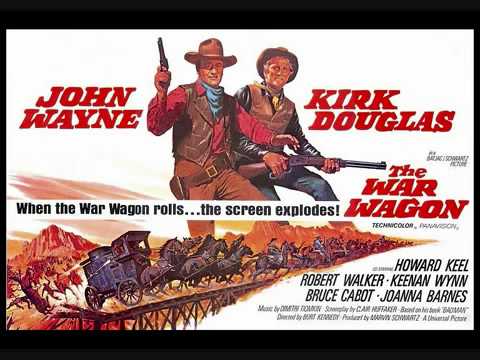
“The War Wagon”

The first thing about the 1967 John Wayne/Kirk Douglas vehicle The War Wagon   (yes, that pun was intentional, thank you)  is that it has o...