Showing posts with label Horror Film. Show all posts

Monday, 18 March 2019

“The Addams Family” (1991)

Being a great enthusiast for the “spooky comedies” subgenre (The Haunted Mansion, and the great art to be found there, whether concept- or fan-, are what got me into it; Vincent Price is largely what made me stay), I easily let myself be persuaded by my sister to watch the 1991 big-screen The Addams Family feature last weekend. At the very least I would then finally discover the context of the large amounts of gifs that Tumblr has wrung out of that poor sod of a movie. Like a distressing number of 1990's movies, you'd be forgiven, judging from Tumblr, for thinking that half this films's dialogue consists of lines designed specifically to be quoted later at comically-appropriate times.

After watching it in earnest, I can testify that, unlike with most of the 1990's movies which get this treatment on the Internet, this sentiment would be entirely accurate. 


But let it be said that those are some damn fine quips, too! Let not the above jaded opening give you the impression that I disliked the movie; forsooth, I liked it quite a bit.

I scarcely think that there is much cause to explain a fairly self-explanatory premise: the titular Family are a jolly ol'bunch of grotesques enjoying the “end-of-the-rope Bela Lugosi who dressed and lived like Dracula” lifestyle to the fullest, and not caring one bit that everyone else finds them utterly creepy. Less straightforward is the plot of the attempt to bring it to the big screen, a rather confused affair of mistaken identity centering on the figure of the Nosferatu-like Uncle Fester. But of course, it is no more confusing, nor farther-fetched, than a lot of Shakespeare plots; if you can sort-of-buy Twelfth Night, you can sort-of-buy this too. The place of the Bard in the realm of literary posterity suggests most people can indeed sort-of-buy Twelfth Night. So, let's move on. 


This Fester character is here played with marvelous, inventive twitchiness by the great Christopher Lloyd. (I have not seen many films with the man; I have not even seen any of those Back to the Future films everyone kept banging on about three years ago. But I have seen Who Framed Roger Rabbit? and Don Bluth's animated Anastasia, and that would be sufficient data to declare Lloyd a great actor, in the over-the-top category, whether or not the Internet was already screaming at me that he is one of the greats. Which it is, very loudly too.) Fester spends most of the movie as an amnesiac impersonating himself at the behest of a mother who adopted him in his 50's — don't worry, it makes just as much sense in context — so as to serve as our introductory “viewpoint character”. And — it's not that it doesn't work — but I'm not entirely certain we needed a viewpoint character. Designed for nigh-worldess newspaper cartoons first, and a 1960's sitcom later, the Addams Family are an extremely self-explanatory bunch; in truth, by the time Fester comes in, we already have a pretty solid idea who the Addamses are and what the tone of the film is going to be.


Though Lloyd is the “big name carrying the movie with a daringly different reinterpretation of one of the franchise's originals” (this is a trick that would be tried again with other fun-gothic films of this movie's generation: it sort-of-worked with Jim Carrey as Count Olaf in the 2003 Lemony Snicket flick, and failed horribly in the Haunted Mansion feature the same year), the rest of the cast is pretty uniformly stellar, from child actress Christina Ricci as the memed-to-death, but truly very entertaining, Wedsneday Addams, to Elizabeth Wilson as our villain, the Mme-de-Tremaine-esque Mrs Abigail Craven. (Craven not a very interesting villain, more as a result of with who and wirth what she's sharing the movie; Joan Cussack in the movie's sequel was dealt a much better deal with not a doubt. But Wilson plays her quite well still.) Anjelica Huston and Raúl Juliá as Morticia and Gomez Addams, in particular — I cannot judge them in comparsion to the televised originals, for I have not watched the TV series; but on their own terms, it is glaringly obvious that they are the most perfect realizations imaginable of what they are trying to be. 


The plot may be a little meandering, but that's never been a problem in a comedy so long as the meat is peppered with enough jokes at a good enough pace; The Addams Family does that. It has the good sense to borrow a fair few of its jokes from Charles Addams's original cartoons, and the rest are very successfully funny too; it also sometimes leaves the funny actors to do their funny things, and they do that very well too. There are a couple of jokes that don't land, or at least not with me (sadly, the last joke in the film is one of them), but aren't there always? 


The direction was handily recognizable as Barry Sonnenfeld to me, from his work on the 2017 Series of Unfortunate Events television series, and Sonnenfeld definitely knows what he's doing, creating a nice tone in almost every scene. The set design in which he's playing around is frequently gorgeous, though some bits of the Addams Mansion are a bit too much of a “boilerplate haunted house”. (There is one other exception I'll save for the post-scriptum.)


The Addams Family is also, of course, an effects picture; so I suppose I am expected to make a statement about those special effects. Well, the most obvious show of said SFX is ‘Thing’ the disembodied hand (it wasn't actually a disembodied hand in the source material, but rather a creature who was so hideous that we could only ever see its hand, the rest being too horrible; this is a vastly more creative concept than "disembodied hand"; but I shan't blame the movie overmuch for that, as that ship had long sailed by the time the movie rolled round, with numerous jokes back in the television series revolving around Thing's hand-ness). It works in most of its scenes, though it feels oddly weightless whenever it's crawling about; there is one exception of terrible greenscreenery, and that is that brief sequence in the climax where it's searching the swamps. But it lasts barely five seconds, so I'll excuse it. Similarly, of all the non-Thing effect, there is one laughably bad one, a computer-generated fire effect supposed to burn down a wooden statue in a few seconds. But it's a brief cutaway gag. 


All in all, it's not perfect, but I solidly recommend it. I look forward to watching the sequel, the amusingly-titled Addams Family Values, next weekend; I don't know if I'll have enough material for another review (we'll see), but for now I'd tacitly recommend it based on the quality of its predecessor and the presence of the great Joan Cussack in it (I know and love her from that other Sonnenfeld project, the Lemony Snicket televisions series). 

Post-Scriptum: 
  • So what is up with the Addams Family Graveyard, anyway? Not only are the statues in a weird, 20th-century-ish style that would scream “Anachronism!” if it had working lungs, but most of the tombs inexplicably bear the sole name of Addams. Guys, sorry to break it to you, but again… this is the Addams family plot. You're not actually telling passersby a whole lot by labeling the tombstones with their occupant's last name. This is one respect in which the Gracey Family Plot in The Haunted Mansion (ride, not film, of course) is indubitably superior, as it instead features first names to the exclusion of last names. 
          (Oh, well. It's a nice enough setpiece to look at, at least; reminded me a bit of Phibes's lair.)

Sunday, 17 February 2019

“Franz Kafka's It's A Wonderful Life”

As a Whovian for whom Peter Capaldi is one of the greatest actors ever to portray the title part on Doctor Who, imagine my surprise and glee when I discovered that Capaldi was also a successful director in his own right; and furthermore, as a fan of Franz Kafka and Frank Capra, imagine my surprise that he had won an Academy Award in 1993 for, well, this. Which, as the icing on the cake, happens to feature great actor (and fellow once-Doctor) Richard E. Grant in the title part of Franz Kafka, which is perhaps the most genius bit of casting I've ever seen in a Kafka movie. 

So how does it hold up, really? Pretty good!


Those accustomed to the endless variations on the “What if you were never born?” sequence of Capra's 1946 picture It's A Wonderful Life will be surprised to note that there isn't really any of that in Capaldi's film; instead, what it takes from the 1946 feature is the general structure of “things are miserable for a self-loathing protagonist who makes it harder on himself, until they are not, as all his gathered friends come together at the end to save both him and the day”. 

What remains is this premise: in a beautifully German-expressionist rendition of Kafka's Czech hometown, the writer is about to begin work on his masterpiece, Die Verwandlung (ye Brits and colonials know this as The Metamorphosis), but can't seem to figure out precisely what it is that Gregor Samsa wakes to find himself transformed into. There are frequent cutaway (as pictured above) to various preposterous options Kafka considers before scrapping them. As the tortured soul tries again and again to fulfill his destiny, and despite the insect imagery constantly staring him in the face, he can't seem to lay a finger on it. What's more, he keeps getting interrupted by various things (a Christmas party going on in the flat below his, a caller come at the wrong address, etc.). 

It is utterly brilliant. 

The thing about Franz Kafka's It's A Wonderful Life is that it's basically the most Kafkayan film I've ever seen, and yes, that includes Orson Welles's outstanding 1962 version of The Trial. Even it didn't quite reach this level of — of — how can I put it? In The Trial, it soon becomes clear that you're in dream logic, with these sprawling vistas of absurdly long corridors and absurdly large halls. In Franz on the other hand, there's nothing explicitly fantastic, or at least, it doesn't seem so until you've finished watching it and reflect back on it. It perfectly channels the weird and unpleasant experience of a bad dream, that cramped feeling, that nagging sensation that none of this is quite right, quite real that you keep mulling over without actually doing anything about it, because you can't. It's what Kafka was a master of turning into words, and Capaldi turned it into film reel. 


And what of the cast? Well, the line of celebrities does not end as Grant & Capaldi, as you'll also recognize Phyllis Logan and Ken Stott in varyingly-incidental parts. But really, a lot of credit must also go to a frightfully young Richard E. Grant, who looks sickly and disturbed without even trying, and without losing the audience's sympathy in the process, which is key to successfully playing a Kafka protagonist. (And to play Franz Kafka in such a picture is to play a Kafka protagonist, since all Kafka protagonists are basically Kafka. The short cleverly spells this point out by having Kafka's neighbors colloquially refer to him as “Mr K.”) This is, perhaps not the part, but certainly one of the parts that Grant was born to play. 

It's also a frightfully witty film, when it's not plunging us in the precise atmosphere of a nightmare; the Capra in its DNA means it has a happy ending and is overall slightly lighter-hearted than a pure Kafka picture, and all the better for it too. I won't spoil too many of the jokes, but perhaps my favorite concerns Franz's timidity about telling the partygoers below to knock it off: after he speaks his mind to the host of said party, the host, who has not lost her smiling demeanor, agrees to yield to his commanding nature, but then asks him “if this is a hypothetical conversation or a real one”. “Hypothetical, of course,” says Kafka. And the host: “Oh, good. Because I'm quite enjoying this party. Goodbye.” She walsk back in, closes the door, and so it's revealed that this scene was all Kafka's fantasy of what he wishes he had the backbone to say. 


Add to this a great visual direction, and music that, while never genius, does its part without distracting for the whole, and you get a real gem of a short film, highly recommended to anyone who enjoys Kafka, Capaldi, Richard E. Grant, or off-kilted filmmaking in general. 

Post-Scriptum:

The underwhelming music aside, I have exactly one (1) issue with the short, and that is that the visual of Samsa-as-Bug we eventually get is pretty bad. Being about pillow-sized, and with spindly long legs, the cockroach-head-thing is nothing like the many-legged pillbug I've always imagined, and nowhere near massive enough. (It is my belief that the creature in which Gregor Samsa was transformed once existed: it is the arthropleura.)

Friday, 19 October 2018

“The Abominable Doctor Phibes”

From his first great film role in Dragonwyck, it was clear that Vincent Price was destined to do great things. And he personally did — no doubt about that — but the things he starred in themselves… now, there wear mixed bags. A lot of those mixed bags are nonetheless enjoyable watches, and a high number of them find their way online in copyright-shady-but-undeniably-convenient circumstances. 

Thus, when I stumbled upon (didn't take long for me to use that word again) The Abominable Doctor Phibes among the YouTube Algorithm's suggested videos, I decided to give it a watch, assuming I'd get, at best, another classic in the vein of The Raven and The Comedy of Terror, and, at worst, an hour's offbeat entertainment enjoying Price's performance unironically, and the rest of it ironically. 


Boy, did this take me by surprise. I don't even know whether I actually like it or not in the end — I'm happier for having seen it, I suppose, but I can't tell if that's in a "pharaoh-sized train-crash of weirdness" way or a "this is actually a good movie" way. 

The Abominable Doctor Phibes is a unique movie. Put the early 1970's, the 1920's, The Phantom of the Opera, Edgar Allan Poe and the Biblical Plagues in a blender, and something might come out that possibly has some vague resemblances to Doctor Phibes, but even that doesn't fully describe it. 

The story, such as it is, is that a series of surgeons are being bumped off in grotesque-but-amusing ways, which mirror the Ten Plagues of Egypt (which the film obstinately refers to as the Ten "Curses" of Egypt, for reasons that escape me). Inspector Trout of Scotland Yard investigates, and it surfaces that the ten surgeons all participated in a failed operation on a Mrs Victoria Phibes decades earlier. The inventive murderer is demented organist and theologian Anton Phibes, believed dead, but who in truth survived with horrific injuries. Hell-bent on avenging his wife, Phibes goes through nine Plagues, though his last victim manages to escape in the nick of time, then enacts his last crazy booby-trap on himself, entombing and embalming himself with his beloved in a final sequence worthy of Terry Gilliam. 

Now, the main feature of this picture is obviously the character and mythos of Doctor Phibes himself, as played by Vincent Price. He's definitely a very memorable bit of character-writing ; a striking picture of desperate, Poe-like madness and genius. His hatred of medical doctors is well-developped and comes together with the plot in the climax, and there's something very Mask of the Red Death-y about his exquisitely-designed lair and his clockwork creations (of whom the inexplicably-named Vulnavia is the most advanced example). 

Where Phibes’s character fails somewhat is in the attempt that was made to make him a "ghoul" as well as a "character". The way he talks and drinks through his neck is, I suppose, unique, but to me it just felt bizarre. The film in general is very hit-or-miss in its "silly-gruesome" elements. Deciding that the face Phibes wears throughout the film would be a false face, a mask to disguise his skull-like ruin of a visage, is a creative twist on both the Phantom of the Opera and the Invisible Man — but it also deprives Price of much of a chance to work his usual magic. His body language is on-point, and the slight variations he puts in Phibes’s face manage to be extremely funny at times (such as the disapproving look he shoots to one of his victims when the decor in his house makes it clear he was rather a bon viveur)… but for most of the film, Phibes is a stiff, lumbering figure. 

Hope you like Vincent's ‘miserable’ face, it's basically all you
get for most of the film. 

The same goes for Phibes's voice, made distorted and monotone through its artificial nature. Its stilted, Dalek-y rhythm makes perfect sense for the story, and it is in itself well-done, but if you won't allow Price to act Price-y, please let him speak Price-y… no? No? Really? 

All of this serves the character well — Phibes is terribly injured, both mentally and physically, and putting on a pretense of life for as long as he takes till his wife is avenged in his eye; he should look miserable and in pain and barely alive — but it greatly lessens how much Price can carry the feature on the back of his acting chops, as I initially assumed he would. 


(By the by, I'm not entirely sure what's up with the way Price doesn't even try to look like he's actually playing the organ, and the Clockwork Musicians’ repetitive motions do not in any way match the supposed music. Intentional kitsch? Actual production goofs? Or is the idea that he's just playing records with the pretense that he and his musicians are the source of the tune? Honestly couldn't tell.)

The rest of the cast, fortunately, is pretty wonderful as well. Peter Jeffrey delivers an extremely likable hero in the person of Inspector Trout, and of course, you have Joseph Cotten as Doctor Vesalius, the final doctor on Phibes's list, forced to operate on his son under stress to save both their lives. Out of all the Doctors, counselors on Trout's investigation, and assorted supporting cast, I don't think there's one clearly bad performance. Virginia North as Vulnavia also does the trick of looking silent, beautiful, and eerie, while also bringing a bit of character to the role in the scenes where she sulks about her boss and creator's lair, giving strange looks to Phibes's other, less advanced puppets. 


Also inherent to the movie's identity is the oddball medley of songs played by the Clockwork Musicians in Phibes's lair, and the rest of the soundtrack. (Sealing how entertaining this movie's music manages to be is the ever-wonderful Paul Frees's brief cameo, bringing on the same cartoony-crooner voice he used in Symposium on Popular Songs.)

In conclusion, one leaves The Abominable Doctor Phibes questioning one's sanity — with the clear sense of having watched a well-crafted bit of entertainment, but at a loss as to how the various bizarre elements of it ever fit together in a coherent picture. (One also leaves it with nagging curiosity as to the Tenth Plague and what is up with the symbols on Phibes's coffins — a sequel-hook that would be all but dropped when the actual sequel was released. Boy, was the sequel weird… but we'll get to that later.)

Oh, and —

A post-scriptum:

What is up with the oft-reproduced poster for this? 

  • Why use Phibes's skull-appearance? It's not a bad ideain theory but the make-up is… it's what it is… and besides, the real face of the Abominable Doctor is a twist, saved for the very last confrontation between him and Dr. Vesalius. No sense in wasting it here. 
  • If the woman is Victoria Phibes, well, she's surprisingly lively-looking for a woman who died decades before the film started, and Caroline Munro has no business sharing the poster with Price when she only ever appears as photographs and a corpse. If she is instead Vulaniava, then why the heck is Phibes kissing Vulnavia? 
  • The tagline is just as puzzling. Phibes isn't trying to be with Victoria in his deformed state at all — indeed, he only became this way shortly after she died. No "monster romance" going on here. One gets the feeling that whoever did the poster was trying to get Phantom of the Opera enthusiasts on-board. 
  • By Jove, aren't those colors the most 1970's thing ever devised. Booh. That font, also. 
  • Hugh Griffith might have been the bigger name, but he's a rather minor character in the film — an exposition-dumping Rabbi who drops in and out as demanded by the plot. It boggles the mind that he and Terry-Thomas are credited, yet the film's actual protagonist, Peter Jeffrey (Trout), is left out.  

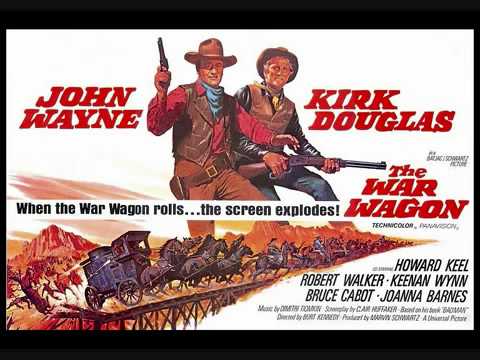
“The War Wagon”

The first thing about the 1967 John Wayne/Kirk Douglas vehicle The War Wagon   (yes, that pun was intentional, thank you)  is that it has o...