Showing posts with label Peter Jeffrey. Show all posts

Tuesday, 12 March 2019

“Middlemarch” (1994)

This review will be a little special, for the reason that I do not feel qualified to talk about the BBC's 1993 Middlemarch miniseries at length, not nearly. For one thing, I have not read the classic George Eliot novel on which it is based; by all accounts this is a fairly accurate adaptation, but it could be that some key detail (or, more insidiously, the general tone) has been drastically altered, and I wouldn't know; and I would feel pretty bad if that were the case. So what I do is I'll lay off talking about the plot and the tone; both seemed very good to this phillistine, I'll leave it at that.

Nevertheless: Middlemarch. I have seen it, and as a piece of television it is truly marvelous. 


This treatment of Eliot's story was written by Andrew Davies (I want to say skillfully; but again I lack the knowledge to say whether it was a skillful adaptation; I can but say that it is a skillful screenplay, and that is undeniable), whom the cover of the DVD box set on which I watched it loudly hailed as the writer of some other thing I haven't watched. I found that fact rather peculiar. How often is the big name-pull in a project like this the adapter? Is there such a thing as a celebrity adapter? Well, there is now. The direction, meanwhile, is the work of Anthony Page, one of the myriad surprisingly competent unknowns that the BBC is apparently bursting with at all times. The direction in Middlemarch isn't anything special, but there's a great many nice shots and well-edited moments; and that's all it needs. Likewise the production and costume design is very good without being so stunning as to lead you to notice it; not the stuff of awards, but it's not trying to be, and what it is trying to do it does superbly. The music is extremely pleasant, between the title theme by the great Stanley Myers and the incidental instrumental score by the alsl-great Christopher Gunning (of Poirot fame, among others). I read the latter received an award for this, and he totally deserved it.


The true stand-out, though, is the cast; both main and supporting, they are truly excellent. Of Juliet Aubrey (Dorothea “Dodo” Brooke, our kind-of-protagonist, though Middlemarch isn't really concerned with having a ‘main character’), Patrick Malahide (grim-faced scholar, and careless husband of the former Edward Casaubon) and Douglas Hodge (Dr Tertius Lydgate, our other kind-of-main-protagonist), I have only to say: that they play their roles to perfection, and (but this is incredibly flimsy and superficial, I know; I'm putting out there anyway, because, one, my blog, and two, said blog does have 'random' right there in the title) that their general demeanors reminded me, respectively, of Allison Williams's Kit Snicket, Richard E. Grant's Doctor Simeon, and Colin Baker's Sixth Doctor. 


Jonathan Firth manages to make the audience care about Fred Vincy from the beginning, which is no mince feat; Trevyn McDowell is likewise a pretty good Rosamund Vincy. She does at least look gorgeously. I must give also give massive props to John Savident (you may recognize him from his minor part in A Clockwork Orange) as a delightfully loathsome, scummy John Raffles who reminds me of nothing more than Timothy Spall's Peter Pettigrew if were more expansive and less cowardly. As for Rufus Sewell's Will Ladislaw — well — everything about him is designed to make the female fanbase fancy him (or male, if so inclined, of course, but he feels particularly fangirl-oriented), but that aside he too does very honorably. 


As the stern, complex, very realistic Scrooge-like figure of Nicholas Bulstrode, we find none other than Peter Jeffrey, whom we left back in 1971 unraveling a series of fiendish Biblical murders. And no matter what a fun presence Jeffrey was in Phibes, there is no denying that he's given many more things, and more interesting things at that, to do here as an actor. By god he pulls it off, too.


And lastly I want to talk about the late, great Robert Hardy, here as the hopeless, but endlessly, thoughtlessly optimistic wannabe-politician Arthur Brooke. The world will remember him mostly for his take on Minister Cornelius Fudge in the Harry Potter movies, because the Harry Potter movies strived on sucking the reputation of esteemed British actors like some sort of fame-vampire, leaving them puppets to its own growing fame forevermore (poor Michael Gambon, poor Jim Broadbent, poor John Hurt). He is quite good at it mind you; we'll get to that whenever I get around to reviewing the Harry Potter movies. 

But oh, that he should be famous for that bit part when this exists as a more fleshed-out, fully realized version of more or less the same character (Fudge is somewhat older than Brooke, but it hardly matters). He feels, like every other Middlemarch character to the possible exception of Ladislaw, like a real, fully-realized human personality; and at the same time he is a fascinatingly good comic relief, the only real full-on comic relief in the entire series. I knew already that Hardy was one heck of an actor, for having seen his take on Shakespeare's Sir Toby Belch in a televised Twelfth Night, but this seals him as one of my favorite lesser-known English actors altogether. Really, really quite good.


So all in all, obviously, I highly recommend Middlemarch to any prospective watchers; it's a very rewarding experience. As to telling any great enhtusiasts of the book whether it's a worthy adaptation of it, I can make no definitive pronouncements. Nevertheless, again: it's very very good. 

Post-Scriptum: 
  • Why yes, I do like, and review, “serious” things as well as wacky pulpy stuff. Have I not warned you that I contained multitudes? MWA HAH HAH. You have no idea. 
  • There is one thing “wrong” — or at least something weird — about this excellent miniseries, and it is that at the end of the last episode, we are treated to a ‘where are they now?’ voice-over, which the credits tell us is supposed to be spoken by George Eliot herself. It's read by Judi Dench, which is nice and all (way to cram one more big British name in there!), but there has not been one minute of narration at any time prior, and it just starts abruptly. It's a bit jarring is what it is. This is a pet peeve I have with movies: either you have a narrator or you don't. Pick one.


Friday, 19 October 2018

“The Abominable Doctor Phibes”

From his first great film role in Dragonwyck, it was clear that Vincent Price was destined to do great things. And he personally did — no doubt about that — but the things he starred in themselves… now, there wear mixed bags. A lot of those mixed bags are nonetheless enjoyable watches, and a high number of them find their way online in copyright-shady-but-undeniably-convenient circumstances. 

Thus, when I stumbled upon (didn't take long for me to use that word again) The Abominable Doctor Phibes among the YouTube Algorithm's suggested videos, I decided to give it a watch, assuming I'd get, at best, another classic in the vein of The Raven and The Comedy of Terror, and, at worst, an hour's offbeat entertainment enjoying Price's performance unironically, and the rest of it ironically. 


Boy, did this take me by surprise. I don't even know whether I actually like it or not in the end — I'm happier for having seen it, I suppose, but I can't tell if that's in a "pharaoh-sized train-crash of weirdness" way or a "this is actually a good movie" way. 

The Abominable Doctor Phibes is a unique movie. Put the early 1970's, the 1920's, The Phantom of the Opera, Edgar Allan Poe and the Biblical Plagues in a blender, and something might come out that possibly has some vague resemblances to Doctor Phibes, but even that doesn't fully describe it. 

The story, such as it is, is that a series of surgeons are being bumped off in grotesque-but-amusing ways, which mirror the Ten Plagues of Egypt (which the film obstinately refers to as the Ten "Curses" of Egypt, for reasons that escape me). Inspector Trout of Scotland Yard investigates, and it surfaces that the ten surgeons all participated in a failed operation on a Mrs Victoria Phibes decades earlier. The inventive murderer is demented organist and theologian Anton Phibes, believed dead, but who in truth survived with horrific injuries. Hell-bent on avenging his wife, Phibes goes through nine Plagues, though his last victim manages to escape in the nick of time, then enacts his last crazy booby-trap on himself, entombing and embalming himself with his beloved in a final sequence worthy of Terry Gilliam. 

Now, the main feature of this picture is obviously the character and mythos of Doctor Phibes himself, as played by Vincent Price. He's definitely a very memorable bit of character-writing ; a striking picture of desperate, Poe-like madness and genius. His hatred of medical doctors is well-developped and comes together with the plot in the climax, and there's something very Mask of the Red Death-y about his exquisitely-designed lair and his clockwork creations (of whom the inexplicably-named Vulnavia is the most advanced example). 

Where Phibes’s character fails somewhat is in the attempt that was made to make him a "ghoul" as well as a "character". The way he talks and drinks through his neck is, I suppose, unique, but to me it just felt bizarre. The film in general is very hit-or-miss in its "silly-gruesome" elements. Deciding that the face Phibes wears throughout the film would be a false face, a mask to disguise his skull-like ruin of a visage, is a creative twist on both the Phantom of the Opera and the Invisible Man — but it also deprives Price of much of a chance to work his usual magic. His body language is on-point, and the slight variations he puts in Phibes’s face manage to be extremely funny at times (such as the disapproving look he shoots to one of his victims when the decor in his house makes it clear he was rather a bon viveur)… but for most of the film, Phibes is a stiff, lumbering figure. 

Hope you like Vincent's ‘miserable’ face, it's basically all you
get for most of the film. 

The same goes for Phibes's voice, made distorted and monotone through its artificial nature. Its stilted, Dalek-y rhythm makes perfect sense for the story, and it is in itself well-done, but if you won't allow Price to act Price-y, please let him speak Price-y… no? No? Really? 

All of this serves the character well — Phibes is terribly injured, both mentally and physically, and putting on a pretense of life for as long as he takes till his wife is avenged in his eye; he should look miserable and in pain and barely alive — but it greatly lessens how much Price can carry the feature on the back of his acting chops, as I initially assumed he would. 


(By the by, I'm not entirely sure what's up with the way Price doesn't even try to look like he's actually playing the organ, and the Clockwork Musicians’ repetitive motions do not in any way match the supposed music. Intentional kitsch? Actual production goofs? Or is the idea that he's just playing records with the pretense that he and his musicians are the source of the tune? Honestly couldn't tell.)

The rest of the cast, fortunately, is pretty wonderful as well. Peter Jeffrey delivers an extremely likable hero in the person of Inspector Trout, and of course, you have Joseph Cotten as Doctor Vesalius, the final doctor on Phibes's list, forced to operate on his son under stress to save both their lives. Out of all the Doctors, counselors on Trout's investigation, and assorted supporting cast, I don't think there's one clearly bad performance. Virginia North as Vulnavia also does the trick of looking silent, beautiful, and eerie, while also bringing a bit of character to the role in the scenes where she sulks about her boss and creator's lair, giving strange looks to Phibes's other, less advanced puppets. 


Also inherent to the movie's identity is the oddball medley of songs played by the Clockwork Musicians in Phibes's lair, and the rest of the soundtrack. (Sealing how entertaining this movie's music manages to be is the ever-wonderful Paul Frees's brief cameo, bringing on the same cartoony-crooner voice he used in Symposium on Popular Songs.)

In conclusion, one leaves The Abominable Doctor Phibes questioning one's sanity — with the clear sense of having watched a well-crafted bit of entertainment, but at a loss as to how the various bizarre elements of it ever fit together in a coherent picture. (One also leaves it with nagging curiosity as to the Tenth Plague and what is up with the symbols on Phibes's coffins — a sequel-hook that would be all but dropped when the actual sequel was released. Boy, was the sequel weird… but we'll get to that later.)

Oh, and —

A post-scriptum:

What is up with the oft-reproduced poster for this? 

  • Why use Phibes's skull-appearance? It's not a bad ideain theory but the make-up is… it's what it is… and besides, the real face of the Abominable Doctor is a twist, saved for the very last confrontation between him and Dr. Vesalius. No sense in wasting it here. 
  • If the woman is Victoria Phibes, well, she's surprisingly lively-looking for a woman who died decades before the film started, and Caroline Munro has no business sharing the poster with Price when she only ever appears as photographs and a corpse. If she is instead Vulaniava, then why the heck is Phibes kissing Vulnavia? 
  • The tagline is just as puzzling. Phibes isn't trying to be with Victoria in his deformed state at all — indeed, he only became this way shortly after she died. No "monster romance" going on here. One gets the feeling that whoever did the poster was trying to get Phantom of the Opera enthusiasts on-board. 
  • By Jove, aren't those colors the most 1970's thing ever devised. Booh. That font, also. 
  • Hugh Griffith might have been the bigger name, but he's a rather minor character in the film — an exposition-dumping Rabbi who drops in and out as demanded by the plot. It boggles the mind that he and Terry-Thomas are credited, yet the film's actual protagonist, Peter Jeffrey (Trout), is left out.  

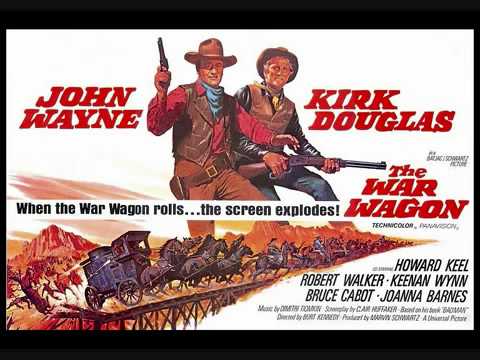
“The War Wagon”

The first thing about the 1967 John Wayne/Kirk Douglas vehicle The War Wagon   (yes, that pun was intentional, thank you)  is that it has o...