Showing posts with label 1970's. Show all posts

Tuesday, 16 July 2019

“An Informal Biography of Scrooge McDuck”

Don Rosa was not the last to attempt a grand, epic biography of Scrooge McDuck, as we have seen. Well, the fact is less well-known, but neither was he the first. As Rosa himself admits, he drew considerable inspiration from a 1974 book called An Informal Biogrpahy of Scrooge McDuck, the work of one Jack L. Chalker who would go on to become a pretty successful science-fiction writer a few years down the line. I've finally obtained it for myself, and it is well worth the read, if only because it's very nicely written. 


It's quite a lovely cover, this. It obviously plays with the fact that for copyright reason — as a preface within the book itself bemoans — no actual images of Scrooge could be used to illustrate the book. In truth, I think the book was only authorized to see print because Chalker could legally claim that it was only a critical work, not a work of fiction. 

Which I must stress is a blatant lie. 

Taking its every cue from Sherlock Holmes enthusiasts' ‘Great Game’, wherein they pretend to be historians researching Holmes as a historical figure, the Informal Biography is written with the conceit that it is an in-universe biography, the work of a historian trying to document Mr McDuck based on the "secondary sources" that are the works of his official chronicler Mr Barks. 

This is delightful, not only because it spices things up, but also because it allows the book to be fallible — if you think one of Chalker's ideas about Scrooge's life is nonsense, then that's no reason to throw out the book, it just means you have identified one of the instances in which Chalker-the-character obviously didn't look hard enough for the real answers. (I'm thinking, for a particularly conspicuous example, of the extremely curious blunder that is Chalker's assumption that Huey, Dewey and Louie are the sons of Donald's brother.)

The debts this (and, consequently, the L&T) owes to Sherlock Holmes exegesis is staggering — the tone in which the narrator treats the subject of the 'biography' is precisely the same cautious, falsely-detached respect — and Chalker owns it. The chapter about Goldie literally opens with a statement that “to Scrooge, she was always The Woman”, and just from that, as controversial as DuckTales 2017's decision to write Scrooge and Goldie's relationship as a modernized version of Sherlock & Irene (well, the pop vision thereof) might be, you can see just where they get it from. 

It goes further, actually. Towards the end of Part 1, we find the following passage, riffing off Only a Poor Old Man's statement that Scrooge once made money training cormorants: 
From Australia, Scrooge made his way north, into Indochina and China itself, where he became involved in the pearl trade. While there he discovered a special affinity for birds, and trained thousands of cormorants after learning their language. His most illustrious customer was a certain aged Oriental doctor who was often seen with cormorants in the years after—they became sort of a trademark. Later on he discovered that the doctor used cormorants trained by Scrooge for nefarious purposes, and was instrumental in the solution of the Adventure of the Trained Cormorants which, because of its unsatisfactory solution — the doctor escaped — and the illustrious reputations of all three men involved, still awaits elaboration in The Whole Art of Detection
In other words, Chalker is outright declaring that his Scrooge exists in the same universe as Arthur Conan Doyle's Sherlock Holmes, and specifically as the Great Game-rooted pastiche collection The Whole Art of Detection. And further, he is very very strongly implying that Scrooge McDuck and Sherlock Holmes once teamed up to fight Doctor Fu Manchu. 

…now, my good friend Joe Torcivia (among others) is notorious for slipping titles to nonexistent "bonus chapters" of the Life and Times of $crooge McDuck in his Disney scripts, and more power to him, but you can't beat that as unseen past Scrooge adventures go. You just can't. 


So anyway, having acknowledged where this book came from, there remains to analyze what it went to. Because it is not merely the precursor to Rosa's L&T, but rather its template. One doesn't want to diminish Don Rosa's own scholarly work, and I'm sure he made sure to pore over all those Barks references once again on his own power before he worked out his own version of Scrooge's biography, but… the fact is that the Chalker version of events lines up astonishingly well with the Rosa rendition. There are, of course, a few differences here and there (in The Empire-Builder from Calisota, Scrooge uses his damnably slow car to reach Duckburg; in the Informal Biography, he buys it shortly after settling in Duckburg), but for every minor difference there are identical leaps of logic that one cannot call coincidences. 

This, by the way, accounts for the suspicious similarities between the L&T and the DuckTales episode Once Upon a Dime, which were big enough that Rosa's protests of never having watched it failed to convince. The DT writers were borrowing from the same source, is all. The biggest smoking gun between Rosa and DT (the identical conflation of Scrooge's own Mississippi days with the 1870 steamboat race between his Uncle Pothole and Porker Hogg) is actually a Chalker invention. 

There are, of course, also some marked differences. Chalker is reluctant to make stuff up, when it isn't ludicrous three-way literary crossovers, and so Scrooge's parents and sisters are nonentities. Borrowing from the classic Sherlock Holmes vision of a restrictive canon rather than expansive one, he also limits his sources to stories written and drawn by Barks, featuring Scrooge, and printed in Uncle Scrooge — that is to say that Scrooge backups in other books are null-and-void even if they're by Barks. Only somewhat less strange is his exclusion of the early Big Threes of Barks's Scrooge, Christmas on Bear Mountain, Voodoo Hoodoo and The Old Castle's Secret, which he holds to be 'obviously apocryphal' due to Scrooge's characterization. 

This? Nah. Never happened. Totally irrelevant
to the Carl Barks canon. Don't be ridiculous.

And, much like with Rosa, Chalker has his little exceptions and quid pro quos. Like Rosa, he lets in the Vic Lockman-written The Invisible Intruder — and his stammered justifications for this 'crime' are, I think, trying too hard: it's a Carl Barks-drawn story where we see Scrooge earn his #1 Dime, of sodding course you're not going to overlook it when writing a biography of Scrooge. 

Way weirder than this very forgivable sidestep is the fact that, and for the life of me I cannot figure this out, this random Tony Strobl four-pager from 1964 (one which introduces a non-Goldie love interest for Scrooge, no less) makes the cut. I mean, I, myself, am delighted, because my personal Duck canon is a gigantic jungle that includes things like the DuckTales plush commercial from 1986 and the unlicensed Eastern European comic-strip where Mickey rivaled with Popeye for the affections of Betty Boop. In rhyme. …But in Chalker's draconian Canon, it's a bit jarring, is all. 

So at any rate, this means that all the stuff about Castle McDuck isn't in Chalker — for Chalker, it's the intact Castle in Old Castle's Secret that is the aberration, and the ruins seen in Hound of the Whiskervilles that is the real thing; whereas for Rosa it's the reverse — and neither, of course, is the Bombie the Zombie plotline. 

Amusingly, Chalker is on the other hand less quick to dismiss Scrooge's offhand mentions of improbable deals he made in the past: "that time he sold wind to Dutch windmills" is absolutely included in the Informal Biography's timeline of Scrooge's life. It almost saddens me that his claim that he learned to speak Bengali "when he was selling maps to Marco Polo" stretches Chalker's willing suspension of disbelief just a bit too far, I'd have loved to see him try to work that out. (It's not as though you couldn't imagine Scrooge getting embroiled with H. G. Wells's Time Machine, could you, Mr Sherlock Holmes vs Fu Manchu?)

The real big difference between the Scrooge and Don Rosa versions of Scrooge's life, however, is not in those details, but rather in the fact that Scrooge is already a millionaire when he arrives in the Klondike. Faced with the facts that Scrooge dug for diamonds in the Transvaal, and an offhand mention of his owning a diamond mine there in the present day, Chalker concludes that Scrooge successfully struck it rich there and then, and only continued living the sourdough life for a few years more because adventure is just in his blood. 

Which… granted, it seems anticlimatic and weird and Wrong that Scrooge would make his money anywhere but in the Klondike (and Chalker tries to preserve some dignitiy for Scrooge's Dawson City days by declaring that this was where he became a billionaire), but on the other hand, one of the most questionable aspects of Don Rosa's L&T has always been the almost Donald levels of bad luck Scrooge is required to endure so that he can simultaneously not come across as incompetent for missing his ride to wealth several times over, and still not get rich in any of his adventures before the big one in White Agony Creek.

And after all, Scrooge is still traveling the world and adventuring in the 'present day', even though he's a billionaire many times over. No reason many of his "past" adventures couldn't have been in the same spirit, I suppose. 


After wrapping up its biography of Past Scrooge, the book interestingly tries to hack together a working timeline of Barks's present-day Duckburg, most strikingly with the Beagle Boys. It mixes and matches and reorders freely, notably coming up with the amusing idea that the Beagle Boys' very first confrontation with Scrooge was Seven Cities of Cibola, a notion which is obviously wrong but also strangely fascinating. This section includes chapters on Scrooge, on his more morally dubious actions, and on the "big three" of his rogues gallery — the Beagle Boys, Magica De Spell and Flintheart Glomgold, in that order — followed by a rundown of other villains. Interestingly, Snake McViper (the Cattle King incarnation of the Pig-Faced Villain) is construed to be a member of the McViper clan from Mystery of the Ghost Town Railroad, even though those McVipers were dognoses, instead of being more reasonably rationalized as an alias of good old Argus McSwine. 

This is also the book from which Don Rosa plucked his idea that Scrooge, Donald and HDL remained so alert and unchanged throughout Barks's stories (which must surely span several years) due to having taken a sip of the Fountain of Youth in That's No Fable!. Chalker, who, unlike Don Rosa, doesn't compress the Ducks' timeline into just the 1950's and accepts that Barks's stories took place over the 25-year period in which he wrote them, goes farther with his notion than Rosa ever dared to, and posits that in most of their appearances, Huey, Dewey and Louie are no longer children at all, but simply adults in unaging childlike bodies, accounting for their unusually mature attitude. It's a vaguely blasphemous notion, but as a nutjob fan theory I think I kinda love it. 
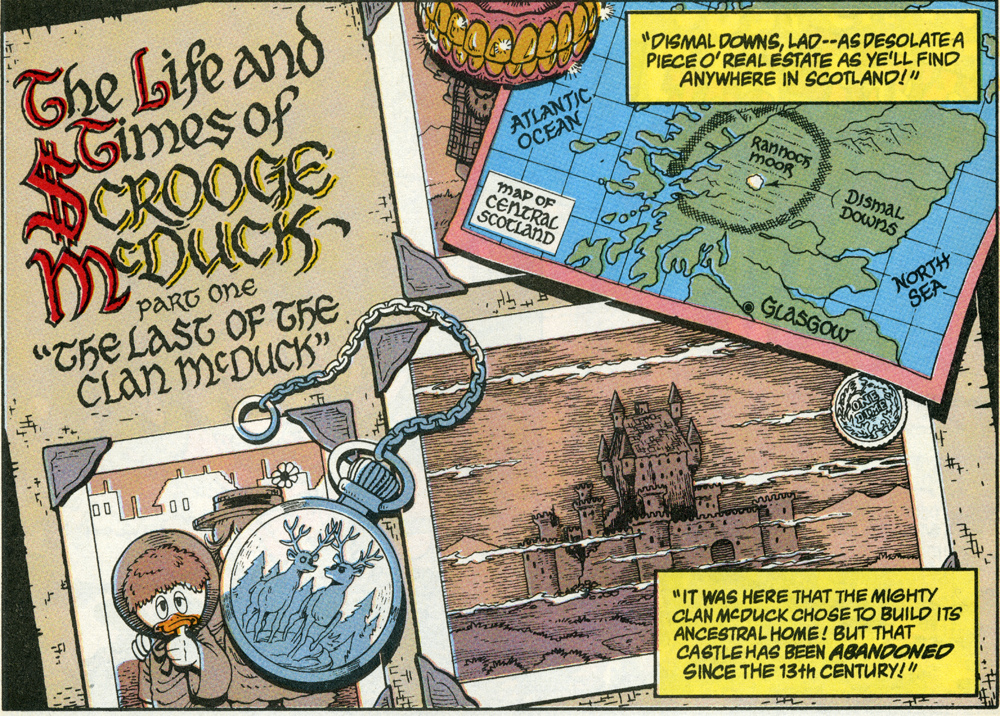

So… that's the Informal Biography. Vaguely infuriating in all sorts of ways (not least its tiresome annotations system), but it is the immediate missing link between Arthur Conan Doyle and Don Rosa, and the importance of that cannot be underestimated. Plus, it's a fun read. As fun as the L&ToSMD? Probably not (except for that bit about Dr Fu Manchu, which, but holy hell I want to read that). But fun. 

Post-Scriptum

  • As you can see from the cover above, the title is An Informal Biography of Scrooge McDuck. Why every second-hand dealer on the Internet refers to it as just Informal Biography of Scrooge McDuck, I cannot tell you. 

Tuesday, 11 December 2018

“Frontier in Space”

As you may know, I am greatly fond of Doctor Who; not particularly of the season that wrapped up last Sunday, but of Who in general, certainly — whether classic or modern. The 1973 six-part serial Frontier in Space, which I have just finished watching, strikes me as one of the most excellent examples of Classic Who and of Jon Pertwee's Doctor, so let's examin exactly how.


Story. Frontier is a clever little science-fiction tale, not without its wisdom. The setpiece is the year 4500 or thereabouts, where Earth's space empire has come to an uneasy truce with another, the Draconian. The modern Earth is a nuanced and interesting portrayal of the future, neither a utopia (the Doctor gets an unpleasant trip to a penal colony on the Moon for political opponent) nor an all-out dictatorship (the President of Earth is obviously well-meaning; she is, incidentally, a woman, which should alone put an end to recent media's unfair claims that classic Who contained old-fashioned sexism in spades, a blatant untruth meant to make the casting of Whittaker as the Doctor more interesting). 

The plot sees the Doctor's old enemy the Master (more about him later) is conspiring to bring the two empires at war with one another, for the sake of a fourth party in whose interest it is to see them weakened by renewed hostilities. To do so, the Master uses the clever science-fiction device of a hypnotic ray that makes you see whoever is in front of you as your worst fear, exploiting it to make Draconians think humans (“Earth-men”, as they are stubbornly called) are attacking their ships, and vice-versa. 

The Doctor, accidentally landing inside one of the attacked ships alongside Jo Grant, suffers much trials and tribulations as he is captured by one Empire and the next and interrogated as a spy, fruitlessly trying to convince both that they're being tricked. By Episode 5, our heroes are aware of the presence of the Master (who makes a fruitless attempt to rectify the situation by imprisoning them himself, and shoots himself in the foot instead), and manage to convince the Draconian Emperor of the truth. But just as it seems like the serial is wrapping up, the true masterminds who employed the Master are revealed; and they're…


Though war between Earth and the Draconians is of course avoided, the Daleks are not foiled altogether, and so Episode 6 of Frontier in Space leads directly into the next serial, Planet of the Daleks. That is in itself a point in favor of Frontier's story; arc structures weren't as established in 1970's Doctor Who as they have been since 2005, but this is quite close to it and I like it. 


Humor. From the First Doctor's inability to keep his words straight (an amusing quirk that modern audiences have often, unfairly, reduced to William Hartnell simply flubbing that many lines accidentally; but it is generally agreed among Whovians that it happens too often to have been wholly uninentional) to the Twelfth Doctor's pretending to enter the TARDIS for the first timeDoctor Who has always included a decent dose of good humor, and while Frontier in Space is hardly The Husbands of River Song, it gets its fair amount of chuckles. Most are owed to our two rival Time Lords; the anecdotes Pertwee's Doctor tells to Jo to cheer her up are simply charming, and Delgado's Master occasionally lapses into cartoony villainy to hilarious results ("Don't you want to kill him?" "Of course I do!… It's just… long-range rocket missiles… it feels like it lacks that personal touch"). 

Villains. It is notorious that Doctor Who would have been cancelled before the end of its first season, all the way back in 1963, if not for the Daleks; ever since, alien monsters and well-acted villains have been staples of the show and one of its greatest draws. Indeed, it's the weakness of many too pedestrian villains such as Josh Bowman's Krasko that has been the greatest flaw of the current series, in my opinion. 

A very appropriate choice of reading. 

Frontier in Space on the other hand is lucky enough to have two great Doctor Who villains in one story, plus secondary one-shots. The first is Roger Delgado's Master, a wonderful evil counterpart to Jon Pertwee's Doctor, refined and unapologetic in his foulness, relishing any time he's on top just as the audience relishes any time he's on screen. Sadly, due to a car accident some few months after the end of shooting, this would be Delgado's last turn as the evil Time Lord; his being a Time Lord allowed the show to bring back the character with new faces, and I absolutely love the Master's portrayals by Anthony Ainley or Michelle Gomez later on, but just like no Doctors can be quite alike, no posterior Master ever recaptured quite the same spirit as Delgado's. 

The second are Doctor Who's iconic evil tin-cans, the Daleks, who are entirely themselves and manage to pose a real threat despite their inherent goofiness. It's not the Daleks' finest turn — if nothing else, their “metal parrot” voices lack the stunning range that Nicholas Briggs would later bring to them — but it is nearly impossible for a halfway-decent Who writer to go completely wrong with the Daleks, and I think we've established that Malcolm Hulke is more than decent a writer, on the faith of this episode alone.

In terms of secondary villains, I will give special recognition to Michael Hawkins as the warmongering General Williams, whose voice is consistently full of gravitas and seems to me to have been a great inspiration for Timothy Dalton's iconic portrayal of Rassilon in The End of Time. Speaking of great actors, John Woodnutt as the Draconian Emperor is also worthy of praise, though the Emperor isn't actually a villain; and as Pertwee himself would remark, the make-up on the Draconians is probably as good as alien makeup got in the Classic Series; it's hardly more rubbery than the very similar Silurians in The Hungry Earth forty years later. 


The most unremarkable creation of the serial would have to be the Ogrons, the Master and Daleks' extraterrestrial grunts, who are little more than their name suggests — ugly, ogre-like space Orcs of limited intelligence. They're never scary, and they're only amusing because of the superintelligent Master's frustration with their stupidity, rather than because of anything about themselves. Their design is woefully uninspired. Still, they're not meant to be the memorable part of the episode, and so one shouldn't be surprised that they're not. 

Frontier in Space is all in all an extremely pleasant Doctor Who experience, highly recommended to anyone with an interest in the series, or just looking to have a good sci-fi time. 

Friday, 19 October 2018

“The Abominable Doctor Phibes”

From his first great film role in Dragonwyck, it was clear that Vincent Price was destined to do great things. And he personally did — no doubt about that — but the things he starred in themselves… now, there wear mixed bags. A lot of those mixed bags are nonetheless enjoyable watches, and a high number of them find their way online in copyright-shady-but-undeniably-convenient circumstances. 

Thus, when I stumbled upon (didn't take long for me to use that word again) The Abominable Doctor Phibes among the YouTube Algorithm's suggested videos, I decided to give it a watch, assuming I'd get, at best, another classic in the vein of The Raven and The Comedy of Terror, and, at worst, an hour's offbeat entertainment enjoying Price's performance unironically, and the rest of it ironically. 


Boy, did this take me by surprise. I don't even know whether I actually like it or not in the end — I'm happier for having seen it, I suppose, but I can't tell if that's in a "pharaoh-sized train-crash of weirdness" way or a "this is actually a good movie" way. 

The Abominable Doctor Phibes is a unique movie. Put the early 1970's, the 1920's, The Phantom of the Opera, Edgar Allan Poe and the Biblical Plagues in a blender, and something might come out that possibly has some vague resemblances to Doctor Phibes, but even that doesn't fully describe it. 

The story, such as it is, is that a series of surgeons are being bumped off in grotesque-but-amusing ways, which mirror the Ten Plagues of Egypt (which the film obstinately refers to as the Ten "Curses" of Egypt, for reasons that escape me). Inspector Trout of Scotland Yard investigates, and it surfaces that the ten surgeons all participated in a failed operation on a Mrs Victoria Phibes decades earlier. The inventive murderer is demented organist and theologian Anton Phibes, believed dead, but who in truth survived with horrific injuries. Hell-bent on avenging his wife, Phibes goes through nine Plagues, though his last victim manages to escape in the nick of time, then enacts his last crazy booby-trap on himself, entombing and embalming himself with his beloved in a final sequence worthy of Terry Gilliam. 

Now, the main feature of this picture is obviously the character and mythos of Doctor Phibes himself, as played by Vincent Price. He's definitely a very memorable bit of character-writing ; a striking picture of desperate, Poe-like madness and genius. His hatred of medical doctors is well-developped and comes together with the plot in the climax, and there's something very Mask of the Red Death-y about his exquisitely-designed lair and his clockwork creations (of whom the inexplicably-named Vulnavia is the most advanced example). 

Where Phibes’s character fails somewhat is in the attempt that was made to make him a "ghoul" as well as a "character". The way he talks and drinks through his neck is, I suppose, unique, but to me it just felt bizarre. The film in general is very hit-or-miss in its "silly-gruesome" elements. Deciding that the face Phibes wears throughout the film would be a false face, a mask to disguise his skull-like ruin of a visage, is a creative twist on both the Phantom of the Opera and the Invisible Man — but it also deprives Price of much of a chance to work his usual magic. His body language is on-point, and the slight variations he puts in Phibes’s face manage to be extremely funny at times (such as the disapproving look he shoots to one of his victims when the decor in his house makes it clear he was rather a bon viveur)… but for most of the film, Phibes is a stiff, lumbering figure. 

Hope you like Vincent's ‘miserable’ face, it's basically all you
get for most of the film. 

The same goes for Phibes's voice, made distorted and monotone through its artificial nature. Its stilted, Dalek-y rhythm makes perfect sense for the story, and it is in itself well-done, but if you won't allow Price to act Price-y, please let him speak Price-y… no? No? Really? 

All of this serves the character well — Phibes is terribly injured, both mentally and physically, and putting on a pretense of life for as long as he takes till his wife is avenged in his eye; he should look miserable and in pain and barely alive — but it greatly lessens how much Price can carry the feature on the back of his acting chops, as I initially assumed he would. 


(By the by, I'm not entirely sure what's up with the way Price doesn't even try to look like he's actually playing the organ, and the Clockwork Musicians’ repetitive motions do not in any way match the supposed music. Intentional kitsch? Actual production goofs? Or is the idea that he's just playing records with the pretense that he and his musicians are the source of the tune? Honestly couldn't tell.)

The rest of the cast, fortunately, is pretty wonderful as well. Peter Jeffrey delivers an extremely likable hero in the person of Inspector Trout, and of course, you have Joseph Cotten as Doctor Vesalius, the final doctor on Phibes's list, forced to operate on his son under stress to save both their lives. Out of all the Doctors, counselors on Trout's investigation, and assorted supporting cast, I don't think there's one clearly bad performance. Virginia North as Vulnavia also does the trick of looking silent, beautiful, and eerie, while also bringing a bit of character to the role in the scenes where she sulks about her boss and creator's lair, giving strange looks to Phibes's other, less advanced puppets. 


Also inherent to the movie's identity is the oddball medley of songs played by the Clockwork Musicians in Phibes's lair, and the rest of the soundtrack. (Sealing how entertaining this movie's music manages to be is the ever-wonderful Paul Frees's brief cameo, bringing on the same cartoony-crooner voice he used in Symposium on Popular Songs.)

In conclusion, one leaves The Abominable Doctor Phibes questioning one's sanity — with the clear sense of having watched a well-crafted bit of entertainment, but at a loss as to how the various bizarre elements of it ever fit together in a coherent picture. (One also leaves it with nagging curiosity as to the Tenth Plague and what is up with the symbols on Phibes's coffins — a sequel-hook that would be all but dropped when the actual sequel was released. Boy, was the sequel weird… but we'll get to that later.)

Oh, and —

A post-scriptum:

What is up with the oft-reproduced poster for this? 

  • Why use Phibes's skull-appearance? It's not a bad ideain theory but the make-up is… it's what it is… and besides, the real face of the Abominable Doctor is a twist, saved for the very last confrontation between him and Dr. Vesalius. No sense in wasting it here. 
  • If the woman is Victoria Phibes, well, she's surprisingly lively-looking for a woman who died decades before the film started, and Caroline Munro has no business sharing the poster with Price when she only ever appears as photographs and a corpse. If she is instead Vulaniava, then why the heck is Phibes kissing Vulnavia? 
  • The tagline is just as puzzling. Phibes isn't trying to be with Victoria in his deformed state at all — indeed, he only became this way shortly after she died. No "monster romance" going on here. One gets the feeling that whoever did the poster was trying to get Phantom of the Opera enthusiasts on-board. 
  • By Jove, aren't those colors the most 1970's thing ever devised. Booh. That font, also. 
  • Hugh Griffith might have been the bigger name, but he's a rather minor character in the film — an exposition-dumping Rabbi who drops in and out as demanded by the plot. It boggles the mind that he and Terry-Thomas are credited, yet the film's actual protagonist, Peter Jeffrey (Trout), is left out.  

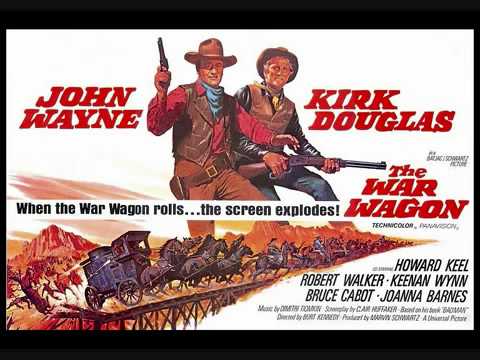
“The War Wagon”

The first thing about the 1967 John Wayne/Kirk Douglas vehicle The War Wagon   (yes, that pun was intentional, thank you)  is that it has o...