Showing posts with label Short. Show all posts

Sunday, 17 February 2019

“Franz Kafka's It's A Wonderful Life”

As a Whovian for whom Peter Capaldi is one of the greatest actors ever to portray the title part on Doctor Who, imagine my surprise and glee when I discovered that Capaldi was also a successful director in his own right; and furthermore, as a fan of Franz Kafka and Frank Capra, imagine my surprise that he had won an Academy Award in 1993 for, well, this. Which, as the icing on the cake, happens to feature great actor (and fellow once-Doctor) Richard E. Grant in the title part of Franz Kafka, which is perhaps the most genius bit of casting I've ever seen in a Kafka movie. 

So how does it hold up, really? Pretty good!


Those accustomed to the endless variations on the “What if you were never born?” sequence of Capra's 1946 picture It's A Wonderful Life will be surprised to note that there isn't really any of that in Capaldi's film; instead, what it takes from the 1946 feature is the general structure of “things are miserable for a self-loathing protagonist who makes it harder on himself, until they are not, as all his gathered friends come together at the end to save both him and the day”. 

What remains is this premise: in a beautifully German-expressionist rendition of Kafka's Czech hometown, the writer is about to begin work on his masterpiece, Die Verwandlung (ye Brits and colonials know this as The Metamorphosis), but can't seem to figure out precisely what it is that Gregor Samsa wakes to find himself transformed into. There are frequent cutaway (as pictured above) to various preposterous options Kafka considers before scrapping them. As the tortured soul tries again and again to fulfill his destiny, and despite the insect imagery constantly staring him in the face, he can't seem to lay a finger on it. What's more, he keeps getting interrupted by various things (a Christmas party going on in the flat below his, a caller come at the wrong address, etc.). 

It is utterly brilliant. 

The thing about Franz Kafka's It's A Wonderful Life is that it's basically the most Kafkayan film I've ever seen, and yes, that includes Orson Welles's outstanding 1962 version of The Trial. Even it didn't quite reach this level of — of — how can I put it? In The Trial, it soon becomes clear that you're in dream logic, with these sprawling vistas of absurdly long corridors and absurdly large halls. In Franz on the other hand, there's nothing explicitly fantastic, or at least, it doesn't seem so until you've finished watching it and reflect back on it. It perfectly channels the weird and unpleasant experience of a bad dream, that cramped feeling, that nagging sensation that none of this is quite right, quite real that you keep mulling over without actually doing anything about it, because you can't. It's what Kafka was a master of turning into words, and Capaldi turned it into film reel. 


And what of the cast? Well, the line of celebrities does not end as Grant & Capaldi, as you'll also recognize Phyllis Logan and Ken Stott in varyingly-incidental parts. But really, a lot of credit must also go to a frightfully young Richard E. Grant, who looks sickly and disturbed without even trying, and without losing the audience's sympathy in the process, which is key to successfully playing a Kafka protagonist. (And to play Franz Kafka in such a picture is to play a Kafka protagonist, since all Kafka protagonists are basically Kafka. The short cleverly spells this point out by having Kafka's neighbors colloquially refer to him as “Mr K.”) This is, perhaps not the part, but certainly one of the parts that Grant was born to play. 

It's also a frightfully witty film, when it's not plunging us in the precise atmosphere of a nightmare; the Capra in its DNA means it has a happy ending and is overall slightly lighter-hearted than a pure Kafka picture, and all the better for it too. I won't spoil too many of the jokes, but perhaps my favorite concerns Franz's timidity about telling the partygoers below to knock it off: after he speaks his mind to the host of said party, the host, who has not lost her smiling demeanor, agrees to yield to his commanding nature, but then asks him “if this is a hypothetical conversation or a real one”. “Hypothetical, of course,” says Kafka. And the host: “Oh, good. Because I'm quite enjoying this party. Goodbye.” She walsk back in, closes the door, and so it's revealed that this scene was all Kafka's fantasy of what he wishes he had the backbone to say. 


Add to this a great visual direction, and music that, while never genius, does its part without distracting for the whole, and you get a real gem of a short film, highly recommended to anyone who enjoys Kafka, Capaldi, Richard E. Grant, or off-kilted filmmaking in general. 

Post-Scriptum:

The underwhelming music aside, I have exactly one (1) issue with the short, and that is that the visual of Samsa-as-Bug we eventually get is pretty bad. Being about pillow-sized, and with spindly long legs, the cockroach-head-thing is nothing like the many-legged pillbug I've always imagined, and nowhere near massive enough. (It is my belief that the creature in which Gregor Samsa was transformed once existed: it is the arthropleura.)

Wednesday, 12 December 2018

“The Dot and the Line”

I love Chuck Jones, and I love animation, and I love obscure, bizarre weirdness.

Hence, this.

From left to right, the Line, the Squiggle and the Dot. 
The Square is not actually anyone in particular, ignore that.

This 1965 MGM-produced Acadamey Award-winner is based on a then three-years-old Norton Juster children's book, and very closely at that, with most of Juster's text making it into Robert Morley's narration (a superior effort as far as child-oriented storytelling goes, both witty and compassionate, right up there with Boris Karloff in Jones's Grinch). 

It's 10 minutes long, which I find very interesting, as I have always regarded 10 minutes theatrical shorts as inherently more sincere than 7- or 6-minutes-long ones. Six or seven minutes was the accepted studio norm; and if you want to go into featurette rather than short, there's a sort of unspoken law that you have to reach 14 minutes at least. Hence 10 minutes is what happens two things coincide; first, the team is really into the short they're making and have a little more material than strictly require; and second, the studio executive is willing to let the team do its thing without griping. Hollywood studio executives being who they are, the second thing is vanishingly rare. 

The story is simple and weird: in an abstract world of sentient geometric shapes, a (male) Line is desperately in love with a (female) Dot. She finds him boring and as literal a stick-in-the-mud as they get, and elects to spend her time with a slovenly Squiggle instead. After some moping about the Line learns to bend himself to create new, complex and intriguing shapes, and comes back to the Dot a virtuoso of contortion with immensely more variety than the Squiggle ever had, and much more control too. The Dot is conquered, and dumps the Squiggle. 


It's a borderline-absurdist, absolutely charming children's fable. The only moral it draws for itself is a fantastic pun (one of several); but it's, of course, ridiculously easy to find all sorts of worthy themes and messages within it if one cares to look. “Adapt and improve yourself to be worthy of who you love.” “You contain multitudes; but you must work to reach them.” “A quiet well-ordered mind contains more potential than all the chaos in the world.” And so on and so forth. Certainly, those who want Meaning in their children's stories won't be disappointed. 

I could find only two flaws in this story and its worldbuilding, and they're not so much flaws as mildly weak points. The first is that despite the claim that there are other Lines, we inexplicably never see any other Dots. The second is a certain moment that, by modern sensibilities, might be taken as somewhat offensive: the Line's passion for the Dot seems unbearably shallow. The one thing the Dot does, personality-wise, is have fun with the Squiggle, and the Line is constantly telling it not to do that. The scene where the Line muses about the way the Dot is perfect to his eyes makes it clear that this perfection is entirely physical and the sole bedrock of his affection. 


But as I thought about it some more, it dawned on me that this isn't an entirely fair criticism. Much of The Dot and the Line's wit lies in double-meaning language which roots itself in the idea that in this geometric cosmos, the mathematical nature of the characters is indistinguishable from their psychic nature. The Squiggle is insubordinate and aimless, the Line is straightforward and rigid. By this metric, to love the shape of the Dot is to love her for her mind, in an abstract way. So I'll let it slide.

At any rate, Chuck Jones's animation is experimental as anything, and it's a hoot. Of course, bringing personality to a simple animated line had been done before, and would be done again, but these three ‘linear’ animation hallmarks all do it in very different ways, and Jones's is the only one that actually feels geometric, if that makes sense. The style of Jones and Maurice Noble's designs had always tended towards the abstract and angular, and one imagines they relished this opportunity to take it to its logical conclusion.

Oh, the animation's not without its flaws; not all of the stiffness can be wholly excused as an artistic choice, for one thing. Also irksome is that any pretense of making the Dot resemble an actual geometrical dot is dropped in favor of making her a disc. Notice how in the above screenshot someone is measuring the width of the Dot, which anybody with a working knowledge of mathematics will tell you is utterly shameful bogus. And as I mocked in the caption of the first picture, the abstract backgrounds occasionally include random shapes which would be fine anywhere else, but, here, can't help but befuddle a viewer who's come to accept that shapes are people in this cartoon's world, and therefore is waiting (in vain) for that square or that triangle to start talking. 

But for every slip-up there's a fantastic color palette, an innovative gag-sequence like the Line's daydreams about being a celebrity, or simply great animation. I particularly like the Squiggle's half-baked attempts to copy the Line's feat, right before it retreats, and the way it shrinks back from the swelling Dot, even if the phrase “swelling dot” is, as I said, anathema to anybody with one ounce of mathematics in them.

For that animation alone, the strange experiment in cartooning that is The Dot and the Line would be worth watching; but the witty writing, great narration, and competent music combined make it a masterpiece and well-deserving of its award. 

Post-Scriptum

Another reason I like The Dot and the Line is because (even though this must largely be coincidental) its style is as close as anything to the masterpiece of absurdist French TV animation, The Shadoks, of which despite the existence of a British dub I can only find one miserable English-language clip online, but I think it's enough to gauge the similarity. 


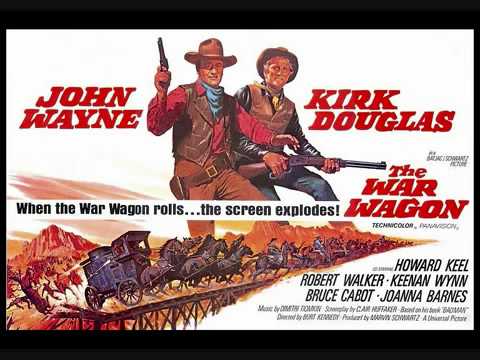
“The War Wagon”

The first thing about the 1967 John Wayne/Kirk Douglas vehicle The War Wagon   (yes, that pun was intentional, thank you)  is that it has o...