Showing posts with label 1960's. Show all posts

Tuesday, 24 December 2019

“The War Wagon”

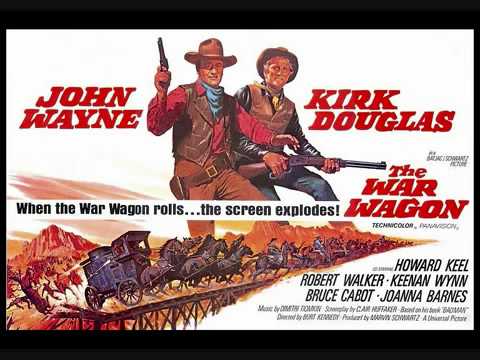
The first thing about the 1967 John Wayne/Kirk Douglas vehicle The War Wagon (yes, that pun was intentional, thank you) is that it has one of the most lovable theme song in movie history. 

The tune is catchy and Ed Ames' voice is warm as can be, which would already make it great, but what makes it so marvelous is that the lyrics are simply the corniest stuff ever — and proud to be. This is a story about the robbery of a wagon full of gold whose theme song's chorus goes “Those men are fighting for a wagon full of gold… Yes, biting and scratching for a WA-GON FULL O'GOOOOLD!”, a movie about a rogue's get-rich-quick plan going awry whose theme song, sung from said character's perspective, proclaims: “Three years in prison made me dream a lotta dreams… Sometimes the dream isn't as easy as it seems!”. And good God I love it. 

But why should I keep prattling about it? You have a listen.


Of course, I wouldn't be writing this review in the way I am if you could get the same experience of the good parts of The War Wagon from a YouTube music video. The movie itself is quite good too, and not just because of Dimitri Tiomkin's soundtrack, though that certainly is a factor. 


Now, the plot concerns former rancher turned ex-convict Taw Jackson returning to his home town to find that the man who sent him to jail on partially-trumped-up charges has taken over his land and is getting rich off a gold mine there. Seeing no other way to get his property back, Jackson gets a gang of rogues together to rob the titular War Wagon, the fearsome armored contraption aboard which the villain, Bruce Cabot's Frank Pierce, has his gold transported. Jackson's plan is… never actually made altogether clear but I gather that he intends to use the gold to get his ranch back in some fashion. At any rate, the real hook of the story, beyond its status as a bog-standard heist flick In The Wild West, is that one of the people Wayne's character is forced to partner up with is Lomax, Kirk Douglas's character. 


Of course, the giddy joy of it is that there is never any doubt that the real story is two of the biggest western movie stars being forced to share top billing. Neither of the characters is entirely virtuous or villainous, so the movie teeters on who's going to come out on top; and for complicated plot reasons Douglas's character spends the entire movie debating whether she should partner up with Wayne's or just shoot him. Feeeel the metaestheticism coursing through your veins! Feel it!

Ostensibly "the question" in such a confrontation or crossover-that-isn't-one (and let's face it, John Wayne  in "Far West shootist" mode was,  for most of his career, basically equivalent to MacisteBlackadder: a single fictional character whom you followed from movie to movie even though he may have a different name and backstory each time; one could, for that matter, argue that Argus McSwine is born of the same mould — so yes, John Wayne Meets Kirk Douglas is very much a "crossover", complete with the usual "they fight then they team up" tradition) is who wins it. It's not the most interesting question, in my opinion. But it is a question, worth addressing if only because everyone, especially the marketing, and up to and including the movie itself, gets it wrong. 

The thing is that in my opinion it is unquestionably Kirk Douglas who wins, is the thing, as far as charisma goes. I love me some John Wayne, but he's not on top form in this particular flick, I think. He has his moment — doesn't he always? — but compared to the sheer vitality of the likably smug rogue played by Douglas, Wayne looks… tired. Underwhelming. 

Yet if you look at the DVD cover and the like, The War Wagon appears to be a John Wayne feature first and a Kirk Douglas feature second; and, of course, the script allows Wayne the last word and the last laugh via the admittedly-hilarious sequence of… well, I won't spoil it here. If anyone's curious, ask me in the comments — but consequently, spoilerphobes beware in said comment section.


The movie is at its best and most vital when Wayne and Douglas are bantering; the rest of the gang are somewhat less interesting, especially Wes Fletcher (Keenan Wynn), who is nothing but an uninteresting walking archetype snarling his way through the picture; even his inevitable betrayal of the good guys is very, very underwhelming. I quite like Howard Keel's cynical Levi Walking Bear, at least, with the usual "couldn't vintage Westerns ever bother to cast actual Native Americans as Native American characters?" caveat. 

As for the plot… the War Wagon itself is a marvelous hook (and a marvelous design), and I am told that casting John Wayne as a robber for once was also intended to be one of this specific film's alluring quirks, though really, if Roger Ebert said, as the Wikipedia page for this film says he did, that the film sees Wayne “play a bad guy for just about the first time in his career”, I don't know what movie he was watching. Taw Jackson breaks the law, sure, but it's all cast in light of that ever-popular John Wayne trope, “I Want My Ranch, That I Built With My Own Two Hands, Back, Please” — more of an empty excuse than ever when the movie doesn't even bother to clarify if, and how, he's going to get it back at the end of the film. It just goes without saying that he will. 

The War Wagon, all in all, is not a perfect film, but it is a hella-entertaining, and occasionally very funny one. I quite recommend it if you like westerns who know how to sell unironically exciting adventure without forgetting to keep a good sense of camp.

Post-Scriptum:
  • Taw Jackson. "Taw." Bit of an odd name, isn't it? But then, I suppose so's "Lomax" (who I'm just now realizing is also denied a first name altogether).
  • I don't want to be too specific about the ending, but it's a bit Treasure of the Sierra Madre, isn't it? Or Don Rosa's Treasure of the Ten Avatars, if you will.
  • I didn't mean for this to be the Christmas review; it's hardly seasonally-appropriate, I know. But I got delayed. Whatever. Merry Christmas and all that!

Monday, 1 July 2019

“Two Rode Together”

John Ford! 1961! James Stewart! Wheee!……


This is 1961's Two Rode Together, a film John Ford made, though I am informed by Wikipedia that he didn't particularly want to, based on a novel by Will Cook adapted for the screen by Frank Nugent. Like many a western, its title doesn't connect to anything in more than a superficial way, and one of the main things you'll notice about it is that it's not as full of "flaring violence" as the above poster would have you believe, not by far. In fact, there isn't really a single action sequence in the whole picture. There's a three-way fistfight, but it's played squarely as a comedy moment. Otherwise, it's just tension all the way down — lots of "shhh!" and pointing guns and calling out bluffs, where no triggers are every pulled. 

Extremely representative of what I mean is how the movie builds up a Comanche warrior called Stone Calf as the athletic bad guy who's obviously going to have to be reckoned with before movie's end, probably after he kills the more level-headed Comanche chief our heroes have been dealing with, allowing for a climactic action sequence… except that buildup pops like a balloon when he tries to attack the protagonists' camp alone and is immediately shot, er, Stone dead, if you'll pardon the turn of phrase. 


The other really surprisingly thing about this film is how dark it is in its preoccupations, and nowhere is this more apparent than in the main character. Marshall Guthrie McCabe is played by James Stewart, except you could not be more wrong if you tried to make assumptions based on that fact, because Stewart is playing (masterfully) against type as a pretty nasty piece of work; one who mellows before movie's end, obviously, but his is a chattier, more openly sarcastic and cynical version of a character more often associated with John Wayne. No, not even that; in any other movie, McCabe would be the villain. When else has the corrupt town marshall who sells weapons to Indians and alcohol to soldiers been the hero in a John Ford movie? Just to stress how unusually despicable Stewart's character is for a hero, Richard Widmark co-stars as a straight-laced, perfectly virtuous co-hero. Mind you, being despicable never stops him from being a charismatic protagonist, because James Stewart is just that good.


Widmark's quite good too, though he's playing much less compellingly unusual a figure. Actually, everyone with a character of any importance is quite good. 

The Comanches are represented… curiously. Stewart's McCabe has a long monologue about how horrible they are, but, of course, it's McCabe, so the movie certainly doesn't seem to agree with all he says (if nothing else, McCabe is simultaneously the guy who trades with the Comanches). On the other hand, Running Wolf is pretty stereotypical and one-note in a way wholly consistent with McCabe's diatribe. So… I don't know. It's certainly not the most progressive portrayal of Native Americans to be found in classic western, let aloen something that could be shown today without public outcry, but it's not distractingly awful or anything, if you keep in mind that McCabe's opinion on things are sour by definition and should not be trusted. 

The Comanches, of course, are not played by actual Native Americans, because they never are. The actors have names like Woody Strode and Henry Brandon. That being said, Strode is an African-American, which is something; and Brandon's casting as Quanah Parker is actually more historically accurate than casting a German-American as a Comanche chief might otherwise be, because Parker was the son of a mixed marriage between a Comanche and a European woman. (Clever, then, to pick him as the voice of the Comanches for this story, considering its premise. The movie never points it out, leaving it as a nugget for the audience to find out or not.)


It is, besides, a stunningly well-made movie, because of course it is. John Ford. I highly recommend it, so long, again, as you're not too bothered by the somewhat schizophrenic portrayl of the Comanches.

Post-Scriptum: 
  • …What the hell kind of name is Stone Calf, anyway?!


Tuesday, 11 June 2019

“Doctor Who and the Dalek Invasion of Earth”

…so the ironic thing is that it'll probably be a while before I watch the actual, televised version of this story, seeing how I've already watched two other takes on the same plot and am getting pretty sick of it. The first version, of course, was the excellent bit of fun that is the Peter Cushing movie, which, in its sole greatest flaw, bears the syntaxically-nightmarish title of Daleks Invasion Earth 2150 A.D.. (All the rights words are there, but it just doesn't………!) 

The second, and subject matter of the present review, is the Terrance Dicks novelization of the same book, from 1977 — well, no, not even that; what I actually got was the 2009 audiobook read by William Russell (Ian Chesterton in the TV series, way, way back) and Nicholas Briggs (the latest and greatest of Dalek voice artists). 

I could recite the plot by heart at this point, but for the benefit of those not currently suffering from Dalek Invasion of Earth overdose: after numerous travels through time and space with 1960's English schoolteachers Ian Chesterton and Barbara Wright, the two runaway Time Lords known as the Doctor and Susan English, respectively, finally manage to land the TARDIS in what appears to be London, where they have been trying to return Ian and Barbara since the second episode. Unfortunately, it soon turns out that this is 22nd century London, and in ruins at that, following many long years of Dalek occupation. 

For indeed, the Daleks, last seen being karmically exterminated by their ancestral enemies the Thals at the end of The Dead Planet, are back with a vengeance. After meeting up with the local resistance, the TARDIS travellers are soon separated and all sorts of things happen as they trudge about the devastated England trying to figure out what the Daleks want on this planet and how to stop them. 

Notable secondary figures in this plot are the laughably-named Robomen, a first draught of the Cybermen (being robotized, emotionless humans) who serve as the Daleks' henchmen; Tyler, a resistance leader who has lost the use of his legs, but not the will to think up a giant bomb with which to rid the planet of the Daleks' filth; and David, a handsome young fighter in the resistance, who develops into Susan's love interest. (In both the televised episode and the audiobook, his last name is Campbell, but I'm told that in the printed version of the novelization, his name was, rather hilariously, David Cameron.) 


So how does it fare? 

Well, for a start, four hours and ten minutes is way too long for this story, which was perfectly condensed as the hour-and-a-half Cushing feature. But that can't really be helped, and I know there is much, much worse (some Doctor Who audiobooks push on 10 hours! Ten blinking hours!). 

As an audio product it's otherwise quite good. William Russell was always a bit too deadpan for my taste as Ian, but he's perfect as a narrator; he doesn't sound much like himself anymore, it must be said, making the times he's reading out Ian's dialogue somewhat eerie; but on the plus side, he's very good at voicing the First Doctor. He's not limiting himself to an impression of his late co-star, not by far; he couldn't do that if he wanted to, because Terrance Dicks took many liberties with the original teleplay when turning it into a novel. 

If nothing else, the Doctor's farewell speech to Susan is very different, and Russell's delivery of it, accordingly, couldn't be further from Hartnell's serene “one day, yes… one day I shall come back”; the corresponding line in the Dicks script (simply “One day, I'll come back!”) is angrier here, as if he's scolding Susan for doubting that he would. 

Aside from the weirdness inherent in an old man voicing Barbara or Susan, there is one weird bit that doesn't quite work, though; the Robomen's voices are described by Dicks as “slurred”, and Russell took that, I think, a bit too much to heart. They don't sound like zombies, they sound drunk

Meanwhile, Nicholas Briggs is predictably awesome as the various Daleks, bringing his full range into it, bless him; it's not that the original voices were bad (1960's Dalek voices, whether on the small or big screen, are the best non-Briggs Dalek voices, in my opinion), but Briggs is an outright wizard. At the drop of a hat, he is the Daleks, and that is because he gets them; as he has explained, when he voices the Daleks, he's not voicing emotionless robots, he's voicing three-dimensional people — it's just that those people happen to be inordinately awful, perpatually-angry little people. Hence he is convincingly confused or vainglorious or angry, without ever forgetting the all encompassing irrational hatefulness lurking beneath their every dark throught. 

The sound design is great; the music, where there is some, is fitting, though a bit forgettable; it's certainly no patch on Bill McGuffie's fantastic score to the Peter Cushing film, which contains, among other things, a marvelously energetic theme song, and one of my favorite pieces of movie music ever, Fugue For Thought


What of the script? Well, it does what it can with the meandering plot; certainly it conveys the apocalyptic scope quite well, and while no character is particularly deep, they're all believable people. Dicks is inordinately good at setting up moods, better than he is at thinking up people; thus things are creepy when they need to be, or majestic, or tense, or thrilling. The opening line “Through the ruin of a city stalked the ruin of a man” is justifiedly famous. 

The story itself, for which, of course, we cannot blame Dicks, is as I said needlessly meandering and needlessly reliant on Susan twisting her ankle at convenient times of the plot, but the sheer fun of a premise like “the Daleks have taken over the Earth” usually makes up for it, and the worldbuilding of what life is like under the Daleks for the resistance forces and for the mining slaves is actually quite well-thought-out. 

Dicks is quite good at foreshadowing the Susan/David romance, but not so much the Doctor's decision to leave her to live with him. The way the televised story made a story arc out of the Doctor's slow realization that she wasn't his little girl any more may have been a bit ungraceful at times (“jolly good smack-bottom” indeed), but it was something; here there is no trace of it; we spend most of the story with no insight into the Doctor's view of Susan, nor any signs that he's getting on in years in a way that would justify her determination that she needs to stay with him to take care of him. Then suddenly, we're told (in quite a hamfisted fashion) by David that “he knew all along”. Well, okay, jolly good, why shouldn't he have? What have we discovered exactly? 

Oh, and another failing, simultaneously very small and quite major: Dicks made the very questionable decision to refer to the mining-cart in which Ian gets trapped for most of the climax as a “giant bucket”. It is much, much harder than anyone in the production expected to take seriously the travails of a man trapped in what an old British actor keeps calling a “giant bucket” with the utmost seriousness. 


All in all, I enjoyed Doctor Who and the Dalek Invasion of Earth, but if you're not a dedicated Who fan, there are probably much quicker, much funnier ways to experience the story, starting with the Cushing film. (Unless, of course, you are visually impaired, in which case, yes, I'm not an expert, but this seems like a pretty fun audiobook.)

Post-Scriptum:
  • An oft-repeated bit of trivia that non-Whovians in the audience may not be aware of: the cover of the novelization, here reused for the CD jacket, was drawn with the Peter Cushing flick as a reference, rather than the TV episode; as a result, the Dalek spaceship is modeled on that in the film rather than the one in the episode itself. Though it's endlessly cut that the Daleks are the only A-list aliens in popular culture who genuinely, unironically use flying saucers as their primary mode of transportation, there's no denying that the hovership in question is a much more interesting bit of design-work. 
  • Also about the CD jacket: that Roboman, from this angle, looks fainty like he's about to ask me if I'm his mummy. 


Saturday, 2 March 2019

“The Woes of a Shopping Supervillain”

So is this the “much better Disney comic than My Second Million” that I mentioned in that review? Eh… maybe. To be honest, when I wrote that promise into the post, I had made a resolve to review some good Disney comic, just to wash the foul taste off my mouth; I didn't have any particular story in mind. This will do. (The title is mine, and more of a placeholder than anything else. I know it's not that good, okay? Still, it, too, will do. …I have to think up a lot of these not-too-awful titles when I create pages for untitled stories on the $crooge McDuck Wiki, so let's all hope I'm not too terrible at it as I feel like I am.)

This is, more than anything else, a reaction to GeoX's year-and-a-half-years-old review of Romano Scarpa's The Blot's Double Mystery, where he contrasted Scarpa's “dignified” treatment of Merril De Marris and Floyd Gottfredson's hooded mastermind with the supposedly slapdash, devil-may-care attitude of American comics in the same period. To this end, he called up this one-pager. 


Now, that one-pager is, yes, freaking awful for a Phantom Blot story. The Blot is supposed to be a sinister criminal mastermind with inscrutable motives. None of that comes across above; the joke would be fine with most any other Disney comic villain (though it would work best, in my opinion, if it was Pete trying to imitate Mickey), but A), the Blot is not some insecure shmuck who'd have to prove ot himself that he can whirl a lasso as well as a random cowboy just because he came across said cowboy in the street; B), the Blot is scarily competent at everything he does, and it goes against everything that makes him memorable for him to be done in by his own clumsiness. 

But I think GeoX cherry-picked his example very egregiously. First, it's kind of sneaky to pick an inside-cover one-pager, since even Carl Barks's Scrooge inside-cover-one-pagers often do things with everyone's favorite feathered plutocrat that don't quite gel with his usual characterization. But even setting that aside… sure, few of the vintage American PB comics were masterpieces, but they were usually much better than this. 

Therefore I call to the stand another more-or-less-randomly-selected PB one-pager (this is from Issue 6 of his solo comic series from the 1960's). 


First things first, it's funny; certainly funnier than the earlier story, because the moment you bring a lasso into a slapstick one-pager, you kinda know what's gonna happen, whereas here—testing pens? Huh? The page really can keep you guessing. So the punchline works more smoothly. 

And it also demonstrates a much better grasp of the Blot and his personal mythos: the conceit of the gag is in fact to wonder precisely how it is that the Blot produces those splotches of ink that form his calling card, since getting a pen to blot in real life on purpose isn't all that easy. Though I imagine it might be somewhat funny, in an absurd way, to someone who only knows that the Phantom Blot's nickname is “the Blot”, it really draws most of its comic effect from knowledge of the Blot's calling card, which isn't restated here. Therefore, hurrah for continuity! 

Furthermore, while the Blot's peculiar manners are essential to the comedy, this doesn't come at the cost of making him bumbling and incompetent, as in the previous one-pager — though it'd be a stretch to call his presence here “threatening”. After all, his demand seems incomprehensible to the salesperson above, but it's not actually stupid or insane from the reader's point of view, since we know precisely why the Blot would need such a thing. So, hurrah again, this time for not making your criminal mastermind an idiot!

Add to this some lovely art from Paul Murry (I.N.D.U.C.K.S. sadly does not know who wrote the thing), and you have proof positive that even in comedic one-pagers, the Americans of yore absolutely could get the Blot right and maintain his dignity. I'll grant you that Darkenblot or The Big Fall, this is not. But that doesn't mean it's not a lot of fun to read. 

Post-Scriptum: 
  • Reading this, I come to realize how good a pastiche Joe Torcivia's childhood-fancomic-turned-background-gag, where the Blot, robbing a museum, ended up lingering too long in front of an exhibit of Victorian Ink Blots and getting nabbed by Chief O'Hara as a result, and which he imagined as another inside-cover one-pager for The Phantom Blot, would have been. It was already a pretty neat gag in itself, but further kudos still, Joe!
  • Did you notice the saleswoman is a human? Albeit a four-fingered one. You rarely see those in Mouse Disney comic, unless they're a “crossover character” like Madam Mim or Grimhilde. 
  • Why yes, the above coloring of the (originally black-and-white) one-pager is by me. Never say I am not devoted to giving the readers of this blog a thorough, lush artistic experience. 

Wednesday, 12 December 2018

“The Dot and the Line”

I love Chuck Jones, and I love animation, and I love obscure, bizarre weirdness.

Hence, this.

From left to right, the Line, the Squiggle and the Dot. 
The Square is not actually anyone in particular, ignore that.

This 1965 MGM-produced Acadamey Award-winner is based on a then three-years-old Norton Juster children's book, and very closely at that, with most of Juster's text making it into Robert Morley's narration (a superior effort as far as child-oriented storytelling goes, both witty and compassionate, right up there with Boris Karloff in Jones's Grinch). 

It's 10 minutes long, which I find very interesting, as I have always regarded 10 minutes theatrical shorts as inherently more sincere than 7- or 6-minutes-long ones. Six or seven minutes was the accepted studio norm; and if you want to go into featurette rather than short, there's a sort of unspoken law that you have to reach 14 minutes at least. Hence 10 minutes is what happens two things coincide; first, the team is really into the short they're making and have a little more material than strictly require; and second, the studio executive is willing to let the team do its thing without griping. Hollywood studio executives being who they are, the second thing is vanishingly rare. 

The story is simple and weird: in an abstract world of sentient geometric shapes, a (male) Line is desperately in love with a (female) Dot. She finds him boring and as literal a stick-in-the-mud as they get, and elects to spend her time with a slovenly Squiggle instead. After some moping about the Line learns to bend himself to create new, complex and intriguing shapes, and comes back to the Dot a virtuoso of contortion with immensely more variety than the Squiggle ever had, and much more control too. The Dot is conquered, and dumps the Squiggle. 


It's a borderline-absurdist, absolutely charming children's fable. The only moral it draws for itself is a fantastic pun (one of several); but it's, of course, ridiculously easy to find all sorts of worthy themes and messages within it if one cares to look. “Adapt and improve yourself to be worthy of who you love.” “You contain multitudes; but you must work to reach them.” “A quiet well-ordered mind contains more potential than all the chaos in the world.” And so on and so forth. Certainly, those who want Meaning in their children's stories won't be disappointed. 

I could find only two flaws in this story and its worldbuilding, and they're not so much flaws as mildly weak points. The first is that despite the claim that there are other Lines, we inexplicably never see any other Dots. The second is a certain moment that, by modern sensibilities, might be taken as somewhat offensive: the Line's passion for the Dot seems unbearably shallow. The one thing the Dot does, personality-wise, is have fun with the Squiggle, and the Line is constantly telling it not to do that. The scene where the Line muses about the way the Dot is perfect to his eyes makes it clear that this perfection is entirely physical and the sole bedrock of his affection. 


But as I thought about it some more, it dawned on me that this isn't an entirely fair criticism. Much of The Dot and the Line's wit lies in double-meaning language which roots itself in the idea that in this geometric cosmos, the mathematical nature of the characters is indistinguishable from their psychic nature. The Squiggle is insubordinate and aimless, the Line is straightforward and rigid. By this metric, to love the shape of the Dot is to love her for her mind, in an abstract way. So I'll let it slide.

At any rate, Chuck Jones's animation is experimental as anything, and it's a hoot. Of course, bringing personality to a simple animated line had been done before, and would be done again, but these three ‘linear’ animation hallmarks all do it in very different ways, and Jones's is the only one that actually feels geometric, if that makes sense. The style of Jones and Maurice Noble's designs had always tended towards the abstract and angular, and one imagines they relished this opportunity to take it to its logical conclusion.

Oh, the animation's not without its flaws; not all of the stiffness can be wholly excused as an artistic choice, for one thing. Also irksome is that any pretense of making the Dot resemble an actual geometrical dot is dropped in favor of making her a disc. Notice how in the above screenshot someone is measuring the width of the Dot, which anybody with a working knowledge of mathematics will tell you is utterly shameful bogus. And as I mocked in the caption of the first picture, the abstract backgrounds occasionally include random shapes which would be fine anywhere else, but, here, can't help but befuddle a viewer who's come to accept that shapes are people in this cartoon's world, and therefore is waiting (in vain) for that square or that triangle to start talking. 

But for every slip-up there's a fantastic color palette, an innovative gag-sequence like the Line's daydreams about being a celebrity, or simply great animation. I particularly like the Squiggle's half-baked attempts to copy the Line's feat, right before it retreats, and the way it shrinks back from the swelling Dot, even if the phrase “swelling dot” is, as I said, anathema to anybody with one ounce of mathematics in them.

For that animation alone, the strange experiment in cartooning that is The Dot and the Line would be worth watching; but the witty writing, great narration, and competent music combined make it a masterpiece and well-deserving of its award. 

Post-Scriptum

Another reason I like The Dot and the Line is because (even though this must largely be coincidental) its style is as close as anything to the masterpiece of absurdist French TV animation, The Shadoks, of which despite the existence of a British dub I can only find one miserable English-language clip online, but I think it's enough to gauge the similarity. 


Saturday, 3 November 2018

“The Loves of Hercules”

I love 1950's/1960's sword-and-sandal films (or, as they are picturesquely known in French, peplums). They are the most formulaic nonsense ever put to screen, but in a wholesome, very entertaining way. 


1960's The Loves of Hercules — a Franco-Italian coproduction most notable for starring Jayne Mansfield as Queen Deianira and her husband Miklòs "Mickey" "Mr Universe" Hargitay as Ancient Times' greatest strongman — is no exception. 

It hits nearly all the beats that I have come to know from other Hercules and Maciste films of the era: the Amazons and their beguiling Queen with an interest in the hero; a lead with as much character as the lump of wood he uses to crush his foes; colorful physical feats; a Queen who longs for love; an evil advisor thereof, seeking power; an uprising against the usurper; a few encounters with random monsters; and, most infuriatingly, the same plot-thread I keep seeing over and over of the evil Amazon (or something) Queen who kills/petrifies/eats/whatever all her lovers and takes an interest in the hero who is temporarily bewitched until he snaps out of it. 

Also, honorable mentions to "mashing together bits and pieces of various connected myths in a way that makes little to no sense", and to "the American dub feels free to rewrite part of the story, why not?" (American may be surprised to learn that Hercules does not in fact visit the Underworld in the original version; the place with the sulphur clouds is just a random canyon). 

So what's to like about this one? 


It's nicely shot, for one thing, and as always, the cast are solid with the exception of the bland-as-gruel Hercules. Jayne Mansfield, here and elsewhere, mercifully does far more than looking pretty for the camera — she was a genuine, and not-untalented, actress, and the difference between her portrayl of the real Deianira and of Hippolyta magically impersonating her makes that clear enough. 

The monsters encountered along the way are also pretty creative. There's a great atmosphere in the Forest of the Dead, and the lovers-turned-trees are a surprisingly haunting creation, albethey this film's take on that "preying-mantis Queen" trope that just refused to die in those days. The Ape-Man at the end is… introduced without any explanation of why we shouldn't be surprised to find an Ape-Man in Ancient Greece (there's a similar thing in Hercules/Maciste Versus the Moon Men, so I presume this was just "a thing" at the time, for some reason), but he has hints of the strange tragedy of King Kong in his breif appearance, and the make-up, while admittedly the fakest thing ever, is also kind of arresting. 

Don't you feel sorry for this poor hirsute chap? Just a little?

Next up… oh, I'm sorry, did I call the Ape-Man the fakest thing in the movie? How could I forget the briefly-appearing Hydra who, for reasons yet to be determined by science, gave its name to the movie in some countries? 


This film's Hydra is what I assume everyone must have thought was an awesome animatronic (its eyes glow and lbik! It breathes fire!), but the truth is, in any but the widest and foggiest shots, it just looks like a big, painted, carboard-covered machine. Which it is. Its claws are also not in any way articulated, leaving the poor stuntman to struggle under its paws, trying its very best to make you believe that the monster is grabbing him — like something out of an Ed Wood film. 

Yet it is certainly memorable. The design gave up on trying to look real, but it still managed to be impressive and creative (certainly, there's a sense of gigantism to this Hydra that is rarely evoked by other movie versions of the beast), and the sound design in the scene must be praised. That howling is not easily forgotten. 

One thing I can't quite forgive the movie for, however, is that they kind of got the concept of the Hydra backwards. Hercules, through the use of a woodsman'saxe he seemingly conjures out of his own personal Hammerspace, chops off one of its heads… and that's… enough to kill it. No "two more heads grow up when you cut one off", not even a "you have to kill all the heads". Whuh? 

Mind, there's a surprisingly atmospheric shots later of the Hydra's still carcass that almost makes you forget its underwhelming demise. So that's something. 


Okay, let's talk villains. I love me a good villain, and Massimo Serato's Licos brushes with greatness, in the “so obviously evil let's not even pretend I'm not a cartoon villain” category. He looks and acts in such hilariously, obviously villainous way that you can't help but love the character. Yet he does not cackle or revel in his power — if you're in for that sort of thing, there's some darker, more tragic depth to Licos, even if it is but barely explored; he mentions having “given up on love long ago” to pursue only power, and it's up to anyone's imagination what might have prompted this drastic choice. 

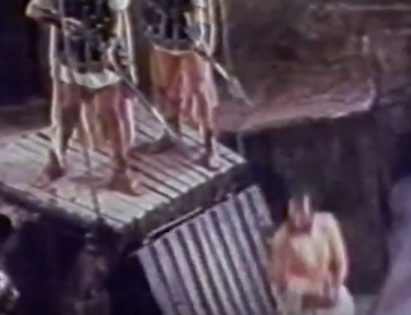
Like all great sword-and-sandal villains, he also owns a designated death trap, though unlike Hippolyta (who, spoiler, dies strangled by one of her own cursed trees), he does not die by it. It's pretty cool. A bridge above a sulphur bit on which the victim is made to stand and can be opened inwards, letting the poor victim plummet to their doom. It is extremely reminiscent of the more modern bridge used by the king of all evil masterminds, Ernst Stavro Blofeld, in You Only Live Twice. The sulphur pit is put to good use in the climactic battle, incidentally — it's an impressive set on multiple levels and has all sorts of interesting staging possibilities. 


“A bridge? Is that the best you can doOOOOWAAAAHHHRGH----”


And over 2000 years later… 
“A brdge? Please! The other guy had a laser, a nuclear bomb
to blow up Fort Knox, and a decapitating hat, is that really
the best you canaaaAAAAAHOHGODNO---”


I have little to say about it, but I feel like I should mention Carlo Innocenzi's composition, too. Italian sword-and-sandal films's scores are rarely bad, but there is a tendency for them to be forgettable orchestral sludge with little character or theme, good enough to accompany the action, but hardly something you'd listen to for its own merits. Not so here. Innocenzi's frequent use of minor-key and a chorus brings a real character to this score. 

Oh, and we must have our trivia-focused Post-Scriptum once again:

  • One, what is up with this poster? 


          Looks to me like someone didn't get the memo that clean-shaven Mickey Hargitay was playing  
          Hercules, and just drew Steve Reeves again. 

  • Two, am I the only one who thinks Maga the Enchantress looks exactly like Docto Who's Ohila? If there's any relationship it must, of course, be the other way around, but it's striking either way. Just look at'em. Twins, I tellsja. 

(Has Steven Moffat seen this film?)


  • And three, a question. The opening credits proclaim that one “Sandrine” (no last name given) plays some significant part in the movie. You may recognize this sort of crediting as the way pop-singers are usually credited when they try out acting, and I presumed Sandrine must be some French or Italian 1960's singer long forgotten. But who does she play? imdb has no friggin' clue. The following screencap is not edited, there's genuinely just a blank. 

Me = confused. 

Friday, 26 October 2018

“Topaz”

What do you get when you make a spy thriller that's about actual spies?

This is the question which Alfred Hitchcock set out to answer in 1969, with the world's craziest schedule and a novel by Leon Uris as his sole weapons. Long story short, Topaz is the tale of a French spy who discovers that the Russians are keeping some suspiciously missile-shaped objects in Cuba, and then uncovers Russian spies within his own government. 


Although I am, perhaps, giving the film too much credit to say that it is "the tale" of anything. By the dual virtue of striving to for once follow real spying events rather than the ravings of Ian Fleming, and of having been written on the cuff of the actors' shirts a few minutes past the studio deadline, Topaz isn't so much one film as three ones of approximately 50 minutes each, which each get a set-up and a conclusion before we move on to the next one. Disney's Atlantis II: Milo's Return is the last movie you'd expect to be reminded of when watching a 1960's Hitchcock film, but it was the only thing I could think of. 

First, you have the story of Philippe Dubois getting a document from the Cuban embassy in New York; then, you have the story of André Devereaux's adventures in Cuba proper and his doomed love with Juanita; then, you have the story of Devereaux unmasking the mole(s) in the French secret service. 

Due, I am given to understand, to Leon Uris taking the events too seriously to let Hitchcock add any of his macabre humor to the proceedings, none of the three stories are among Hitch's best; if we're talking anti-U.S.S.R. flicks from the 60's, give me Torn Curtain anyday. And the character arc of André's wife Nicole is a mess — first she's the enamored wife who wants André to retire from his dangerous work so he can be with her, then she's… having an affair with… the villain? But then by the end of the film she and André are together again with no fanre? Huh? …But they're fine. If nothing else, they succeed at giving a somewhat realistic Hollywood look at Cold War-era spywork, which is a welcome change from your standard James Bond fare. 

The actors are a mixed bag. Frederick Stafford as our hero André has a knack for "constant poker-face" that would make a great spy, but makes for a poor actor, especially where the romantic subplots are concerned. It's easy to see how he got the part (the man looks like a hybrid of Timothy Dalton ands Roger Moore: of course you want him as your spy and yes I am aware neither of those had yet been cast as 007, but I'm just saying). But he is just. So. Wooden.


John Vernon delivers a fine performance as Rico-Parra-Totally-Not-Che-Guevara, a Cuban envoy to New York whose part of the film ends on a surprisingly tragic note — but in truth, what works here doesn't take much skill — look equal parts stoic and intimidating, and you've got it. Karin Dor opposite him as Juanita de Cordoba plays her character quite well, but her character, as it happens, is even more patently a tragic figure, who feels like she belongs in another movie entirely, and that kind of bothered me throughout her part of the film. 

Philippe Noiret (as the aforementioned Russian spy Henri Jarré) and the improbably-named Per-Axel Arosenius (as K.G.B. defector Boris Kusenov) are both highlights whenever they appear, but have too little a part in this wooly-mammoth of a picture to save it all on thier own. John Forsythe plays the American agent Michael Nordstrom very by-the-book (entirely fine for what he is, but nothing to remember him by). 


A surprisingly enjoyable side-character was Shakespearean actor Roscoe Lee Browne as Philippe Dubois, one of André's agents in New York, who handles the obtention of the secret documents from the Cuban embassy in the first of the three films-in-the-film. You wouldn't think so to look at the man when he's first introduced, a florist in a preposterous yellow jacket, but his brief stint as the movie's protagonist proves he is everything you want from the hero in a spy film, much moreso than Stafford's André. I'd seriously have watched the heck out of a Persuaders-style TV series about The Florist, played by Browne, with a recast André as his very own “M” or “Judge Fulton”.

Claude Jade as André's daughter is sure to disappoint any fans of hers who watched the movie for her sake, not because she does anything wrong, but because she doesn't really do anything. She's in and out of the film almost as quickly as Alfred Hitchcock himself, whose cameo is easy-to-miss but probably the only real joke in the movie (and it's a good one, too). 

As for Michel Piccoli as Jacques Granville/Colombine, his exterior fame and how high he is in the credits make me feel like I ought to have something to say about him, but I really don't. He's just sort of there. The movie throws out as the last second, when we already know he's the traitor, that, oh, André's wife is having an affair with him, and, oh, he was old friends with André in the Résistance, and goddammit why didn't you tell us that earlier?! 

What's more, I am told by Wikipedia that he was robbed of his last chance to redeem his character, a final duel between him and André in a soccer stadium. (Why a soccer stadium? I don't know! Why do you ask me these things?!) It would have been somewhat out-of-place considering how late his significance was introduced, but it would have given Piccoli a chance to do something.

Mind, I don't disagree with the motives for cutting the aforementioned duel, namely, that the film was way too long. At 125 minutes it is already way longer than it can afford from people's attention-spans, and I can't imagine what sort of disaster the 147-minute-long original cut would have been. 

So… mixed-to-negative, is my final impression. One of Hitchcock's few earnest misfires. It's not a bad film, really, if you forget whose name is attached to it, but even without Hitchcock's other masterpieces to take into account, it would be very, very hard to argue that this is a good film. 

Post-Scriptum

Someone tell me, what is wrong with Uribe's glasses? I was waiting and waiting for someone to address it, but, no. The chap just… wears his glasses sideways. Whuh?


Thursday, 18 October 2018

“The Case of the Sinister Robot”

And our mystery Disney comic is The Case of the Sinister Robot!

Told ya you wouldn't guess.


Also known as W MM 113-02 to the alien tome of eldritch lore that is the INDUCKS database, The Case of the Sinister Robot is a 1967 story from Walt Disney's Mickey Mouse #113, reprinted in #202 of the same. History has forgotten the name of its writer, as it often does when that writer wasn't someone people care about (like Carl Barks) or someone too blinkin' weird to ever be confused with anyone else (like Vic Lockman). 

The story is extremely obscure, as are most 1960's Mickey Mouse stories, especially those not drawn by Paul Murry, which is extremely unfair; nothing against Murry, individually, but Strobl here does just as good in his own style. I stumbled upon it (get used to that phrase, I “stumbled upon” most of the stuff I'm going to be reviewing here) quite recently and found it quite delightful. It's very 1960's, very goofy, but also a compelling sci-fi story in its own right. 

The best way I can describe it is, its plot is a house of cards standing on a table of clichés, but heck, are the cards pretty. 

The introduction sets up a nice and looney mystery as Mouseton is wracked by all mechanical devices going nuts. 


This culminates in gravity itself failing, and Mickey, Goofy and Chief O'Hara wading to the Mayor's office like astronauts in space. (Most puzzling is the Chief's line that he thought Mickey might know what's going on — Mickey solves the crazy occurrences, but he's rarely behind them…) 

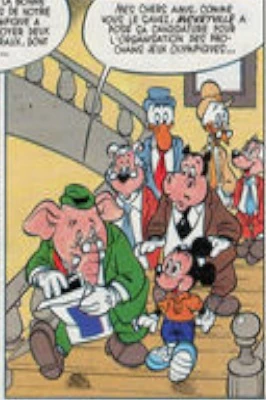
The Mayor himself is not characterized very strongly — but then, he never is — the most you can say about the Mayor of Mouseton as a character is that he was a pink elephant for some reason in a couple of 1980's stories. Duckburg's Pig-Mayor, he is not. But while the Mayor himself is just a random mustached dognose, we do get a very amusing picture of the scientists and authorities he has gathered to solve the problem, where both the unknown writer's dialogue, and Strobl's art, really shine. 


Who would dare to look at that panel and call Strobl a "mediocre cartoonist" (which seems to be everyone's unspoken opinion of him, if they have one at all)? Props, also, to the coloring department. Not always the most competent lot at the time, and they do inexplicably dye Chief O'Hara's hair brown here, but the choice of colors for the costumes of the scientist flows very well, and the reddish-brown mustache for Mustache Guy in the middle is perfect

I mentioned Unknown Writer earlier, and again, what a shame it is that we don't know who that guy was. This story's premise is amusing enough, but it's the execution that makes it shine: "machines going backwards" could be played by-the-book with no particular punch, but the fast pacing allows it to really hit its mark. I did not expect to laugh out loud at an American, 1960's Mickey Mouse comic book, but Unknown Writer proved me wrong. 


And at the same time, he develops a good mystery. It begins with not-Doctor-Syclocks here, mysteriously unaffected by the anti-gravity ray, who manages to shake off Mickey and the police…


…features the input of Shamrock Bones (a character who was funnier in theory than in practice, I often find, but here he doesn't overstay his welcome)…

(I dig the orange-and-green colors cheme for his checkered suit. Much more memorable than the usual Sherlock-Holme-brown. Also, notice: "peformed" instead of "performed". It's a credit to Disney comics that this is the only time I ever saw a blatant typo in a Disney speech balloon.)

…and leads our heroes to the Mouseton City Dump, where the sci-fi portion of the story begins in earnest as a mysterious energy being absorbs surrounding junk and builds itself a robot body out of it. 

(…) 

The glowing-ball-of-energy form is cool, and never really explained; as for Kettlehead the Robot itself, it looks very distinctive, as do all the other robots in the story. 

After another rather cool bit where the entrance to the villain's typically 1960's, stainless-steel underground lair is inside a wrecked old car, Mickey and Goofy begin to look for the mad scientist behind the whole scheme, and finds that there isn't one. Instead, our antagonist is a robot himself, bearing the delightfully nonsensical name of “X - Y + 2”. Wounded in his honor after he was retired due to his computational system being faulty, X-Minus has turned his genius to the task of repurposing all human technology, driving all of mankind to madness. He then plans to take over. 

X-Minus is not actually the most interestingly-designed robot in the lair — it's telling that the cover for the story features his minion “0 = 4X”, and not himself — but he's very well-characterised. He's both clearly an insane robot, and a character rather than a mere bogeyman. 


(You have to admire how 0 = 4X is entirely about to disintegrate them, then Mickey says "you can't! that's murder!", and the robots just… opine and desist from any murderous intent. It's funny for how unexpected it is, and on top of that, it actually makes sense if you stop and ponder it. After all, we all know the Three Laws of Robotics ought to prevent our antagonistic androids from actually planning to destroy anyone — and we know that X-Minus is broken — so I propose that it seemed like a right plan to him because it genuinely did not register for him that disintegrating people was murder until Mickey pointed it out; at which point he remembered his programming and thought of something else.) 

I won't spoil it here, but the reveal of the Mysterious Not-Doctor-Syclocks from earlier is also very clever and creative, and something I don't think I've ever seen done with another fictional robot, so points for that. The final fate of X-Minus is also not bad, though the denouement in general feels a bit rushed. 

Oh, one also has to love X-Minus's "last words" before he's powered down:

(Said every ‘Doctor Who’ villain ever. Or they should)

And there you have it. 

The Case of the Sinister Robot seriously has all the qualities of the classic Gottfredson, Scarpa or Casty formula for a Mickey story: wacky goings-on - compelling mystery - interesting sci-fi concept behind it - snappy humor. Seriously, find a used copy or something, and give the thing a read. 

I don't care what preconceptions you may have about a 1967, Tony Strobl-drawn Mickey Mouse story. Read it. I promise you won't regret it. 

“The War Wagon”

The first thing about the 1967 John Wayne/Kirk Douglas vehicle The War Wagon   (yes, that pun was intentional, thank you)  is that it has o...