Showing posts with label Terrance Dicks. Show all posts

Tuesday, 11 June 2019

“Doctor Who and the Dalek Invasion of Earth”

…so the ironic thing is that it'll probably be a while before I watch the actual, televised version of this story, seeing how I've already watched two other takes on the same plot and am getting pretty sick of it. The first version, of course, was the excellent bit of fun that is the Peter Cushing movie, which, in its sole greatest flaw, bears the syntaxically-nightmarish title of Daleks Invasion Earth 2150 A.D.. (All the rights words are there, but it just doesn't………!) 

The second, and subject matter of the present review, is the Terrance Dicks novelization of the same book, from 1977 — well, no, not even that; what I actually got was the 2009 audiobook read by William Russell (Ian Chesterton in the TV series, way, way back) and Nicholas Briggs (the latest and greatest of Dalek voice artists). 

I could recite the plot by heart at this point, but for the benefit of those not currently suffering from Dalek Invasion of Earth overdose: after numerous travels through time and space with 1960's English schoolteachers Ian Chesterton and Barbara Wright, the two runaway Time Lords known as the Doctor and Susan English, respectively, finally manage to land the TARDIS in what appears to be London, where they have been trying to return Ian and Barbara since the second episode. Unfortunately, it soon turns out that this is 22nd century London, and in ruins at that, following many long years of Dalek occupation. 

For indeed, the Daleks, last seen being karmically exterminated by their ancestral enemies the Thals at the end of The Dead Planet, are back with a vengeance. After meeting up with the local resistance, the TARDIS travellers are soon separated and all sorts of things happen as they trudge about the devastated England trying to figure out what the Daleks want on this planet and how to stop them. 

Notable secondary figures in this plot are the laughably-named Robomen, a first draught of the Cybermen (being robotized, emotionless humans) who serve as the Daleks' henchmen; Tyler, a resistance leader who has lost the use of his legs, but not the will to think up a giant bomb with which to rid the planet of the Daleks' filth; and David, a handsome young fighter in the resistance, who develops into Susan's love interest. (In both the televised episode and the audiobook, his last name is Campbell, but I'm told that in the printed version of the novelization, his name was, rather hilariously, David Cameron.) 


So how does it fare? 

Well, for a start, four hours and ten minutes is way too long for this story, which was perfectly condensed as the hour-and-a-half Cushing feature. But that can't really be helped, and I know there is much, much worse (some Doctor Who audiobooks push on 10 hours! Ten blinking hours!). 

As an audio product it's otherwise quite good. William Russell was always a bit too deadpan for my taste as Ian, but he's perfect as a narrator; he doesn't sound much like himself anymore, it must be said, making the times he's reading out Ian's dialogue somewhat eerie; but on the plus side, he's very good at voicing the First Doctor. He's not limiting himself to an impression of his late co-star, not by far; he couldn't do that if he wanted to, because Terrance Dicks took many liberties with the original teleplay when turning it into a novel. 

If nothing else, the Doctor's farewell speech to Susan is very different, and Russell's delivery of it, accordingly, couldn't be further from Hartnell's serene “one day, yes… one day I shall come back”; the corresponding line in the Dicks script (simply “One day, I'll come back!”) is angrier here, as if he's scolding Susan for doubting that he would. 

Aside from the weirdness inherent in an old man voicing Barbara or Susan, there is one weird bit that doesn't quite work, though; the Robomen's voices are described by Dicks as “slurred”, and Russell took that, I think, a bit too much to heart. They don't sound like zombies, they sound drunk

Meanwhile, Nicholas Briggs is predictably awesome as the various Daleks, bringing his full range into it, bless him; it's not that the original voices were bad (1960's Dalek voices, whether on the small or big screen, are the best non-Briggs Dalek voices, in my opinion), but Briggs is an outright wizard. At the drop of a hat, he is the Daleks, and that is because he gets them; as he has explained, when he voices the Daleks, he's not voicing emotionless robots, he's voicing three-dimensional people — it's just that those people happen to be inordinately awful, perpatually-angry little people. Hence he is convincingly confused or vainglorious or angry, without ever forgetting the all encompassing irrational hatefulness lurking beneath their every dark throught. 

The sound design is great; the music, where there is some, is fitting, though a bit forgettable; it's certainly no patch on Bill McGuffie's fantastic score to the Peter Cushing film, which contains, among other things, a marvelously energetic theme song, and one of my favorite pieces of movie music ever, Fugue For Thought


What of the script? Well, it does what it can with the meandering plot; certainly it conveys the apocalyptic scope quite well, and while no character is particularly deep, they're all believable people. Dicks is inordinately good at setting up moods, better than he is at thinking up people; thus things are creepy when they need to be, or majestic, or tense, or thrilling. The opening line “Through the ruin of a city stalked the ruin of a man” is justifiedly famous. 

The story itself, for which, of course, we cannot blame Dicks, is as I said needlessly meandering and needlessly reliant on Susan twisting her ankle at convenient times of the plot, but the sheer fun of a premise like “the Daleks have taken over the Earth” usually makes up for it, and the worldbuilding of what life is like under the Daleks for the resistance forces and for the mining slaves is actually quite well-thought-out. 

Dicks is quite good at foreshadowing the Susan/David romance, but not so much the Doctor's decision to leave her to live with him. The way the televised story made a story arc out of the Doctor's slow realization that she wasn't his little girl any more may have been a bit ungraceful at times (“jolly good smack-bottom” indeed), but it was something; here there is no trace of it; we spend most of the story with no insight into the Doctor's view of Susan, nor any signs that he's getting on in years in a way that would justify her determination that she needs to stay with him to take care of him. Then suddenly, we're told (in quite a hamfisted fashion) by David that “he knew all along”. Well, okay, jolly good, why shouldn't he have? What have we discovered exactly? 

Oh, and another failing, simultaneously very small and quite major: Dicks made the very questionable decision to refer to the mining-cart in which Ian gets trapped for most of the climax as a “giant bucket”. It is much, much harder than anyone in the production expected to take seriously the travails of a man trapped in what an old British actor keeps calling a “giant bucket” with the utmost seriousness. 


All in all, I enjoyed Doctor Who and the Dalek Invasion of Earth, but if you're not a dedicated Who fan, there are probably much quicker, much funnier ways to experience the story, starting with the Cushing film. (Unless, of course, you are visually impaired, in which case, yes, I'm not an expert, but this seems like a pretty fun audiobook.)

Post-Scriptum:
  • An oft-repeated bit of trivia that non-Whovians in the audience may not be aware of: the cover of the novelization, here reused for the CD jacket, was drawn with the Peter Cushing flick as a reference, rather than the TV episode; as a result, the Dalek spaceship is modeled on that in the film rather than the one in the episode itself. Though it's endlessly cut that the Daleks are the only A-list aliens in popular culture who genuinely, unironically use flying saucers as their primary mode of transportation, there's no denying that the hovership in question is a much more interesting bit of design-work. 
  • Also about the CD jacket: that Roboman, from this angle, looks fainty like he's about to ask me if I'm his mummy. 


Friday, 19 April 2019

“Eighth Doctor Adventures” - Part 1

In vaguely anachronistic order, I have begun reading BBC Books's Eighth Doctor Adventures from the second half of the 1990's, the medium by which Paul McGann's take as the title part in Doctor Who was to be developed after his planned TV season went bust. (I say "was to be" because there is heated rivalry between those who consider the Doctor Who Magazine comic-strips, the BBC Books Eighth Doctor Adventures, or the Big Finish audioplay Eighth Doctor Adventures the official continuation of the Eighth Doctor's story, being that the three accounts are often as irreconciliable as those things get in Doctor Who.)

The Eight Doctor Adventures have a complicated reputation, but for the moment I don't find them nearly as bad as people say they are. So:


Terrance Dicks's The Eight Doctors is often described as "bad fanfiction". I wouldn't say "bad" — but it's very, very obvious that it is "fanfiction" when compared to the real novels that were to come, the ones with an actual narrative structure, the one with an actual story that isn't just a reflection/"greatest hits compilation" of preexisting episodes. You know what, though? I like fanfiction quite a bit. 

What The Eight Doctors does most of all is try to be a sequel to The TV MovieThe Trial of a Time Lord and The Five Doctors simultaneously, and take that opportunity to smooth over continuity issues in those two stories. The way this enterprise is disguised as a story is extremely clunky, yes, but not enough credit is given to the fact that it's a pretty good attempt to make sense of those two stories. I did not believe it was possible to simplify the Valeyard as much as this does. 

The characterization is somewhat weaker. The past Doctors are done well enough, with the potential exception of the Seventh, who is sadly in his terminally unfunny Virgin New Adventures incarnation and whose story doesn't really lead anywhere. But… for one thing, it's a truism that no one really knew what to do with Rassilon until the new series recast him as a straight-up villain in The End of Time; he was dangling on the fence between good and evil, not in an interesting sense of moral ambiguity some much as in "the writers themselves aren't sure if he's a villain or not, and therefore try to sound as noncommital as possible". Add to that the even greater confusion on whether he's dead or a god or a ghost or an artificial intelligence or what in Gallifrey's "present-day", and it's no surrpsie that his Deus Ex Machinesque appearance here is nothing if not confusing. 

And the Eighth Doctor? A blank slate, very self-consciously. Dicks wipes his memory at the beginning of the story, to make sure he doesn't actually have to do any characterization on him. This is a patently stupid move — you can't have the main character of your new book series as a nonentity in the first book — and if you're going to do it anyway, you definitely shouldn't do it by having him lose his memory again after The TV Movie was already all about an amnesiac Doctor. That's just lazy. 

New companion Samantha Jones is not bad, at least. Some people think she's annoying, but not me. 


Now there's a novel. Perhaps my favorite of the Who novels I've read so far, Vampire Science actually succeeds in being a sequel (a good sequel) to The TV Movie, even sharing its San Francisco setting. It has all the good parts of that film (chiefly the slightly gothic atmosphere and the Eighth Doctor's character; also a campy-yet-scary villain, though not the same one) and none of the bad parts or occasional clumsiness. Sam is better than ever, the Doctor is fantastic… and it's also a heckuva good vampire story. The worldbuilding and characterization of the story's vampires is excellent; tasteful unique without at all trying to be a radical reimagining. 

The "head vampiress", Johanna Harris is a complex and immensely likable presence throughout the story, and the way her plotline plays out is full of twists and turns and unique ideas and defied expectations. After five seasons of Steven Moffat, it's also nice to have a sympatheitc villainess who isn't either koo-koo or trying to shag the Doctor (not that I hate all, or even most, of the various characters of that description; Missy's a fantastic version of the Master, and played to perfection; but it does get tiresome). 

Author Jonathan Blum also took the opportunity to canonize his earlier, unlicensed fanfilm Time Rift by having his character from there, Brigadier Kramer, appear in it. I can but applaud this, for Time Rift, terrible picture quality aside, is a very good piece of television, which it is not hard at all to imagine as a real 1980's episode of the series. This despite my apathy to Kramer as a character, who is little more than “the Brigadier, but American and a woman”. 


Genocide is another very good novel, very much apiece with Vampire Science (if you like one, I can't see why you wouldn't like the other). The characters are once again quite good overall, though the cast is more uneven; we get another fantastic villainess, in a completely different register from Johanna (variety, Mr Moffat, variety), but her human henchman is very one-note, and I couldn't help but conflate him with the much-despised Krasko in my mind, which… isn't a good thing. The worldbuilding is marvelous, though. Truly marvelous. 

It is strangely prescient of things to come (¨cough cough¨ Time War ¨cough cough¨) in the sort of moral dilemmas with which it presents the Eighth Doctor, but somewhat bungles up the delivery thereof. It looks good on paper, but then the detail is added (for urgency) that the timeline will crumble and the universe cease to exist unless the Doctor acts, and thus there's only one real option left, and no moral quandary. Oh well, points for trying. 

I like the way this story does australopithecines as characters, also. I feel like this is largely how talking to australophithecines would go. 


War of the Daleks gets a lot of hate as another, even more egregious case of "hacky fanfiction" than The Eight Doctors. Not altogether deservedly. Yes, the story exists in part to retcon a bunch of previous ones, chiefly the destruction of Skaro in Remembrance of the Daleks, but, with apologies to all the people who love said event and wish it hadn't been so unceremoniously undone, bugger that. I love Skaro as a setting, and cheered when it became apparent the new televised series had picked up Peel's decision to bring it back. Is the way in which it was brought back a bit clunky? Yeah, but it was always going to be clunky, and Peel at least wrings some decent character moments for the Doctor and Davros out of this. 

Yes, did I mention the characters? The first half of War's plot is kind of nonsensical (the Thals' motivations are meandering and daft), but things pick up immensely once we land on the resurrected Skaro and a triplefold battle of wits gets underway between the Eighth Doctor, Davros and the Dalek Emperor. The Dalek Emperor (a hugely magnetic presence in his two only real screen appearances, one of which was yet to come when War was released) has never been better than here; far from just an archetype, he is a fully-realized character, as deep and complex as non-redeemed Daleks get. 

All in all, it's not perfect, and its retcons are more or less as clumsy as everyone says they are… but that excepted, this isn't a bad book at all. If you like stories about Daleks as characters with agencies, rather than mindless monsters (and sweet Rassilon I do), this is the one for you. 


Paul Magrs's The Scarlet Empress isn't actually as revolutionary and postmodern as it's made out to be. The setting and atmosphere of the planet Hyspero is no different than what the televised story would revisit in The Rings of Akhaten, for one thing. What it is is a slightly absurdist version of Arabian Nights In Space, and that's always fun, innit? 

The big attraction of The Scarlet Empress is of course the proper introduction into Doctor Who (the careful phrasing is firstly because she actually began as a solo character elsewhere, and secondly because she had even actually already encountered the Doctor, albeit in a long-forgotten short story) of Iris Wildthyme, the Doctor's timey-wimey old bat of a fellow Gallifreyan. A Time Lady who exists as a shameless, dingy parody of the Doctor, Iris draws her appeal from how very self-conscious she is of the aforementioned fact; she's not quite fourth-wall-aware in this story (she is elsewhere), but her relationship with the Doctor is precisely that of an affectionate parody personified meeting the original. The Doctor is vaguely irritated by her existence, and something keeps nagging at him that's not 'right' about her; she, for her part, keeps criticizing his various flaws, and shamelessly steals and corrupts his trademark features, but she also loves him deeply without daring to say so out loud. It's all very clever. 

The plot is kind of meandering, but that's to be expected in an Arabian Nights-esque stories. There are a few other choice meta-moments in the story (such as a merciless satire of "canonicity" as a concept: a Lewis Carrol-esque visit to an alien library whose bigoted librarian insists it contains all the knowledge about th euniverse, which must be read in chronological order or not at all, and who cannot bear to think about "unreal things" without a dozen reminders and qualifiers that they are "imaginary stories"), too, which do get a chuckle. 

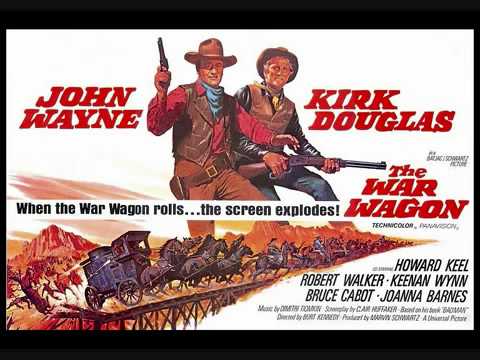
“The War Wagon”

The first thing about the 1967 John Wayne/Kirk Douglas vehicle The War Wagon   (yes, that pun was intentional, thank you)  is that it has o...