Showing posts with label Nicholas Briggs. Show all posts

Tuesday, 11 June 2019

“Doctor Who and the Dalek Invasion of Earth”

…so the ironic thing is that it'll probably be a while before I watch the actual, televised version of this story, seeing how I've already watched two other takes on the same plot and am getting pretty sick of it. The first version, of course, was the excellent bit of fun that is the Peter Cushing movie, which, in its sole greatest flaw, bears the syntaxically-nightmarish title of Daleks Invasion Earth 2150 A.D.. (All the rights words are there, but it just doesn't………!) 

The second, and subject matter of the present review, is the Terrance Dicks novelization of the same book, from 1977 — well, no, not even that; what I actually got was the 2009 audiobook read by William Russell (Ian Chesterton in the TV series, way, way back) and Nicholas Briggs (the latest and greatest of Dalek voice artists). 

I could recite the plot by heart at this point, but for the benefit of those not currently suffering from Dalek Invasion of Earth overdose: after numerous travels through time and space with 1960's English schoolteachers Ian Chesterton and Barbara Wright, the two runaway Time Lords known as the Doctor and Susan English, respectively, finally manage to land the TARDIS in what appears to be London, where they have been trying to return Ian and Barbara since the second episode. Unfortunately, it soon turns out that this is 22nd century London, and in ruins at that, following many long years of Dalek occupation. 

For indeed, the Daleks, last seen being karmically exterminated by their ancestral enemies the Thals at the end of The Dead Planet, are back with a vengeance. After meeting up with the local resistance, the TARDIS travellers are soon separated and all sorts of things happen as they trudge about the devastated England trying to figure out what the Daleks want on this planet and how to stop them. 

Notable secondary figures in this plot are the laughably-named Robomen, a first draught of the Cybermen (being robotized, emotionless humans) who serve as the Daleks' henchmen; Tyler, a resistance leader who has lost the use of his legs, but not the will to think up a giant bomb with which to rid the planet of the Daleks' filth; and David, a handsome young fighter in the resistance, who develops into Susan's love interest. (In both the televised episode and the audiobook, his last name is Campbell, but I'm told that in the printed version of the novelization, his name was, rather hilariously, David Cameron.) 


So how does it fare? 

Well, for a start, four hours and ten minutes is way too long for this story, which was perfectly condensed as the hour-and-a-half Cushing feature. But that can't really be helped, and I know there is much, much worse (some Doctor Who audiobooks push on 10 hours! Ten blinking hours!). 

As an audio product it's otherwise quite good. William Russell was always a bit too deadpan for my taste as Ian, but he's perfect as a narrator; he doesn't sound much like himself anymore, it must be said, making the times he's reading out Ian's dialogue somewhat eerie; but on the plus side, he's very good at voicing the First Doctor. He's not limiting himself to an impression of his late co-star, not by far; he couldn't do that if he wanted to, because Terrance Dicks took many liberties with the original teleplay when turning it into a novel. 

If nothing else, the Doctor's farewell speech to Susan is very different, and Russell's delivery of it, accordingly, couldn't be further from Hartnell's serene “one day, yes… one day I shall come back”; the corresponding line in the Dicks script (simply “One day, I'll come back!”) is angrier here, as if he's scolding Susan for doubting that he would. 

Aside from the weirdness inherent in an old man voicing Barbara or Susan, there is one weird bit that doesn't quite work, though; the Robomen's voices are described by Dicks as “slurred”, and Russell took that, I think, a bit too much to heart. They don't sound like zombies, they sound drunk

Meanwhile, Nicholas Briggs is predictably awesome as the various Daleks, bringing his full range into it, bless him; it's not that the original voices were bad (1960's Dalek voices, whether on the small or big screen, are the best non-Briggs Dalek voices, in my opinion), but Briggs is an outright wizard. At the drop of a hat, he is the Daleks, and that is because he gets them; as he has explained, when he voices the Daleks, he's not voicing emotionless robots, he's voicing three-dimensional people — it's just that those people happen to be inordinately awful, perpatually-angry little people. Hence he is convincingly confused or vainglorious or angry, without ever forgetting the all encompassing irrational hatefulness lurking beneath their every dark throught. 

The sound design is great; the music, where there is some, is fitting, though a bit forgettable; it's certainly no patch on Bill McGuffie's fantastic score to the Peter Cushing film, which contains, among other things, a marvelously energetic theme song, and one of my favorite pieces of movie music ever, Fugue For Thought


What of the script? Well, it does what it can with the meandering plot; certainly it conveys the apocalyptic scope quite well, and while no character is particularly deep, they're all believable people. Dicks is inordinately good at setting up moods, better than he is at thinking up people; thus things are creepy when they need to be, or majestic, or tense, or thrilling. The opening line “Through the ruin of a city stalked the ruin of a man” is justifiedly famous. 

The story itself, for which, of course, we cannot blame Dicks, is as I said needlessly meandering and needlessly reliant on Susan twisting her ankle at convenient times of the plot, but the sheer fun of a premise like “the Daleks have taken over the Earth” usually makes up for it, and the worldbuilding of what life is like under the Daleks for the resistance forces and for the mining slaves is actually quite well-thought-out. 

Dicks is quite good at foreshadowing the Susan/David romance, but not so much the Doctor's decision to leave her to live with him. The way the televised story made a story arc out of the Doctor's slow realization that she wasn't his little girl any more may have been a bit ungraceful at times (“jolly good smack-bottom” indeed), but it was something; here there is no trace of it; we spend most of the story with no insight into the Doctor's view of Susan, nor any signs that he's getting on in years in a way that would justify her determination that she needs to stay with him to take care of him. Then suddenly, we're told (in quite a hamfisted fashion) by David that “he knew all along”. Well, okay, jolly good, why shouldn't he have? What have we discovered exactly? 

Oh, and another failing, simultaneously very small and quite major: Dicks made the very questionable decision to refer to the mining-cart in which Ian gets trapped for most of the climax as a “giant bucket”. It is much, much harder than anyone in the production expected to take seriously the travails of a man trapped in what an old British actor keeps calling a “giant bucket” with the utmost seriousness. 


All in all, I enjoyed Doctor Who and the Dalek Invasion of Earth, but if you're not a dedicated Who fan, there are probably much quicker, much funnier ways to experience the story, starting with the Cushing film. (Unless, of course, you are visually impaired, in which case, yes, I'm not an expert, but this seems like a pretty fun audiobook.)

Post-Scriptum:
  • An oft-repeated bit of trivia that non-Whovians in the audience may not be aware of: the cover of the novelization, here reused for the CD jacket, was drawn with the Peter Cushing flick as a reference, rather than the TV episode; as a result, the Dalek spaceship is modeled on that in the film rather than the one in the episode itself. Though it's endlessly cut that the Daleks are the only A-list aliens in popular culture who genuinely, unironically use flying saucers as their primary mode of transportation, there's no denying that the hovership in question is a much more interesting bit of design-work. 
  • Also about the CD jacket: that Roboman, from this angle, looks fainty like he's about to ask me if I'm his mummy. 


Monday, 8 April 2019

“Resolution”

Alright, so Chris Chibnall promised Daleks, and delivered Daleks, and therefore was not set on fire by the enraged Doctor Who fandom. What else?


A very good episode of Doctor Who, is what else. It does not altogether feel like a “special” in the way the Christmas Specials did (I suppose New Year's is even more of a formality for most people than Christmas; I suppose pledges of doing one's chores are somewhat poorer at stirring the heart than love, family and hot cocoa), but it's quite a good one-shot Dalek episode. The acting from the guest characters is great, Akinola's music is mostly unobjectionable this time around and has a few legitimately great moments (short though they are), the direction is up to the usual Series 11 standards, and… Chris Chibnall turned in a good script.


I know, I know. But it can happen! The Silurian two-parter from Series 5 and Dinosaurs on a Spaceship, for example. And I think Resolution is actually a better than those, even if it still has the Chibnall trademark of a science-fiction story and a relationship-drama story mashed together with a sledge-hammer (one scene from one, cut, one scene from the other) as opposed to actually being welded in any significant way. Resolution, in fact, has got that particular problem more than any of his previous episodes you'd care to name. But perhaps this is in fact a good thing, for it allows each side to stand on its own, leaving one with the somewhat boilerplate, but not really unpleasant, "Ryan's Dad" subplot, on one side, a frankly great Dalek story on the other. 


So the plot: on New Year's Day 2019, two archeologists, an immensely likable pair played by Charlotte Ritchie and Nikesh Patel, who, I'm sorry to say, are a billion times more interesting to watch than Ryan & Yaz for most of the time they're onscreen) dig up an ancient burial site beneath Sheffield — yes, of course it's beneath Sheffield, it's Series 11… or good as. Among the weird things they find is a fragment of a Dalek-creature, who has been buried on Earth since the 9th century, having been one of the first Dalek scouts sent out from the Planet Skaro way back in the day. A veritable army had, at the time, managed to subdue the Dalek and destroy its casing, but even after hacking the mutant blob apart, it still lived and twitched (as per The Witch's Familiar's addition to the Daleks' lore; gotta love that continuity), so they buried the pieces in the far corners of the Earth and founded a secret society (the Order of Custodians) to keep them separate. 

I should hasten to point out that this "buried in the four corners of the Earth", "Order of Custodians" nonsense is of absolutely zero importance to the plot, for the Reconnaissance Dalek promptly puts itself back together through some weird, ill-explained teleportation ability of his,  andwe never meet the Order, nor do they do anything of importance in the backstory that comprises their entire appearance. It's just daft, and probably the writing's capital sin, though it is one that's easily ignored.

“ExterminHEeElLLlllPPpPPP!!!!

On the other hand, I've seen criticism of the idea that any number of 9th century warriors (even an army) would be able to destroy a Dalek's casing — but this is actually a nonissue, for it is the later, Time War Daleks who were practically indestructible, whereas the Reconnaissance Dalek is explicitly "one of the first to leave Skaro", meaning that A) it got there without time travel and B) it is therefore a thousand years older than the relatively-easily-destroyed models from The Dalek Invasion of Earth (who got to Earth in the 22nd century!). Most likely it was basically identical to the original The Daleks Daleks, and those guys could be destroyed by kicking them and making them fall down elevator shafts, or just pushing them against a wall really hard. See above.


So, having pulled itself back together, the Reconnaissance Dalek proceeds to possess Charlotte Ritchie's character (because yes, Dalek creatures can do that now, shaddap) and drive her around like a puppet in an effort to get her to build it a new and improved casing — the whole sequence with single-minded, possessed-Lin is truly glorious, and Nicholas Briggs as the Dalek's voice reaches new heights. The way Lin is made to speak along with it also extremely effective. One is truly saddened when it is over, though the product of Lin's smelting (the parallels to the Doctor's creation of a new Sonic Screwdriver in The Woman Who Fell to Earth are obvious) is quite a sight to; a misshapen, rusty Dalek clearly built out of spare parts, yet still fearsome enough.  


The reconstructed Reconnaissance Dalek has a verbal showdown with the Doctor, as Team TARDIS (who has been frantically tracking the Dalek thus far) finally catch up with it just a moment too late. It's an effective scene, though there's little that makes it stand out from earlier "the Doctor defies a Dalek" moments (the gold standards for those, of course, being Christopher Eccleston's turn in Dalek, which everyone else has just kind of been shamelessly copying). Whittaker's Doctor finally gets to show a bit of menace, an element which many critics agree was missing from her performance thus far. The Doctor has to deserve that “Oncoming Storm” title the Daleks give him/her.

(Speaking of which, if this is truly a pre-Dalek Invasion of Earth Dalek as we're led to believe, it does not entirely make sense that it would so readily recognize the Doctor, for at that point the Daleks had only met Hartnell's Doctor, and presumably didn't know about regeneration. Oh well.)


Unfortunately, this is where things take a turn for the… well, worse, though that's not to say the resolution of Resolution (heh) is bad per se. It soon becomes clear that we're not just trying to stop the Reconnaissance Dalek because the Reconnaissance Dalek might kill people (though it does do that, too, mind you). No, the Reconnaissance Dalek must be stopped before it highjacks all radio-transmitters in Great Britain in order to send a signal to the main Dalek fleet.

Whut? 

There is so much wrong with this idea. For one thing, considering there was an entire Time War in-between the Reconnaissance Dalek's arrival on Earth and the events of Resolution, and the Daleks changed leadership, like, ten times, it is no guarantee the current Daleks would even listen to that half-dead relic of their ancient times. It's a bit like worrying that one of Napoleon's army scouts, cryogentically frozen since 1807, might, if thawed-out today, lead the modern French Army on the warpath overnight if he's allowed to reach a telephone with which to call the French Minister of the Armies. 

Furthermore, the modern Daleks know full well that Earth exists and would be suitable to Dalek conquest. In fact, they've tried. Repeatedly. And the Doctor has stopped them. If he got the Reconnaissance Dalek's message of “I HAVE DISCOVERED A PLANET WE MIGHT CONQUER! IT'S CALLED EARTH! COME DOWN HERE!”, the Dalek Emperor would probably answer, as patiently as he could manage: "YES. WE KNOW EARTH EXISTS. WE KNOW. THERE'S A REASON WE STILL HAVEN'T CONQUERED IT YET; IN FACT, I THINK YOU'VE MET HER. BUT WE KNOW.” Hardly that scary an event.


The Dalek's final defeat (no, don't worry, the above picture isn't it) begins amusingly, but is by the end dull and a little bit confusing. It is praiseworthy that Chibnall tried to involve Ryan's Dad and his microwave-oven into the proceedings, but it only works the first time around; by the time the Dalek has lost its casing again and tries to possess Ryan's Dad, who inexplicably manages to fight it off better than Lin because……the power of love……?……, you just wish the microwave had been enough.

Still, in terms of tone, Resolution is everything you could want, and with strong actors and Series 11's ever-reliable visuals to go along with it, why deny yourself? It's one of the best Chibnall-era stories yet in my book, though perhaps not the best (I think I'd still rank Demons of the Punjab and Kerblam! above it, not necessarily in that order).

Post-Scriptum:
  • Dear entertainment industry, could we just stop defeating bad guys by judicious opening of airlocks? Or other "irresistible sucking force" plot devices? Doctor Who, you, in particular, already played that card in Doomsday, and much more impressively than here. So enough.


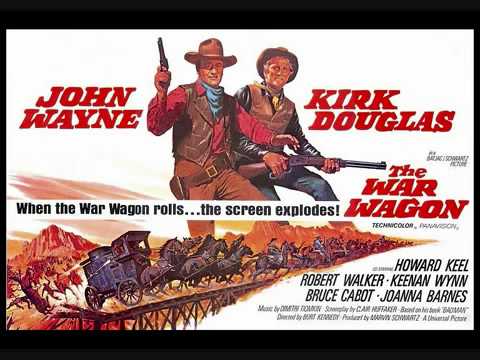
“The War Wagon”

The first thing about the 1967 John Wayne/Kirk Douglas vehicle The War Wagon   (yes, that pun was intentional, thank you)  is that it has o...