Showing posts with label The Doctor. Show all posts

Sunday, 16 June 2019

“The Enemy of the Daleks”

…or Enemy of the Daleks, as it is more commonly, but also incorrectly, referred to.


This audio story from 2009 is the first Big Finish effort we'll be looking at; it features mainstays Sylvester McCoy and Sophie Aldred, once again reprising their roles of the Seventh Doctor and of Ace, respectively. Big Finish may quite possibly never have gotten off the ground if not for those two's stunning willingness to return to their old characters at the drop of a hat, whether or not the production has a license — Aldred put in an appearance in the low-budget Internet parody series Bitesize Who just a few years ago, for example. 

At any rate, they're very good, and in general The Enemy of the Daleks' cast is quite good (if nothing else, Nicholas Briggs as the Daleks, need I say more?). So is its sound design, though the Kiseibya's voices are not as intelligible as I think they're meant to be.

Now the writing… ah. Hm. Well, there's this divide in Who fandom — though it is somewhat arbitrary, as has been well-argued elsewhere — between the ‘frock’ and ‘gun’ approaches. The former embraces the beautiful silliness of a story about a daft old man moving through time and space in a police box and whose greatest enemies are pepperpots who sound like parrots with laryngitis, and are named after the “frock coat” worn by the Doctor (not that it's actually a frock coat in any incarnation past the first, any fashion enthusiast will be happy to tell you, but that's neither here nor there). The latter, whose totem is, ahem, obvious, prefer darker, more mature stories about war and moral dilemmas and totalitarian dystopias. 

The Enemy of the Daleks is an extremely gun story (…just look at the cover!), is the thing, and I just don't like gun stories very much. 

The central conceit is that this Japanese scientist in the future, while humanity is at war with the Daleks, creates a new and equally monstrous species to act as predators for the Daleks, finally kicking them off the top of the food chain that they otherwise occupy. These monsters, uneuphoniously called the Kiseibya, eat flesh in larval state and metal in adult form, making the Daleks the ideal food-source for them. The first sign that the Professor cannot control them is, however, when they begin eating all his scientific equipment, and it's clearly played for drama, even though, guys, this here is a mad scientist who created metal-eating monsters and is now upset that they're eating all his stuff. This is a joke. A good one too. Own up to that. 

The other problem is that, in presenting a “History tragically repeats itself” scenario, the story is trying very hard to be a thematic sequel to Genesis of the Daleks — a thematic sequel where the Doctor actually crosses the wires and exterminates the Daleks/Kiseibya before they can escape into the universe. Fair enough, but Bishop isn't actually up to the task of exploring the moral ramifications of this decision; in fact, the Doctor's main reason for going through with it appears to be that he has known all along that a great atrocity must be committed on this day in this place, and so It Is His Destiny to do this, and he knows it, and so he does, and GAWD NO. The fact that the characterization of McCoy's Doctor, as time went on, was increasingly swallowed up by the “machiavellian chessmaster who knows in advance everything that must be done, and does them out of a grim sense of duty” idea, is usually trumpeted as a good thing, but rather than making him epic and complex, I always felt it just robbed him of any real characterization.

Oh well. It's not boring at all, but it's all a bit too grim and gritty for me. 

Post-Scriptum:
  • Not entirely sure what the point of the local human army detachment being a “Valkyrie Unit” entirely composed of women is, whether in- and out-of-universe. It's just there, a vaguely nonsensical detail in a story so very desperate to be taken seriously. …And come on, if you're going to stick Ace with a whole batallion of other trigger-happy female soldiers, you had bloody well better do something with it.
  • This was my first exposure to companion Hex (I am not listening to the Big Finish audios in anything like chronological order) and, I mean, he's okay, I guess? I don't see much to tell him apart from Rory for now — yes, Hex actually came first, but that's neither here nor there. I also wish that just for the hell of it, it was Hex from Discworld as a companion. I don't even know what that would look like, but it sure would be funny. 

Tuesday, 11 June 2019

“Doctor Who and the Dalek Invasion of Earth”

…so the ironic thing is that it'll probably be a while before I watch the actual, televised version of this story, seeing how I've already watched two other takes on the same plot and am getting pretty sick of it. The first version, of course, was the excellent bit of fun that is the Peter Cushing movie, which, in its sole greatest flaw, bears the syntaxically-nightmarish title of Daleks Invasion Earth 2150 A.D.. (All the rights words are there, but it just doesn't………!) 

The second, and subject matter of the present review, is the Terrance Dicks novelization of the same book, from 1977 — well, no, not even that; what I actually got was the 2009 audiobook read by William Russell (Ian Chesterton in the TV series, way, way back) and Nicholas Briggs (the latest and greatest of Dalek voice artists). 

I could recite the plot by heart at this point, but for the benefit of those not currently suffering from Dalek Invasion of Earth overdose: after numerous travels through time and space with 1960's English schoolteachers Ian Chesterton and Barbara Wright, the two runaway Time Lords known as the Doctor and Susan English, respectively, finally manage to land the TARDIS in what appears to be London, where they have been trying to return Ian and Barbara since the second episode. Unfortunately, it soon turns out that this is 22nd century London, and in ruins at that, following many long years of Dalek occupation. 

For indeed, the Daleks, last seen being karmically exterminated by their ancestral enemies the Thals at the end of The Dead Planet, are back with a vengeance. After meeting up with the local resistance, the TARDIS travellers are soon separated and all sorts of things happen as they trudge about the devastated England trying to figure out what the Daleks want on this planet and how to stop them. 

Notable secondary figures in this plot are the laughably-named Robomen, a first draught of the Cybermen (being robotized, emotionless humans) who serve as the Daleks' henchmen; Tyler, a resistance leader who has lost the use of his legs, but not the will to think up a giant bomb with which to rid the planet of the Daleks' filth; and David, a handsome young fighter in the resistance, who develops into Susan's love interest. (In both the televised episode and the audiobook, his last name is Campbell, but I'm told that in the printed version of the novelization, his name was, rather hilariously, David Cameron.) 


So how does it fare? 

Well, for a start, four hours and ten minutes is way too long for this story, which was perfectly condensed as the hour-and-a-half Cushing feature. But that can't really be helped, and I know there is much, much worse (some Doctor Who audiobooks push on 10 hours! Ten blinking hours!). 

As an audio product it's otherwise quite good. William Russell was always a bit too deadpan for my taste as Ian, but he's perfect as a narrator; he doesn't sound much like himself anymore, it must be said, making the times he's reading out Ian's dialogue somewhat eerie; but on the plus side, he's very good at voicing the First Doctor. He's not limiting himself to an impression of his late co-star, not by far; he couldn't do that if he wanted to, because Terrance Dicks took many liberties with the original teleplay when turning it into a novel. 

If nothing else, the Doctor's farewell speech to Susan is very different, and Russell's delivery of it, accordingly, couldn't be further from Hartnell's serene “one day, yes… one day I shall come back”; the corresponding line in the Dicks script (simply “One day, I'll come back!”) is angrier here, as if he's scolding Susan for doubting that he would. 

Aside from the weirdness inherent in an old man voicing Barbara or Susan, there is one weird bit that doesn't quite work, though; the Robomen's voices are described by Dicks as “slurred”, and Russell took that, I think, a bit too much to heart. They don't sound like zombies, they sound drunk. 

Meanwhile, Nicholas Briggs is predictably awesome as the various Daleks, bringing his full range into it, bless him; it's not that the original voices were bad (1960's Dalek voices, whether on the small or big screen, are the best non-Briggs Dalek voices, in my opinion), but Briggs is an outright wizard. At the drop of a hat, he is the Daleks, and that is because he gets them; as he has explained, when he voices the Daleks, he's not voicing emotionless robots, he's voicing three-dimensional people — it's just that those people happen to be inordinately awful, perpatually-angry little people. Hence he is convincingly confused or vainglorious or angry, without ever forgetting the all encompassing irrational hatefulness lurking beneath their every dark throught. 

The sound design is great; the music, where there is some, is fitting, though a bit forgettable; it's certainly no patch on Bill McGuffie's fantastic score to the Peter Cushing film, which contains, among other things, a marvelously energetic theme song, and one of my favorite pieces of movie music ever, Fugue For Thought. 


What of the script? Well, it does what it can with the meandering plot; certainly it conveys the apocalyptic scope quite well, and while no character is particularly deep, they're all believable people. Dicks is inordinately good at setting up moods, better than he is at thinking up people; thus things are creepy when they need to be, or majestic, or tense, or thrilling. The opening line “Through the ruin of a city stalked the ruin of a man” is justifiedly famous. 

The story itself, for which, of course, we cannot blame Dicks, is as I said needlessly meandering and needlessly reliant on Susan twisting her ankle at convenient times of the plot, but the sheer fun of a premise like “the Daleks have taken over the Earth” usually makes up for it, and the worldbuilding of what life is like under the Daleks for the resistance forces and for the mining slaves is actually quite well-thought-out. 

Dicks is quite good at foreshadowing the Susan/David romance, but not so much the Doctor's decision to leave her to live with him. The way the televised story made a story arc out of the Doctor's slow realization that she wasn't his little girl any more may have been a bit ungraceful at times (“jolly good smack-bottom” indeed), but it was something; here there is no trace of it; we spend most of the story with no insight into the Doctor's view of Susan, nor any signs that he's getting on in years in a way that would justify her determination that she needs to stay with him to take care of him. Then suddenly, we're told (in quite a hamfisted fashion) by David that “he knew all along”. Well, okay, jolly good, why shouldn't he have? What have we discovered exactly? 

Oh, and another failing, simultaneously very small and quite major: Dicks made the very questionable decision to refer to the mining-cart in which Ian gets trapped for most of the climax as a “giant bucket”. It is much, much harder than anyone in the production expected to take seriously the travails of a man trapped in what an old British actor keeps calling a “giant bucket” with the utmost seriousness. 


All in all, I enjoyed Doctor Who and the Dalek Invasion of Earth, but if you're not a dedicated Who fan, there are probably much quicker, much funnier ways to experience the story, starting with the Cushing film. (Unless, of course, you are visually impaired, in which case, yes, I'm not an expert, but this seems like a pretty fun audiobook.)

Post-Scriptum:
  • An oft-repeated bit of trivia that non-Whovians in the audience may not be aware of: the cover of the novelization, here reused for the CD jacket, was drawn with the Peter Cushing flick as a reference, rather than the TV episode; as a result, the Dalek spaceship is modeled on that in the film rather than the one in the episode itself. Though it's endlessly cut that the Daleks are the only A-list aliens in popular culture who genuinely, unironically use flying saucers as their primary mode of transportation, there's no denying that the hovership in question is a much more interesting bit of design-work. 
  • Also about the CD jacket: that Roboman, from this angle, looks fainty like he's about to ask me if I'm his mummy. 


Friday, 19 April 2019

“Eighth Doctor Adventures” - Part 1

In vaguely anachronistic order, I have begun reading BBC Books's Eighth Doctor Adventures from the second half of the 1990's, the medium by which Paul McGann's take as the title part in Doctor Who was to be developed after his planned TV season went bust. (I say "was to be" because there is heated rivalry between those who consider the Doctor Who Magazine comic-strips, the BBC Books Eighth Doctor Adventures, or the Big Finish audioplay Eighth Doctor Adventures the official continuation of the Eighth Doctor's story, being that the three accounts are often as irreconciliable as those things get in Doctor Who.)

The Eight Doctor Adventures have a complicated reputation, but for the moment I don't find them nearly as bad as people say they are. So:


Terrance Dicks's The Eight Doctors is often described as "bad fanfiction". I wouldn't say "bad" — but it's very, very obvious that it is "fanfiction" when compared to the real novels that were to come, the ones with an actual narrative structure, the one with an actual story that isn't just a reflection/"greatest hits compilation" of preexisting episodes. You know what, though? I like fanfiction quite a bit. 

What The Eight Doctors does most of all is try to be a sequel to The TV Movie, The Trial of a Time Lord and The Five Doctors simultaneously, and take that opportunity to smooth over continuity issues in those two stories. The way this enterprise is disguised as a story is extremely clunky, yes, but not enough credit is given to the fact that it's a pretty good attempt to make sense of those two stories. I did not believe it was possible to simplify the Valeyard as much as this does. 

The characterization is somewhat weaker. The past Doctors are done well enough, with the potential exception of the Seventh, who is sadly in his terminally unfunny Virgin New Adventures incarnation and whose story doesn't really lead anywhere. But… for one thing, it's a truism that no one really knew what to do with Rassilon until the new series recast him as a straight-up villain in The End of Time; he was dangling on the fence between good and evil, not in an interesting sense of moral ambiguity some much as in "the writers themselves aren't sure if he's a villain or not, and therefore try to sound as noncommital as possible". Add to that the even greater confusion on whether he's dead or a god or a ghost or an artificial intelligence or what in Gallifrey's "present-day", and it's no surrpsie that his Deus Ex Machinesque appearance here is nothing if not confusing. 

And the Eighth Doctor? A blank slate, very self-consciously. Dicks wipes his memory at the beginning of the story, to make sure he doesn't actually have to do any characterization on him. This is a patently stupid move — you can't have the main character of your new book series as a nonentity in the first book — and if you're going to do it anyway, you definitely shouldn't do it by having him lose his memory again after The TV Movie was already all about an amnesiac Doctor. That's just lazy. 

New companion Samantha Jones is not bad, at least. Some people think she's annoying, but not me. 


Now there's a novel. Perhaps my favorite of the Who novels I've read so far, Vampire Science actually succeeds in being a sequel (a good sequel) to The TV Movie, even sharing its San Francisco setting. It has all the good parts of that film (chiefly the slightly gothic atmosphere and the Eighth Doctor's character; also a campy-yet-scary villain, though not the same one) and none of the bad parts or occasional clumsiness. Sam is better than ever, the Doctor is fantastic… and it's also a heckuva good vampire story. The worldbuilding and characterization of the story's vampires is excellent; tasteful unique without at all trying to be a radical reimagining. 

The "head vampiress", Johanna Harris is a complex and immensely likable presence throughout the story, and the way her plotline plays out is full of twists and turns and unique ideas and defied expectations. After five seasons of Steven Moffat, it's also nice to have a sympatheitc villainess who isn't either koo-koo or trying to shag the Doctor (not that I hate all, or even most, of the various characters of that description; Missy's a fantastic version of the Master, and played to perfection; but it does get tiresome). 

Author Jonathan Blum also took the opportunity to canonize his earlier, unlicensed fanfilm Time Rift by having his character from there, Brigadier Kramer, appear in it. I can but applaud this, for Time Rift, terrible picture quality aside, is a very good piece of television, which it is not hard at all to imagine as a real 1980's episode of the series. This despite my apathy to Kramer as a character, who is little more than “the Brigadier, but American and a woman”. 


Genocide is another very good novel, very much apiece with Vampire Science (if you like one, I can't see why you wouldn't like the other). The characters are once again quite good overall, though the cast is more uneven; we get another fantastic villainess, in a completely different register from Johanna (variety, Mr Moffat, variety), but her human henchman is very one-note, and I couldn't help but conflate him with the much-despised Krasko in my mind, which… isn't a good thing. The worldbuilding is marvelous, though. Truly marvelous. 

It is strangely prescient of things to come (¨cough cough¨ Time War ¨cough cough¨) in the sort of moral dilemmas with which it presents the Eighth Doctor, but somewhat bungles up the delivery thereof. It looks good on paper, but then the detail is added (for urgency) that the timeline will crumble and the universe cease to exist unless the Doctor acts, and thus there's only one real option left, and no moral quandary. Oh well, points for trying. 

I like the way this story does australopithecines as characters, also. I feel like this is largely how talking to australophithecines would go. 


War of the Daleks gets a lot of hate as another, even more egregious case of "hacky fanfiction" than The Eight Doctors. Not altogether deservedly. Yes, the story exists in part to retcon a bunch of previous ones, chiefly the destruction of Skaro in Remembrance of the Daleks, but, with apologies to all the people who love said event and wish it hadn't been so unceremoniously undone, bugger that. I love Skaro as a setting, and cheered when it became apparent the new televised series had picked up Peel's decision to bring it back. Is the way in which it was brought back a bit clunky? Yeah, but it was always going to be clunky, and Peel at least wrings some decent character moments for the Doctor and Davros out of this. 

Yes, did I mention the characters? The first half of War's plot is kind of nonsensical (the Thals' motivations are meandering and daft), but things pick up immensely once we land on the resurrected Skaro and a triplefold battle of wits gets underway between the Eighth Doctor, Davros and the Dalek Emperor. The Dalek Emperor (a hugely magnetic presence in his two only real screen appearances, one of which was yet to come when War was released) has never been better than here; far from just an archetype, he is a fully-realized character, as deep and complex as non-redeemed Daleks get. 

All in all, it's not perfect, and its retcons are more or less as clumsy as everyone says they are… but that excepted, this isn't a bad book at all. If you like stories about Daleks as characters with agencies, rather than mindless monsters (and sweet Rassilon I do), this is the one for you. 


Paul Magrs's The Scarlet Empress isn't actually as revolutionary and postmodern as it's made out to be. The setting and atmosphere of the planet Hyspero is no different than what the televised story would revisit in The Rings of Akhaten, for one thing. What it is is a slightly absurdist version of Arabian Nights In Space, and that's always fun, innit? 

The big attraction of The Scarlet Empress is of course the proper introduction into Doctor Who (the careful phrasing is firstly because she actually began as a solo character elsewhere, and secondly because she had even actually already encountered the Doctor, albeit in a long-forgotten short story) of Iris Wildthyme, the Doctor's timey-wimey old bat of a fellow Gallifreyan. A Time Lady who exists as a shameless, dingy parody of the Doctor, Iris draws her appeal from how very self-conscious she is of the aforementioned fact; she's not quite fourth-wall-aware in this story (she is elsewhere), but her relationship with the Doctor is precisely that of an affectionate parody personified meeting the original. The Doctor is vaguely irritated by her existence, and something keeps nagging at him that's not 'right' about her; she, for her part, keeps criticizing his various flaws, and shamelessly steals and corrupts his trademark features, but she also loves him deeply without daring to say so out loud. It's all very clever. 

The plot is kind of meandering, but that's to be expected in an Arabian Nights-esque stories. There are a few other choice meta-moments in the story (such as a merciless satire of "canonicity" as a concept: a Lewis Carrol-esque visit to an alien library whose bigoted librarian insists it contains all the knowledge about th euniverse, which must be read in chronological order or not at all, and who cannot bear to think about "unreal things" without a dozen reminders and qualifiers that they are "imaginary stories"), too, which do get a chuckle. 

Friday, 15 March 2019

“Do You Have a Licence to Save This Planet?”

Back in Doctor Who's Wilderness Years, there was a substrate of the (adult) fandom who decided to start taking advantage of the quaint way copyright of British television works: individual writers retain full rights to the scripts they wrote and characters therein introduced. 

And this meant that the enthusiastic fans could dig up the geriatric genius who'd written the first story with Sontarans or Autons in it, and persuade him to give them the rights to make an Sontaran/Auton/whatever television story. Of course, they couldn't use those elements of Who owned by the BBC (the Doctor himself, the TARDIS, the theme song, the Daleks), but that didn't stop a wave of spinoffs — which were, in essence, licensed fanfilms; certainly, there's no doubt that the type of fellow who do today's best fanfilms would have been doing these spin-offs at the time — from being released on home video. 

Sometimes, they would also persuade one of the iconic Who actors to lend a hand; they played their original part if rights were available, and if not,… they made the film anyway and changed a few cosmetic details to placate BBC lawyers. For example, there was a whole series of direct-to-video films starring Colin Baker, who was obviously playing the Sixth Doctor, except he was only ever referred to as “the Stranger”, he didn't have the patchwork coat, and the camera cut away whenever he and his friendly female companion headed for their perpetually-offscreen time machine. They occasionally used this same trick for the monsters whose rights they couldn't scrounge up; there was a series of films featuring the Cyberons, metallic, emotionless alien cyborgs who are so very obviously the Cybermen, except without the handlebars. 

They made a book about this stuff, of which this is
the cover illustration, bringing together a bunch of “licensed fanfilm”
 characters; front-and-center and from left to right are the retired Brigadier Lethbridge-Stewart
played by Nicholas Courtney in Downtime, a Cyberon, Sophie Aldred as not-Ace,
and Sylvester McCoy as Totally-Not-The-Seventh-Doctor-We-Swear. 

A lot of these 'DTV spin-offs' were produced by the comically-titled BBV Productions (nothing to do with the BBC: the BBV stands for Bill & Brenda's Videotapes, y'see, Bill and Brenda Baggs being the daring entrepreneurs behind the whole thing). And in 2001, shortly before they went out of business (Bill Baggs went on to become a health guru, of all things, I am told), BBV produced a very odd, 30-minutes-long, home-video-released self-parody by the title of Do You Have a Licence to Save This Planet?. 


The story brought together the licensed Autons and Sontarans, and the unlicensed Cyberons, all chasing after Sylvester McCoy in a patchwork coat he'd curiously go on to wear in a 2004 reprise of the Seventh Doctor character, though here the conceit is that he's not dressed as the 7th Doctor, which just goes to show how flimsy these “no, we're not in breach of copyright, what on Earth are you talking about?” arguments usually were. 


Thing is, as the title might have clued you in already, this is precisely what DYHALTSTP? is all about. See, McCoy is here playing “the Chiropodist” (or “Foot Doctor” for philistines), a “Chrono-Duke” hwo travels around the universe in a time-traveling washing machine, and fights evil with his “sonic spoons”. Due to being “unlicensed”, he is under hot pursuit by “the Licensor” (Nigel Fairs), an incredibly campy Master parody who is head of the Licensed Reality CorporationTM. The Foot Doctor is helped by an enthusiastic chap going by “the Salesman” (Mark Donovan), who came to him under the belief that he was the real Doctor wanting to become his new companion. He is noticeably disappointed when he realizes that the Foot Doctor “is BBV” (yes, they actually say that) but stays anyway, and explains that he sells hackneyed plot devices, of which he packs a whole suitcase.


Not factoring into anything to any real degree except to pad out the runtime and add a few gags are a duo of Cyberons who have infiltrated Earth and are now living in a house. They interact with their human neighbors a little bit and moan about not haveing “ears” (=Cybermen handles) like they would do if they were licensed. There is also a Sontaran, the reason for the presence of whom is never made entirely clear; unlike the Cyberons, he's explicitly not in the Licensor's employ. I dunno. 


So is it any good? Ah, hm, well, about that. See, this metafictional gag-filled romp packed full of easter eggs and references is supposed to be just the kind of thing I like, and make no mistake, Paul Ebbs & Gareth Preston (both pull double-duties, as the stuntmen in the Cyberon and Auton costumes, a trapping so very typical of fanfilms today) turned in a very solid script. With the exception of a couple of dubious bits with the Sontaran, and one or two of the Cyberon gags, it is a masterful parody. The intent that this be a kind of “Monty Python does Doctor Who” thing is very clear, and the presence of a (terrible) animation interlude with Rassilon only adds to that feeling. I also feel like Nigel Fairs in his second part (the Cyberon's human neighbor Geoff) is pulling a rather poor Graham Chapman impression, but I could be wrong about that. (It is at the very least a poor performance, that much is certain.)


As for the actors, they too aren't to blame. Sylvester McCoy is Sylvester McCoy, and therefore a joy to watch, though he flip-flops between just playing the damn Seventh Doctor, and returning to the exaggerated pantomime of the early days of his pre-Who career; he's great at both but it can be a bit jarring. Nigel Fairs is pretty excruciating as Geoff, but it's a noble failure in trying to be funny, not the wooden acting of an amateur; his Licensor is a much better turn — he's a lot of fun to watch. Not quite as fun as Jonathan Pryce's equivalent character in The Curse of Fatal Death, of course; nothing can top that. And even at self-proclaimed “top-campiness”, Fairs's Licensor isn't actually quite as hammy as the fully-canonical Soldeed from The Horns of Nimon. Still, if we had to judge every hammy parody villain by the standards of Graham Crowden and Jonathan Pryce, there are precious few who could be called hammy at all. The other actors are good without being stand-outs (Rupert Booth, a noted fanfilm Doctor, here plays a Sontaran; he is as far as I know the only other actor aside from McCoy who's somehow “notable”.) The effects, surprisingly, aren't too bad either. There's some pretty good CGI by early-2000's-home-video standards in there. Nothing fancy, but it works well enough. 


No, the one, glaring, fatal flaw of DYHALTSTP? is the direction and editing. It is simply wretched, and I can't conceive of how Bill Baggs ever thought he could get away with — that. Incompetent editing that doesn't even have most fanfilms' decency to stick to long, basic shots and instead tries to frequently shift angles is the plague of this movie, mangling joke after joke and sucking anything like comedy timing out of something that could not possibly survive without it. The simple, funny idea that as he steps out of his washing-machine TARDIS, the Chiropodist is sprayed with clean laundry, is rendered almost incomprehensible to the watcher by some of the poorest intercutting of shots in the history of cinema. Bah! Bah! And bah! 


Of course, there are gags which even incompetent editing and sound design cannot bungle, and there are some sequences where the film rises to the levels of competency. It's not unwatchable — just nowhere near as funny as it could have been with better direction. 


In the end, I would say that I do recommend DYHALTSTP? to Who fans, especially if they're at least mildly aware of BBV. It's a good chance to see Sylvester McCoy do his thing once more, in a less bleak context than the latter half of his televised tenure, and also to play a fun game of ‘Spot the Reference’. Just don't go in expecting the Douglas Adams-level sci-fi gigglefest that summaries (and, indeed, the DVD backcover blurb) might lead you to believe it is… even though it was this close to being precisely that. Oh well. In the words of disappointed Doctor Who fans everywhere (and everywhen), there's always Big Finish. 

Post-Scriptum:

Also, I kinda like the theme song. It's obviously meant to remind you of the official Who tune, but I quite like it in its own right. Gets stuck in your head just as well as the real thing, too. 


Monday, 4 February 2019

“Born Again”

Fanfiction and fanfilms existed even before the Internet and have become a simple fact of life ever since its inception. Yet not all fan works are apiece. Where a fanfiction, say, of DuckTales, is just that, there are some franchises that have spawned such fandom that fan works based on them have begun a genre of their own, with their recurring themes and their codes, to the extent that you can find people who forego the original completely and are a fan of the fanworks. The incommensurably gigantic Harry Potter fanfiction community is the quintessential example, but Britons don't stop at that; they have a cinematic equivalent too. And that is Doctor Who fanfilm.

Ranging anywhere from children dressing up in their parents' jackets (and being very charming too!) to productions of truly professional quality — and let's not talk about the odd aberration that are fanfilms to whom the official actors contributed, just for the heck of it! — Doctor Who fanfilms are astonishing, frequently awful, and sometimes superior to many televised episodes I could name. I love them dearly and regularly enter ‘Doctor Who fanfilm’ into YouTube's search bar just to see if any new nice ones have popped up.

And just two days ago, well fancy that.


Born Again, the work of Paris Freeman (who also plays the Doctor and directs this first episode; this is very common in fanfilms, for obvious reasons), is the first episode of a new fanfilm series which transparently comes to fill the power vacuum left by the DW2012 series, the ten-year-spanning, four-seasons œuvre of Luke Newman, another fan turned writer-director-Doctor. (If you want proof of Freeman's obvious intention to be the next Newman, look no further than the name of the YouTube channel now hosting his first attempt, TimeLord2016.)

The DW2012 series was not the best fanfilm series by far, not even the best one on YouTube; some of its stories flirted with the downright imbecilic, and it had all the wobbly cardboard sets, tinfoil monsters, barely-pubescent actors and reused sountracks cribbed from the official show that are the hallmarks of cheap YouTube fanfilms everywhere. Yet it had proven to be the most popular, perhaps through sheer tenacity (ten years and four seasons is more than most halfway-competent fanfilmmakers can boast), perhaps also thanks to Newman's extremely likable, hearfelt, original take on the character of the Doctor, far more than the cheap Matt Smith impression you usually get in these things. Not that Newman isn't very Smith-esque, of course.

But we're not here to talk about the DW2012 series; we're here to talk about Born Again. How does it hold up? Averagely, is my cop-out answer. Though it commits the sin of having one of the most boilerplate pilot titles imaginable, it's off to a very strong start as we watch the Doctor regenerate into a still very harried Paris Freeman and frantically try to steer the crashing TARDIS.


It's a very strong start, full of action and moody lighting and good acting. The effects work, by fanfilm standards, is pretty amazing, and will remain so for the duration of the entire episode (not that it's a feature film, not anywhere close; it's a tight 20 minutes or so). This is, no joke, probably the best regeneration effect and in-flight TARDIS I've ever seen in a fanfilm, and still pictures wouldn't do it justice; whether or not you meant to watch the whole thing, I definitely urge you to follow my earlier link and just watch the first few minutes and the opening credits sequence. And — oh — the opening credits sequence — that too is a thing of beauty. It has nothing to be ashamed of when viewed back-to-back with the intro used in Peter Capaldi's last official season, and I daresay I prefer it to the more understated affair of Series 11, though I'm not quite sold on the creative rearrangement of the iconic opening tune, which is as far removed from Murray Gold's 2010's version as even Gold's 2005 version was from the 1963 Ron Grainer classic, and that is perhaps one step removed too many. 


Unfortunately, things rather quickly go downhill from there as Paris Freeman's Doctor crashes into an American girl's back yard, and the girl, though wary of him, ends up cooking for him, and finding herself believing that he is an alien after all, and finding herself drawn in even though she is less than impressed by some of his idiosyncrasies, and… and right about now you're probably realizing that this is just Amy Pond, except without any of the interesting bits. A common ailment in fanfilm companions, sadly. Complain all you like about the blandness and interchangeability of the official onscreen companions, but you ain't seen nothing yet.


But stuck we are with Nicole Williamson (I'll give the film that this is pleasantly sounds like an American name without being a caricature of one). The fact that she is as basic a fanmade companion as they get would be bad enough, but she is portrayed with frigidly wooden acting and a gratingly monotone voice by Gabrielle Wright.

And I realize that it is unfair to pick on fanfilm actors, who are by definition doing a labor of love with an amateur background, but I hope that the TimeLord2016 folks take this as the backhanded compliment that it is: it is only because you got so close to letting me forget this is a fan production that this acting (well, lack thereof) sticks out like a sore thumb. 

But if the companion's a dud, at least the Doctor has to be okay, right? Well, mostly, yeah.


The bad first: past the opening scene where a certain amount of harried slurriness was expected, I slowly came to notice, with not inconsiderable dismay, that Paris Freeman mumbles half his lines instead of saying them. When he does say them he does it well enough, and his American accent isn't nearly as noticeable a 'flaw' as you might think, but this is certainly not a Doctor I'd listen to in Big Finish audios. In totally unrelated matters, I won't speculate on Freeman's exact age, but there is the unavoidable fact that he looks strikingly boyish. Not in itself damning for a Doctor (Matt Smith and Peter Davison were certainly very boyish-looking), except that Freeman doesn't seem to realize quite the extent of his own boyishness. His portrayal seems to befit a considerably more mature Doctor than what we're looking at; it's telling that the feel of his costume, and the music used in his very first scene, are both clearly inspired by Peter Capaldi's Twelfth Doctor.

But those are minor problems. In a world where otherwise-great fanfilms are marred by leads who Just. Can't. Act, Freeman yields a perfectly acceptable, even entertaining performance. He's certainly no worse than Luke Newman was in his Doctorish debut (where Freeman now mumbles, Newman once muttered); he's confident and charismatic in his portrayal, though not as much so as a professional actor might perhaps be in his place. If there is one easily-fixed flaw in the Paris Freeman Doctor, it is more with the writing than the acting, and it is that he hasn't really had a chance to be funny yet. Genial, yes, but I'm still waiting for a moment of outright daffiness for him to call his own.

All in all, Freeman delivers a perfectly serviceable fanfilm Doctor — of the breed who would be a travesty if actually cast as the Doctor on actual television, unlike, say, Bryan McCormack, but who by YouTube amateur standards deserve more encouragement than criticism.


Okay, so we've got our Doctor and our companion, what of the villain/monster? Ah, I thought you might ask. Well. Again, it's complicated. 

Surprisingly for a fanfilm, where it's usually the opposite, what we have here is a stunningly-realized concept that, as a concept, really doesn't hold much water. Perhaps it might make more snese in a more polished script, but the Stratagem… let me try to sum them up for you: the Stratagem is an alien hive mind remotely controlling a robot body trying to coerce the Doctor into teaching them how to steer a time machine with which they are accidentally opening gaps in the fabric of space-time, which may destroy Earth given time. All this in the space of — well, of ten minutes, really, allowing for the opening and sequences and the half of the actual screentime that is devoted to the tepid spectacle of the Doctor meeting, and bonding with, Nicole.

By contrast, the Daleks are angry dustbins who want to kill people.

But let's not be too hard on the Stratagem; as I said, where the concept is lacking and overconvoluted, the execution is very effective. The robot body is as real-looking and imposing as any pre-2005 Cyberman, that is to say, pretty damn much for something which inescapably looks first and foremost like a chrome-painted costume; Andrew Dillon does a good job of making it move in stilted, economically jittery littlemovements, withou nary any corpsing. Dillon also provides it with a shrill, monotone voice the — the filter used on it sounds a little too much like a Dalek voice, perhaps, but that doesn't have to be a bad thing. All in all it does a very good job of making you forget that strictly all it does for all of its screentime is stand around in one place.

Also: next to the Stratagem in all of its shots is a round mechanical energy-wheel-thingy (see above) which serves as its time machine's power source, and it's such a little thing, but the effect on it is really, really good. Doesn't at all feel like tacked-on CGI. The light even seems to reflect on the Stratagem's outer plating. Congratulations.


Speaking of props and effects, I earlier congratulated the CGI, in-flight TARDIS. Well, the physical one ain't no slouch, either. Its control room is made of deep brown, well-polished wood, with a particular clever bit of set design in the panels on the hexagonal console (hexagonal, like the classic hexagonal things on the wall) which can be opened to reveal the switches and buttons and levers. Now, this hexagonal console lacks a moving, vertical column-thing (what true Whovians know to be called a “Time Rotor”), and compared to the official televised ones it is really quite a small thing, like the room itself, for that matter. But it matters not — an actual control room it is, as opposed to some unconvincing greenscreen hocus-pocus such as I have encountered in the past, and quite a delightfully-designed one. And did I mention they have an actual physical TARDIS prop for outside shots? Full props to the props department.


All in all Born Again does not transcend the genre of Doctor Who fanfilms, but it is a very fine example of the form, and if they heed the quibbles earlier outlined, I have very high hopes for TimeLord2016's fanfilm series. Let us hope it will enjoy as much of a bright future as DW2012 did!

And for our Post-Scriptum, appropriately enough, I urge you, if you do watch Born Again for yourself, to watch its end credits too. They, also, are gorgeous. 

Monday, 24 December 2018

“Doctor Who” - Series 11

I have neither the time nor energy to make full-scale reviews of the individual episodes of Series 11 of Doctor Who — or, for those of us who still bemoan Russel T. Davies's 2005 clerical error and try to reinstate the real numbering, Season 37 — but I do still want to say something about it. 


Hence, I'll make this catch-all review, not including the yet-to-air holiday special (Resolution, a.k.a. The One That Promised Us Daleks And Had Better Have Daleks Or Else The Fandom Will Literally Set Chris Chibnall On Fire). First I'll briefly review each episode, then I'll write up general thoughts about the series.

INDIVIDUAL MINIREVIEWS:


The Woman Who Fell to Earth - Sets up a nice sense of mystery and is as good an introduction to a new Doctor and companions as anything. Very efficient climax. The vlog framing device is gratuitous and annoying, however (a series opener should know better than to recall so heavily a one of the most hated episodes of modern Who), and as effectice a surprise as Grace's death is, it's also a darn shame, as an older woman is not something we've had as a companion before and might have been brilliant. As for the monsters? Middling average, I guess. T'zim-Sha is imposing enough, with just enough complexity to work, and the Datacoil is successfully scary and a creative sci-fic concept. But I could have done without the "teeth" gimmick, which is squickier than it is anything else, and overall this ain't exactly the new Daleks. The cinematography's nice, the effects are great, everyone's acting gets the job done, and can I just say that I kinda like the Thirteenth Doctor in the torn, loose-fitting Twelfth Doctor costume than in the more "cookie-cutter" attire she later picks out as "her" outfit? Maybe it's because it reminds me of the sorely-underappreciated Second Doctor's look. 


The Ghost Monument - Has the good sense to spoil its big reveal towards the beginning; it was rather obvious and a whole episode of building up to it would have been extremely obnoxious. The Race is a nice hook for a story, and Desolation is just brilliant as a setting. Unfortunately, the guest characters are unbearably cliché — the tough cynical guy whose cynicism goes back to textbook Freudian trauma, the scrappy racer of poor background who wants the money so she can support her family, blah blah blah, yeah, yeah, whatever. The Remnants are creative (if confusingly named) monsters, but are given far too little screen time compared to the stupid cookie-cutter "Sniper-Bots". …Oh, the ending scene where they find the TARDIS is suitably squee-inducing, I suppose. Not anything special, but neat. I do like this TARDIS design — that is to say I like the interior; the exterior is not nearly blue enough. 


Rosa - If Doctor Who was to return to its primitive “educational show for young audiences” aspect (…why?), this episode takes a decent stab at doing that by teaching kids about the Rosa Parks story. Certainly, a time-traveling villain who's trying to change a flurry of tiny details in order to prevent the event from happening, forcing the heroes to gather all knowledge they can about how things really happened to make sure they do happen that way, is a clever way to work the educational element into the time-travel story. Unfortunately, the episode undoes that very clever concept for "fun learning" with its incredibly clumsy ending which sees the Doctor just kind of monologue about the rest of Rosa Parks's life like she's the narrator of an abridged biopic for kids. Bluh. Combine that with the most laughably heavy-handed depiction of racism in 20th-century America you've ever seen (and I get that the show has its heart in the right place; it's just… when literally the first thing that happens stepping into 1950's Alabama is a white-skinned jerk punching your black character, you might want to crank up the subtlety just a bit), and the most uncharismatic villain this side of the Abzorbaloff, and you have a very, very mixed bag. Oh well. I wouldn't be in quite so much of a huff about this, except that (no doubt to make sure to telegraph to the world that they are of course very progressive and antiracist) a crushing majority of people gave the episode glowing reviews it simply doesn't deserve, and that irks me. 


Arachnids in the U.K. - It pains me that some of the spiders in this episode hardly look any better than those of Planet of the Spiders several decades ago. Aside from that… an entertaining enough adventure, and I'll give it that it has a very strong setpiece in the cobweb-covered apartment. Things kind of go downhill from there, however. As I said the effects are wonky; the plot is very thin in places; the well-acted but lazy Trump parody is nothing more than a lazy Trump parody, and will just serve to make future viewers wince in embarrassment twenty years from now; the episode ignores the square-cube law (which, fine, if you must have giant spiders you might as well), then suddenly decides that it doesn't and has its resolution hinge on it; the way the spiders are lured into the Doctor's trap is one the stupidest way to defeat a monster in the history of television. 

Also, the episode seems very confused on the "moral dilemma" it tries to present at the end. We're meant to side with the Doctor when she chides Not-Donald-Trump for wanting to shoot the mother spider and says the creatures deserve to "die with dignity". I have a feeling the episode got too caught up in lampooning Americans' "have you tried shooting it with a gun?" attitude to problem-solving, and didn't stop to consider that a quick painless death by gunshot to the brain is what is usually understood by "helping an animal die with dignity" when it's already fatally wounded. This is especially puzzling when the only other way for the spiders to die if Not-Donald-Trump doesn't interfere is to slowly suffocate to death, which the episode just pointed out is a miserable and painful way to die, like, a minute ago. What the heck? 


The Tsuranga Conundrum - Silly and confused in all the wrong ways, despite some cool ideas here and there. The Pting feels more like an idea than a fully-realized concept, though it has a certain silly charm. The idea of setting the action on a hospital ship isn't really used to a meaningful degree outside of the alien giving birth to amp the drama at one point. It feels like we're going to get a bit of an arc for the Doctor, who has to learn to sometimes not try to take charge and leave it to the actual professionals; that's certainly what the beginning of the episode seems to be building towards; but… nope. This episode is a big bubble of nothing with only the cinematography to recommend it, and even that (one of Series 11's strongest points overall) is stifled by the enclosed setting. 


Demons of the Punjab - Wherein the characters take a trip to the past of the forebears of the female companion, promising not to interfere, then proceed to interfere, mostly because they hadn't even begun to plan a shred of a cover story. Buh. …But, oh, I shouldn't gripe. Punjab may Rosa's flaw of being much too heavy-handed in tugging at its audience's heartstrings, but it looks very beautiful and has a number of nice moments, with good to great acting from everyone involved, and some of the best music in the series (even if I still think Murray Gold was an overall superior composer, Akinola has several great moments in this one). What's more, it approaches its historical subject matter… not perfectly, but certainly with more tact and nuance than Rosa did. 

I do think it was a bit early after Twice Upon a Time to pull another "the time-traveling humanoid monsters may look scary but they're actually nice, and visiting the times of people's death for entirely selfless reasons" twist, and now I can't help but imagine the comedy sketch that would result from a lingering 'Demon' to bump into an early-bird Testimony, but after all, not repeating itself has never been one of Doctor Who's strengths. Also: the glorious moment of the Doctor being too focused on the readings of the ubiquituous Sonic Screwdriver and missing the giant spaceship right there at her feet. Gotta love that. 


Kerblam! - My, do I ever approve of the Doctor wearing a fez. Please let her keep the fez for once, please please pl-nope, of course not. (Sigh.) Anyway. This is a very good episode. Well-shot as always, it is also well-acted; aside from the regulars, Julie Hesmondhalgh's highly energetic performance is a highlight, similar to fan-favorite Harriet Jones without feeling like a cheap copycat; Claudia Jessie's Kira Arlo is a veritable ball of charm wrapped in lovable sweetness; and Leo Flanagan is convincing both at face value, and following the twist about his true motivation (though I kind of bemoan the existence of said twist considering how charming face-value-Charlie was). And it famously hass creative plot-points and twists; this is certainly the first story I know to make bubblewrap a major plot element, let alone scary. The dialogue is probably the snappiest in the series. 

The situation of the conflict doesn't fully make sense to me — it's a future with human-level, or even superior, artificial intelligence and robots; so what hopelessly broken economy produces a world where people still need to have jobs, to the point that there are protests about it, and you solve this problem with regulations forcing companies to use fewer robots? DOES NOT COMPUTE. But then, Doctor Who's glimpses of future Earth history are rarely if ever convincing as actual speculative futurology. Few science-fiction shows have ever been more zeerusty than Doctor Who. (See, for example, The Happiness Patrol and The Long Game.) So this didn't bother too much. Oh, and in term sof monsters, the Kerblam-Men are probably the best-designed creatures in the series, even if I do wish the episode would clarify whether they're sentient, or just drones controlled by the main System's intelligence (Twirly certainly seems to have a lot of character, and, indeed, we see that a lot of the robots have names; but if the robots are sentient, then why is the System being sentient too such a revelation? and why does it control them at will?). All-around great episode!


The Witchfinders - Great actors (everyone agrees Cummings as King James is a treat of hamminess, and yes, he is — though he doesn't entirely befit the tone of the episode at large),  and the visuals are, as always, great. But as for the rest… The story, however, is a little… tepid, somehow; it's not that it's slow, not at all, but it was surprisingly hard to get invested in the proceedings. Maybe it's my aversion to the general "the heroes pretend to be something they're obviously not in front of the villains, who are inexplicably taken in despite a dozen close calls" trope. The monsters are creepy, in fairness, but not particularly appealing or well-explained. Oh, and… I was kind of hoping that Willa might become a companion, unlikely though it was. It's been far too long since we've had a non-contemporary-Earth-based companion. 


It Takes You Away - So, Doctor Who does Coraline? Why not! The first line (“Nice fjords!”) is entirely accurate: this was yet another extremely beautiful-looking episode, as seen above. Filming in Norway helps. Anyway, this was a rather original, unpredictable episode, which I like; Team TARDIS's first incursion into the Anti-Zone, with the delightfully despicable goblin-man Ribbons, feels nicely mythological, somewhat Wagnerian even. I like that a lot too. Not to mention the emotional moments with Bradley Walsh's Graham.

In the negative, I found the blind girl (Ellie Wallwork)'s performance quite lacking in emotion, and while the final confrontation between the Doctor and the Solitract was very well-acted, the lack of lip-synching on the Solitract's body was extremely distracting. It worked for the Monks, but sorry, Wannabe-Kermit, it don't work for you. 


The Battle of Ranskoor Av Kolor - Not gonna lie: my reaction to the opening scene was: ‘oi, you've gotten some Star Wars - The Last Jedi into my Doctor Who’. And my reaction when we saw what T'zim Sha had become was ‘oi, you've gotten some Darth Vader into my Stenza’. …But aside from that, pretty neat episode.  Bringing back T'zim Sha was certainly a good call. As always, the visuals look fantastic, and Bradley Walsh continues to be one heck of an actor, but I say that every time; our guest actor Mark Addy was also pretty great. Still, a good episode does not a good finale make; this was constructed as a sequel to The Woman Who Fell to Earth but no more, and otherwise feels more like a standalone. And if you were going to bring back one of the monsters from The Ghost Monument, why did it have to be the cookie-cutter Sniperbots, and not the intriguing and original Remnants?  


Twas the Night Before Christmas - Oh, so that's what we get for a Christmas special? One minute? Bah. It looks pretty enough, but aren't we past the 'slightly moving cutouts' level of animation for Doctor Who? I feel like I'm back watching a slightly better-polished version of Death Comes to Time. Mind you, the story itself is fun, short though it may be (it's nice to finally see acknowledgement that Santa Claus is real in the Whoniverse after Last Christmas shed doubt on whether the writing team had tossed out that particular bit of continuity), and Bradley Walsh's narration is nice and warm and everything. Still, it's a bit lot of nothing at the end of the day, compared to what a proper Christmas special should be. Barely one and a half minute long, I ask you!

GENERAL THOUGHTS:

Aside from its famously brilliant cinematography, Series 11 is a frankly bit of a downgrade from its predecessor, which was not itself quite as good as the previous few series. The writing is decent but rarely as witty and crisp as what Steven Moffat could sometimes bring to the table, and that shouldn't be a surprise when the new showrunner's previous episodes were often agreed to be among the worst  (or, worse, the blandest) of the Moffat era; the same goes for the score by Segun Akinola, which has its moments but doesn't quite live up to the glorious operatic feel that Murray Gold could sometimes achieve. I think the series greatly suffered from lack of continuity with its predecessor, in a way that no recent Doctor Who seasons have been (2005's Series 1 anchored itself to the Classic Series via the Daleks; when Series 5 came by, Steven Moffat had already written a number of episodes and introduced River Song). One returning writer, or keeping Bill as a companion, or simply Murray Gold staying for one more season, would have smoothed over the transition much better. 


As concerns the cast, Jodie Whittaker's Thirteenth Doctor is fine as the lead, but she has far too little personality of her own; that is to say, she's good at being the Doctor, though her take on the character doesn't have as much depth beneath the friendly, puckish exterior as other similar Doctors. But she brings little to nothing new to the table. Mix up Troughton, Tennant and Smith's Doctors, and you've basically got her personality — in a way that you simply couldn't derive Tom Baker from blending together William Hartnell, Patrick Troughton and Jon Pertwee. Of course, as the number of previous Doctors increases, being original at all becomes exponentially harder; and perhaps there was a conscious decision to make this Doctor "play it safe" due to a feeling that the changed gender was already risky enough a change. For these two reasons I won't be too hard on Whittaker's Doctor. But at face value, without being a dishonor to her predecessors, she really isn't the second coming of Tom Baker, either — even though, for, I think, much the same reason people heaped praise on Rosa ("I'm not one of those people! I'm inclusive! Look at how progressive I am!"), it's become fashionable to praise the Thirteenth Doctor in similar terms. And what few people don't do that are those who hate her. Well, I'd like to register a polite "I think she's average", please. 


The companions are, similarly, fine, though not my favorite TARDIS team either. Bradley Walsh's Graham is a witty, reliable presence and not without depth, or the ability to be warm and kindly at times (i.e. his talk with Yaz in Punjab) and the clear stand-out out of the three in my book. Mandip Gill's Yaz is very likeable, and introduced in an extremely funny scene, but spends half the season as little more than a wallflower, following the others around without contributing much of anything, either in term of participating in the adventure, or simply of comic relief; she's the most audience-surrogate-y of the three, and perhaps it's no coincidence that (as a young woman) she's the one who most resembles the "stereotypical companion". As for Tosin Cole's Ryan, he kind of has the opposite problem — he starts out with a lot of character and an arc to himself, but it's largely left behind past the first episode, and by the end of the season, after the Yaz situation has been somewhat corrected by Arachnids in the U.K. and Demons of the Punjab's exploration of her background, he's the one who just lumbers around without anything to do. And though he acts fine, Cole is, I find, somewhat lacking in charisma; in particular he does "sullen and frustrated" alright, but can't seem to find a way to be whimsical and giddy; and a Who companion should, at times, be whimsical and giddy, or what are they following the Doctor around to see the wonders of the universe for?

This feels like the right time to note that I'm kinda bummed the rumors of a return to "pure historicals" were unfounded. Demons of the Punjab came close, since its aliens were a misdirection and the actual plot was happening in spite of their interference rather than because of it, but it wasn't it. But aside from that, my final sentence on Doctor Who, Series 11, is: “yeah, it's good, no masterpiece but it's good, looking forward to the next one.” 

And also to the New Year's Special. Seriously, Chibnall. If you don't, episode, Dalek, we, you, burn at the stake. I mean it. 

“The War Wagon”

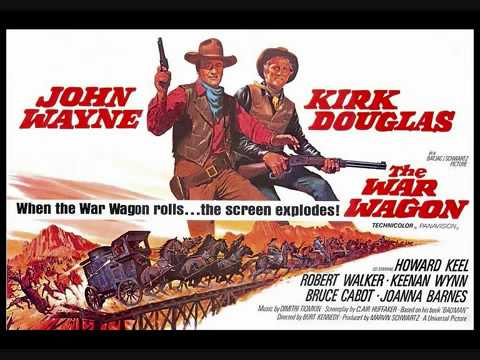
The first thing about the 1967 John Wayne/Kirk Douglas vehicle The War Wagon   (yes, that pun was intentional, thank you)  is that it has o...