Showing posts with label 2010's. Show all posts

Friday, 19 July 2019

“The Nutcracker and the Four Realms”

Disney are really scrapping the bottom of the barrel of potential live-action remakes with this one, aren't they? Not a bad thing, mind. The Nutcracker Suite sequence in Fantasia was so aggressively impossible to turn into a live-action picture in the copy-and-paste way of Beauty and the Beast or The Lion King that the filmmakers would be forced, not just bound but forced, to come up with some creative ideas, if they had to be dragged there kicking and screaming. 

So I thought going into it.

Well… 

…oh dear. 


The thing with 2018's Nutcracker and the Four Realms is that it looks magnificent, and the world and plot-hooks are quite nice, and original, and all. The biggest complaint I have with it on paper is that the Nutcracker is an utter non-entity, whose meager relevance to the plot does not even remotely warrant his getting first billing in the title. But as a story, it's fine. 

So the synopsis is alright. Clockwork kingdom, key, mice, life-giving machine for turning toys into recognizable British actors, yes, yes, all good. 

But the script… oh, the script… I don't think I've ever seen a script quite this unfathomably incompetent. Every word that comes out of the characters' mouth is beyond clichéd, and that goes double for the "morals" the movie keeps pushing — we are in literal "all that you need is in here… and this box contains only a mirror" is a territory, folks. The pacing's also rubbish. Everything happens far too quickly; things like the Polichinelles are broughtback for the climactic battle in what is clearly meant to be one of these ‘everything from the first half of the movie comes back at the end’ kind of things, except they feel like they've just been introduced five minutes ago. Nothing has weight. Nothing has time to settle in. 

Also, for a movie pompously retitled The Nutcracker and the Four Realms, it is strangely uninterested in exploring said Four Realms; the only one we ever really see outside of brief flashbacks is the derelict Realm of Amusements. 

There is, of course, a twist villain. She's a reasonably good twist villain, mind, as these things go, but I just thought I'd throw this out there. Disney, stop with the twist villains already. That is an order. And while, as I admitted, it is well-executed, the concept of this one is just… really? It thinks it's way cleverer than it is. “Ooh, the Sugar-Plum Fairy is the villain! Betcha didn't see that coming!” Well, no, I didn't, because it's idiotic. God

The cast is a mixed bag. The curiously named Mackenzie Foy is what you expect from the female lead in this sort of movie; perfectly adequate; doesn't make too strong an impression either; but you can't blame her for this because the role is so very very blandly written. Keira Knightley is hammily marvelous as the Esmé Squalor-esque Sugar Plum. Helen Mirren and Morgan Freeman, the two main 'name actors', are given barely enough material to make an impression, but they acquit themselves of it quite well. The same cannot be said of poor Richard E. Grant, whose role would already be a paltry cameo were he not encased in a frankly ludicrous make-up job. Jack Whitehall and Omid Djalili (as the dumbly-named guards Harlequin and Cavalier) are, meanwhile, a wholly unfunny comic duo. 

And as for our very nominal male lead Jayden Fowora-Knight (the Nutcracker, here named Phillip), well, the truth is that he's pretty damn awful. He's blander than the screenplay itself, if that's possible. He's such a forgettable slice of nothing that, as of this writing, despite being the male co-star in a 130-million-dollar Disney extravaganza, he doesn't have a Wikipedia page. There's not even a redlink on the cast list of Wikipedia's page on The Nutcracker, which, for the Wikipedia-illiterate, would indicate that the lack of the relevant page is not unnoticed and will be fixed soon. No. Nothing. No one cares enough.

Add to that the fact that James Newton Howard's score is completely clueless as to how to handle the demand to quote and riff on Tchaikovsky's original ballet suite, and so opts to do it as little as possible. 

Really, the visuals and the cleverness of the concepts (when not too impaired by the daftness of the execution) are the only things the movie can rely on. Fortunately, the concepts are clever, and the visuals are breathtaking, so watching The Nutcracker and the Four Realms is still a mostly positive experience. By God it's infuriating, though. 

Post-Scriptum:
  • I am seriously wondering if they cast Richard E. Grant as the Ice King for no other reason than because they thought it would be funny for an actor famous for his "icy delivery" to play the part. If so… good try, but Steven Moffat got there before you, and did it much better. 
  • The end credits are just Misty Copeland dancing to Tchaikovsky within some fancy (but minimalistic) sets and lighting, and that would have been a way better movie. 

Tuesday, 30 April 2019

“Asterix: The Secret of the Magic Potion”

A film which is not, as most talks of it on the Internet would have you believe, Asterix and the Secret of the Magic Potion. Huh. I wonder why, actually, because it's a much better title.


This latest installements in the comical Gaul's animated adventure is the first since 1978's outstanding Twelve Tasks of Asterix not to be based on a corresponding comic book, and that had an original script by René Goscinny himself, so this (written by director Alexandre Astier) is in a sense the first truly theatres-only Asterix story. How does it fare?

Well, as a story, it is a strange crash between modern animation's tastes and the Asterix universe — the result hangs together well enough as a standalone feature, but there's a strange disconnect between the elements that are truly faithful to the continuity of the comics (such as a cameo by Aplusbégalix, the renegade chieftain from The Big Fight) and the modern humor, the modern pace of the storytelling, and most importantly the nature of the villain, an outright sorcerer in a way Getafix/Panoramix never was in Goscinny and Uderzo's conception. I should also mention the nature of the climax is, to say the least, not something you could imagine in an Asterix comic-book… the one with aliens apart, of course, but that… thing… really shouldn't count. That being said, albeit in a very different way, Twelve Tasks's story really didn't feel like one of the comics either, so let's be lenient. I shall be less lenient of the shameless clickbaity nature of the title, for while the passing on of the recipe is admittedly a big part of the storyline, the actual recipe itself is not given to us as the advertising tricked us into hoping. 


That bsaid, albeit in a very different way, Twelve Tasks's story really didn't feel like one of the comics either, so let's be lenient. What of the animation? It is CGI, and that loses it some points in my book, but for what it is it's very well-done. The human characters have a vaguely blocky look to them that reminds me of a high-quality video game's cutscenes more than of a film, but the movements itselfare very solid, the designs of the new characters are great, and there's some really nice effectswork in there too; I love how they did the Magic Potion, which never really had a standard appearance before now, that I know of. This one is likely to become the gold standard from now on (and the use of the word 'gold' is quite deliberate).  


As concerns the cast (I speak only of the French cast; being French, I had little incentive to track down the English dub of all things)… oh my. Bernard Alane is back as Panoramix and does quite good, though he takes some getting used to, being very much unlike the previous Panoramixes of the cartoons. But the absence of Roger Carel as Asterix is very sorely felt, and his replacement Christian Clavier, fresh off butchering the role of the Count of Champignac in another Franco-belgian-comic film (the dire Spirou & Fantasio live-action film), isn't even remotely up to the task. 


The one true stand-out in the cast is Daniel Mesguich as the villainous Sulfurix, a character who is best described as “the Soothsayer, except actually magical”. The character is well-designed and well-thought-out, with an interesting backstory and motivation (even if it's not kept coherent the whole way through; being that his thing is that he wants to spread use of the Magic Potion to all of Gaul so that it can take over Rome and end all wars forever, the movie struggles to explain why he ends up allying himself to the Romans, something apparently done only so Caesar could be in the movies for a few minutes because we gotta have Caesar in any Asterix picture whatsoever now), and his voice is a masterful effort, even managing to sell a few dodgy lines along the way. I should also point out that while the voice he uses there couldn't be more difference, I get the impression that a Carel-accurate voice would totally have been within Mesguich's ability, and that we got freakin' Clavier instead just makes me so mad. 


There's also one Lévanah Solomon as the kid Pectine, who isn't very deeply characterized and seems to exist mostly as a setup for other, better stories about her. Certainly she's more of the concept “Panoramix's youthful-inventor apprentice” than she is a fully-realized character for now, and she feels a little bit shoehorned in the plot. Not wholly bad at all, just… a little fuzzy around the edges. Solomon herself is pretty good, if nothing stratospheric. 

So that's Secret of the Magic Potion — certainly not the new Twelve Tasks of Asterix, but some of the voice cast aside, a pretty fun adventure, and as good an occasion as any to return to the Gaulish village while the comic authors take their time to get the new book together. 

Post-Scriptum:
  • Instead of a full-on comic adaptation, the movie is getting a picture book adaptation. Kind of lame, but at least, the cover looks gorgeous


Tuesday, 16 April 2019

Fanny Ferré, “Tribal Crossings”

RANDOM reviews. It's right there in the title. I have every right to go review modern fine art by some French sculptress, if I like. I could post a review of the color orange if I liked and still not be betraying the core concept of this blog.

So!  Traversées Tribales (Tribal Crossings to non-French-speakers) is a series of very beautiful, very skillfully-made terracotta statues by contemporary artist Fanny Ferré. Whilst vacationing in Honfleur, I stumbled upon an exhibition of the collection, and took a number of pictures of it (all the pictures below are mine), and therefore decided I might as well blog about it.


Ferré's statues mostly depict humans (some life-sized, others delicate miniatures of exquisite detail). It is a little hard to tell what sort of humans — a prehistoric sort of civilization, as the title implies; one is tempted to think Neolithic, and there are some figures who are not unlike Neanderthals in their facial features, though the sort of animal life depicted — and, indeed, the general feeling one gets — should place them further south. It does not really matter; what matters is the feeling they give off, and that feeling is a charming sort of nomadic Neolothic. A lot of the figures are bathing — some of them in the nude — and I do not quite know why, save perhaps that Ferré enjoyed the challenge of depicting bathing in a medium where liquid water itself cannot be convincingly rendered.


Gangly, exaggerated, with their legs at odd angles, Ferré's human figures are not what you might call ‘realistic’, though they do feel 'real' and 'alive' on an emotional level — they do feel as though they are mare of flesh and blood. It's quite an amazing trick. Indeed, they are quite beautiful. It is not unlike some examples I've seen of prehistoric art and sculpting, which I'm sure is no coincidence. 


There are objects, too, and animal figures, mostly barnyard ones. They too are extremely well-done — Ferré's is truly an excellent depiction of fur, better than one would assume possible with roughly-modelled terracotta — though in a surprisingly different style from their human masters. Which is not to say they don't fit in with the rest of the artwork, mind you; somehow, they do. I'm just stating facts.


So… there you are. What I say is, hallelujah, for there are still good artists in the world, and some of them even get exhibitions to their names in French seaside resorts!…

Post-Scriptum:
  • The below life-sized terracotta goat is a beautiful artpiece, yes, but the expression on its face also looks like an Internet reaction image. Doesn't it? 


Monday, 8 April 2019

“Resolution”

Alright, so Chris Chibnall promised Daleks, and delivered Daleks, and therefore was not set on fire by the enraged Doctor Who fandom. What else?


A very good episode of Doctor Who, is what else. It does not altogether feel like a “special” in the way the Christmas Specials did (I suppose New Year's is even more of a formality for most people than Christmas; I suppose pledges of doing one's chores are somewhat poorer at stirring the heart than love, family and hot cocoa), but it's quite a good one-shot Dalek episode. The acting from the guest characters is great, Akinola's music is mostly unobjectionable this time around and has a few legitimately great moments (short though they are), the direction is up to the usual Series 11 standards, and… Chris Chibnall turned in a good script.


I know, I know. But it can happen! The Silurian two-parter from Series 5 and Dinosaurs on a Spaceship, for example. And I think Resolution is actually a better than those, even if it still has the Chibnall trademark of a science-fiction story and a relationship-drama story mashed together with a sledge-hammer (one scene from one, cut, one scene from the other) as opposed to actually being welded in any significant way. Resolution, in fact, has got that particular problem more than any of his previous episodes you'd care to name. But perhaps this is in fact a good thing, for it allows each side to stand on its own, leaving one with the somewhat boilerplate, but not really unpleasant, "Ryan's Dad" subplot, on one side, a frankly great Dalek story on the other. 


So the plot: on New Year's Day 2019, two archeologists, an immensely likable pair played by Charlotte Ritchie and Nikesh Patel, who, I'm sorry to say, are a billion times more interesting to watch than Ryan & Yaz for most of the time they're onscreen) dig up an ancient burial site beneath Sheffield — yes, of course it's beneath Sheffield, it's Series 11… or good as. Among the weird things they find is a fragment of a Dalek-creature, who has been buried on Earth since the 9th century, having been one of the first Dalek scouts sent out from the Planet Skaro way back in the day. A veritable army had, at the time, managed to subdue the Dalek and destroy its casing, but even after hacking the mutant blob apart, it still lived and twitched (as per The Witch's Familiar's addition to the Daleks' lore; gotta love that continuity), so they buried the pieces in the far corners of the Earth and founded a secret society (the Order of Custodians) to keep them separate. 

I should hasten to point out that this "buried in the four corners of the Earth", "Order of Custodians" nonsense is of absolutely zero importance to the plot, for the Reconnaissance Dalek promptly puts itself back together through some weird, ill-explained teleportation ability of his,  andwe never meet the Order, nor do they do anything of importance in the backstory that comprises their entire appearance. It's just daft, and probably the writing's capital sin, though it is one that's easily ignored.

“ExterminHEeElLLlllPPpPPP!!!!

On the other hand, I've seen criticism of the idea that any number of 9th century warriors (even an army) would be able to destroy a Dalek's casing — but this is actually a nonissue, for it is the later, Time War Daleks who were practically indestructible, whereas the Reconnaissance Dalek is explicitly "one of the first to leave Skaro", meaning that A) it got there without time travel and B) it is therefore a thousand years older than the relatively-easily-destroyed models from The Dalek Invasion of Earth (who got to Earth in the 22nd century!). Most likely it was basically identical to the original The Daleks Daleks, and those guys could be destroyed by kicking them and making them fall down elevator shafts, or just pushing them against a wall really hard. See above.


So, having pulled itself back together, the Reconnaissance Dalek proceeds to possess Charlotte Ritchie's character (because yes, Dalek creatures can do that now, shaddap) and drive her around like a puppet in an effort to get her to build it a new and improved casing — the whole sequence with single-minded, possessed-Lin is truly glorious, and Nicholas Briggs as the Dalek's voice reaches new heights. The way Lin is made to speak along with it also extremely effective. One is truly saddened when it is over, though the product of Lin's smelting (the parallels to the Doctor's creation of a new Sonic Screwdriver in The Woman Who Fell to Earth are obvious) is quite a sight to; a misshapen, rusty Dalek clearly built out of spare parts, yet still fearsome enough.  


The reconstructed Reconnaissance Dalek has a verbal showdown with the Doctor, as Team TARDIS (who has been frantically tracking the Dalek thus far) finally catch up with it just a moment too late. It's an effective scene, though there's little that makes it stand out from earlier "the Doctor defies a Dalek" moments (the gold standards for those, of course, being Christopher Eccleston's turn in Dalek, which everyone else has just kind of been shamelessly copying). Whittaker's Doctor finally gets to show a bit of menace, an element which many critics agree was missing from her performance thus far. The Doctor has to deserve that “Oncoming Storm” title the Daleks give him/her.

(Speaking of which, if this is truly a pre-Dalek Invasion of Earth Dalek as we're led to believe, it does not entirely make sense that it would so readily recognize the Doctor, for at that point the Daleks had only met Hartnell's Doctor, and presumably didn't know about regeneration. Oh well.)


Unfortunately, this is where things take a turn for the… well, worse, though that's not to say the resolution of Resolution (heh) is bad per se. It soon becomes clear that we're not just trying to stop the Reconnaissance Dalek because the Reconnaissance Dalek might kill people (though it does do that, too, mind you). No, the Reconnaissance Dalek must be stopped before it highjacks all radio-transmitters in Great Britain in order to send a signal to the main Dalek fleet.

Whut? 

There is so much wrong with this idea. For one thing, considering there was an entire Time War in-between the Reconnaissance Dalek's arrival on Earth and the events of Resolution, and the Daleks changed leadership, like, ten times, it is no guarantee the current Daleks would even listen to that half-dead relic of their ancient times. It's a bit like worrying that one of Napoleon's army scouts, cryogentically frozen since 1807, might, if thawed-out today, lead the modern French Army on the warpath overnight if he's allowed to reach a telephone with which to call the French Minister of the Armies. 

Furthermore, the modern Daleks know full well that Earth exists and would be suitable to Dalek conquest. In fact, they've tried. Repeatedly. And the Doctor has stopped them. If he got the Reconnaissance Dalek's message of “I HAVE DISCOVERED A PLANET WE MIGHT CONQUER! IT'S CALLED EARTH! COME DOWN HERE!”, the Dalek Emperor would probably answer, as patiently as he could manage: "YES. WE KNOW EARTH EXISTS. WE KNOW. THERE'S A REASON WE STILL HAVEN'T CONQUERED IT YET; IN FACT, I THINK YOU'VE MET HER. BUT WE KNOW.” Hardly that scary an event.


The Dalek's final defeat (no, don't worry, the above picture isn't it) begins amusingly, but is by the end dull and a little bit confusing. It is praiseworthy that Chibnall tried to involve Ryan's Dad and his microwave-oven into the proceedings, but it only works the first time around; by the time the Dalek has lost its casing again and tries to possess Ryan's Dad, who inexplicably manages to fight it off better than Lin because……the power of love……?……, you just wish the microwave had been enough.

Still, in terms of tone, Resolution is everything you could want, and with strong actors and Series 11's ever-reliable visuals to go along with it, why deny yourself? It's one of the best Chibnall-era stories yet in my book, though perhaps not the best (I think I'd still rank Demons of the Punjab and Kerblam! above it, not necessarily in that order).

Post-Scriptum:
  • Dear entertainment industry, could we just stop defeating bad guys by judicious opening of airlocks? Or other "irresistible sucking force" plot devices? Doctor Who, you, in particular, already played that card in Doomsday, and much more impressively than here. So enough.


Monday, 4 February 2019

“Born Again”

Fanfiction and fanfilms existed even before the Internet and have become a simple fact of life ever since its inception. Yet not all fan works are apiece. Where a fanfiction, say, of DuckTales, is just that, there are some franchises that have spawned such fandom that fan works based on them have begun a genre of their own, with their recurring themes and their codes, to the extent that you can find people who forego the original completely and are a fan of the fanworks. The incommensurably gigantic Harry Potter fanfiction community is the quintessential example, but Britons don't stop at that; they have a cinematic equivalent too. And that is Doctor Who fanfilm.

Ranging anywhere from children dressing up in their parents' jackets (and being very charming too!) to productions of truly professional quality — and let's not talk about the odd aberration that are fanfilms to whom the official actors contributed, just for the heck of it! — Doctor Who fanfilms are astonishing, frequently awful, and sometimes superior to many televised episodes I could name. I love them dearly and regularly enter ‘Doctor Who fanfilm’ into YouTube's search bar just to see if any new nice ones have popped up.

And just two days ago, well fancy that.


Born Again, the work of Paris Freeman (who also plays the Doctor and directs this first episode; this is very common in fanfilms, for obvious reasons), is the first episode of a new fanfilm series which transparently comes to fill the power vacuum left by the DW2012 series, the ten-year-spanning, four-seasons œuvre of Luke Newman, another fan turned writer-director-Doctor. (If you want proof of Freeman's obvious intention to be the next Newman, look no further than the name of the YouTube channel now hosting his first attempt, TimeLord2016.)

The DW2012 series was not the best fanfilm series by far, not even the best one on YouTube; some of its stories flirted with the downright imbecilic, and it had all the wobbly cardboard sets, tinfoil monsters, barely-pubescent actors and reused sountracks cribbed from the official show that are the hallmarks of cheap YouTube fanfilms everywhere. Yet it had proven to be the most popular, perhaps through sheer tenacity (ten years and four seasons is more than most halfway-competent fanfilmmakers can boast), perhaps also thanks to Newman's extremely likable, hearfelt, original take on the character of the Doctor, far more than the cheap Matt Smith impression you usually get in these things. Not that Newman isn't very Smith-esque, of course.

But we're not here to talk about the DW2012 series; we're here to talk about Born Again. How does it hold up? Averagely, is my cop-out answer. Though it commits the sin of having one of the most boilerplate pilot titles imaginable, it's off to a very strong start as we watch the Doctor regenerate into a still very harried Paris Freeman and frantically try to steer the crashing TARDIS.


It's a very strong start, full of action and moody lighting and good acting. The effects work, by fanfilm standards, is pretty amazing, and will remain so for the duration of the entire episode (not that it's a feature film, not anywhere close; it's a tight 20 minutes or so). This is, no joke, probably the best regeneration effect and in-flight TARDIS I've ever seen in a fanfilm, and still pictures wouldn't do it justice; whether or not you meant to watch the whole thing, I definitely urge you to follow my earlier link and just watch the first few minutes and the opening credits sequence. And — oh — the opening credits sequence — that too is a thing of beauty. It has nothing to be ashamed of when viewed back-to-back with the intro used in Peter Capaldi's last official season, and I daresay I prefer it to the more understated affair of Series 11, though I'm not quite sold on the creative rearrangement of the iconic opening tune, which is as far removed from Murray Gold's 2010's version as even Gold's 2005 version was from the 1963 Ron Grainer classic, and that is perhaps one step removed too many. 


Unfortunately, things rather quickly go downhill from there as Paris Freeman's Doctor crashes into an American girl's back yard, and the girl, though wary of him, ends up cooking for him, and finding herself believing that he is an alien after all, and finding herself drawn in even though she is less than impressed by some of his idiosyncrasies, and… and right about now you're probably realizing that this is just Amy Pond, except without any of the interesting bits. A common ailment in fanfilm companions, sadly. Complain all you like about the blandness and interchangeability of the official onscreen companions, but you ain't seen nothing yet.


But stuck we are with Nicole Williamson (I'll give the film that this is pleasantly sounds like an American name without being a caricature of one). The fact that she is as basic a fanmade companion as they get would be bad enough, but she is portrayed with frigidly wooden acting and a gratingly monotone voice by Gabrielle Wright.

And I realize that it is unfair to pick on fanfilm actors, who are by definition doing a labor of love with an amateur background, but I hope that the TimeLord2016 folks take this as the backhanded compliment that it is: it is only because you got so close to letting me forget this is a fan production that this acting (well, lack thereof) sticks out like a sore thumb. 

But if the companion's a dud, at least the Doctor has to be okay, right? Well, mostly, yeah.


The bad first: past the opening scene where a certain amount of harried slurriness was expected, I slowly came to notice, with not inconsiderable dismay, that Paris Freeman mumbles half his lines instead of saying them. When he does say them he does it well enough, and his American accent isn't nearly as noticeable a 'flaw' as you might think, but this is certainly not a Doctor I'd listen to in Big Finish audios. In totally unrelated matters, I won't speculate on Freeman's exact age, but there is the unavoidable fact that he looks strikingly boyish. Not in itself damning for a Doctor (Matt Smith and Peter Davison were certainly very boyish-looking), except that Freeman doesn't seem to realize quite the extent of his own boyishness. His portrayal seems to befit a considerably more mature Doctor than what we're looking at; it's telling that the feel of his costume, and the music used in his very first scene, are both clearly inspired by Peter Capaldi's Twelfth Doctor.

But those are minor problems. In a world where otherwise-great fanfilms are marred by leads who Just. Can't. Act, Freeman yields a perfectly acceptable, even entertaining performance. He's certainly no worse than Luke Newman was in his Doctorish debut (where Freeman now mumbles, Newman once muttered); he's confident and charismatic in his portrayal, though not as much so as a professional actor might perhaps be in his place. If there is one easily-fixed flaw in the Paris Freeman Doctor, it is more with the writing than the acting, and it is that he hasn't really had a chance to be funny yet. Genial, yes, but I'm still waiting for a moment of outright daffiness for him to call his own.

All in all, Freeman delivers a perfectly serviceable fanfilm Doctor — of the breed who would be a travesty if actually cast as the Doctor on actual television, unlike, say, Bryan McCormack, but who by YouTube amateur standards deserve more encouragement than criticism.


Okay, so we've got our Doctor and our companion, what of the villain/monster? Ah, I thought you might ask. Well. Again, it's complicated. 

Surprisingly for a fanfilm, where it's usually the opposite, what we have here is a stunningly-realized concept that, as a concept, really doesn't hold much water. Perhaps it might make more snese in a more polished script, but the Stratagem… let me try to sum them up for you: the Stratagem is an alien hive mind remotely controlling a robot body trying to coerce the Doctor into teaching them how to steer a time machine with which they are accidentally opening gaps in the fabric of space-time, which may destroy Earth given time. All this in the space of — well, of ten minutes, really, allowing for the opening and sequences and the half of the actual screentime that is devoted to the tepid spectacle of the Doctor meeting, and bonding with, Nicole.

By contrast, the Daleks are angry dustbins who want to kill people.

But let's not be too hard on the Stratagem; as I said, where the concept is lacking and overconvoluted, the execution is very effective. The robot body is as real-looking and imposing as any pre-2005 Cyberman, that is to say, pretty damn much for something which inescapably looks first and foremost like a chrome-painted costume; Andrew Dillon does a good job of making it move in stilted, economically jittery littlemovements, withou nary any corpsing. Dillon also provides it with a shrill, monotone voice the — the filter used on it sounds a little too much like a Dalek voice, perhaps, but that doesn't have to be a bad thing. All in all it does a very good job of making you forget that strictly all it does for all of its screentime is stand around in one place.

Also: next to the Stratagem in all of its shots is a round mechanical energy-wheel-thingy (see above) which serves as its time machine's power source, and it's such a little thing, but the effect on it is really, really good. Doesn't at all feel like tacked-on CGI. The light even seems to reflect on the Stratagem's outer plating. Congratulations.


Speaking of props and effects, I earlier congratulated the CGI, in-flight TARDIS. Well, the physical one ain't no slouch, either. Its control room is made of deep brown, well-polished wood, with a particular clever bit of set design in the panels on the hexagonal console (hexagonal, like the classic hexagonal things on the wall) which can be opened to reveal the switches and buttons and levers. Now, this hexagonal console lacks a moving, vertical column-thing (what true Whovians know to be called a “Time Rotor”), and compared to the official televised ones it is really quite a small thing, like the room itself, for that matter. But it matters not — an actual control room it is, as opposed to some unconvincing greenscreen hocus-pocus such as I have encountered in the past, and quite a delightfully-designed one. And did I mention they have an actual physical TARDIS prop for outside shots? Full props to the props department.


All in all Born Again does not transcend the genre of Doctor Who fanfilms, but it is a very fine example of the form, and if they heed the quibbles earlier outlined, I have very high hopes for TimeLord2016's fanfilm series. Let us hope it will enjoy as much of a bright future as DW2012 did!

And for our Post-Scriptum, appropriately enough, I urge you, if you do watch Born Again for yourself, to watch its end credits too. They, also, are gorgeous. 

Tuesday, 29 January 2019

“Doctor Necromantic”

Doctor Necromantic is a webcomic by Nate Bramble, currenly published either on its own domain or on the website Tapastic (or do they prefer Tapas now? bah! humbug! I'll call them Tapastic much as I will call Wikia Wikia to my dying breath, whether or not they rename themselves Ostrich or whatever). Webcomics, much like print comics, are a wild jungle of mediocrity with the occasional gem, and I think this is one of them. 


It concerns a wel-off gentleman by the wonderful name of Dr Olaf Derleth, who decides to take up necromancy as a hobby. Spooky fun ensues in a classic Addams Family or Comedy of Terror vein.


Even setting aside for a moment the fact that I really like spooky comedies, and that this is a very good one, I think the biggest draw has to be the artwork. The watercolor coloring/shading and the “classic” look of the characters, combined with the detailed backgrounds, make for an extremely appealing aesthetic that is too rarely seen in modern comics. Note also that this uses the comic font, the one foolish discarded by IDW lately as you'll recall from the last post. I dig it.


The above strip is representative of the kind of joke usually found, and of Dr Olaf's dynamic with his simple-minded (but in no way  Igor-eque) assistant Carl. Most of the comic is just strips of this sort chronicling Dr Olaf's studies into the Dark Arts. The Doctor himself is a fun protagonist, whose acerbic wit, ego, and cynicism somehow shouldn't work with the fact that he is also an incompetent beginner, but, somehow, do.


This not to say, of course, that Doctor Necromantic is perfect. As with any comic strip, some jokes just aren't that funny or tasteful, and some of the attempts to inject a serialized story into the proceedings don't work as well as the author thinks they do.

Nevertheless, Doctor Necromantic is a very enjoyable (and rather quick) read, recommended to all who like both classic comic strips and fun spookiness. 

Post-Scripta:
  • Is it a coincidence that both this and another, much-better-known gothic-story-parody, Lemony Snicket's Series of Unfortunate Events, feature an egotistical, cynical nobleman by the name of Olaf with a unibrow? I frankly don't know. 
  • Yes, this review was rather short, but I don't have much time these days. Still, you can look forward to a review of a much better Disney comic than… what we saw last time… quite soon! And after that, to another, non-comic bit of wannabe-gothic hilarity…


Saturday, 19 January 2019

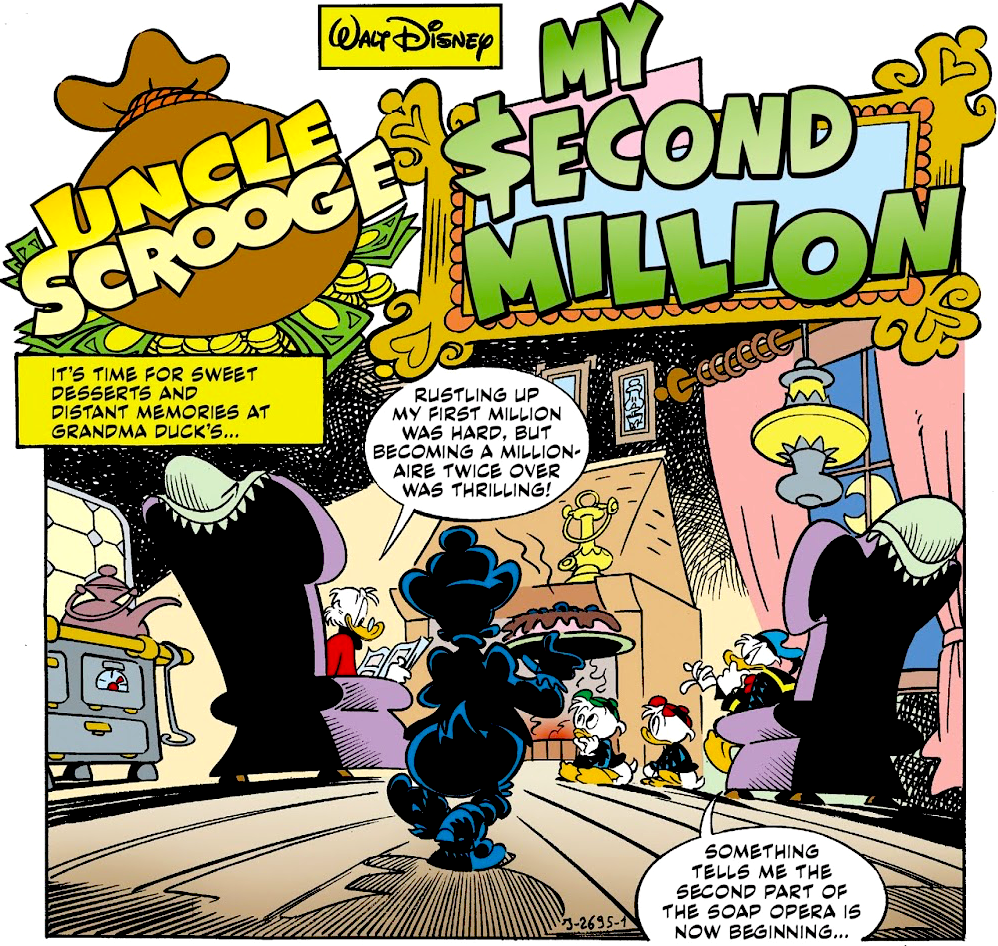
“My Second Million” And Its Translation

I love Disney Comics, and I love period dramas, and I love ventures into the pre-1947 life of $crooge McDuck — indeed, my only beef with Don Rosa's masterful Life and Times series has always been Rosa's conscious decision to not only limit himself to Barks, but to try and write a 'definitive' biography with precious few holes for other authors' tales to fill. Thus it stands to reason that I would love All of $crooge McDuck's Millions, the miniseries which New IDW have elected to start off their run of Uncle $crooge with. 

But no. 

It's terrible. 

The series itself — it's a little on the bland side already. I'd previously read a few chapters of it, though not this one, either in French or in their online ComiXology format. But a little blandness is nothing some snappy, euphonious dialogue can't solve. That had, ever since they began, been the philosophy of American translations of Disney comics; and while I don't condone some of the heavier changes performed by these 'freeform' translators in the past, there's no doubt who I'd pick between them and dialogue that sounds like it's been written by a goddamn robot. 

And oh, does the IDW version of All of $crooge McDuck's Millions (renamed Uncle Scrooge: My First Millions in this printing, in perhaps one of its wisest decisions; mark that noting something title's is slightly less terrible than it could have been is probably the faintest praise anyone's ever damned anything with) ever read like it was written by a goddamn robot. Let me demonstrate. 


So I'll make a cursory note that Paolo Mottura's art is what it always is, namely that the background and shadowwork are extremely impressive at times, the characters' on-modelness is sometimes less so, and overall it's pretty solid. This isn't its most impressive example or anything, but it's soearing leagues above Fausto Vitaliano's frankly insipid plot, and more to the point grafting this terrible English dialogue on it feels rather like surgically giving a pig's tail to the Marsupilami. 

But so then, the dialogue. To begin with, Scrooge's line is fine, I guess, but ‘hard’ vs. ‘thrilling’ is hardly the most effective dichotomy. Might I suggest, for example, ‘tough’ instead of ‘hard’? Mostly however, it is Donald's line which fails horribly. “The second part of the soap opera is now beginning”? Who's saying this, Donald Duck, or David Attenborough? Try to imagine Clarence Nash saying this in his Donald voice. Just you try it. The line even fails on its own terms — “soap opera” is an amusing turn of phrase that cannot ever, ever, ever sound refined; sticking it in the same sentence as a by-the-book construction such as “is now beginning” simply will not do. 

The awful thing, of course, being that this line could be very funny. Comparing Scrooge's tales to a soap opera from within a serialized format of storytelling is delightfully metafictional. But you can't even think of all that, because your eyes hurt from how badly that thought is translated into words. 

And the stilted, robotical, unsayable-by-real-humans dialogue does not


ever


ever


goddamn


STOP. 

I've heard people defending the so-called ‘Fresh And New’ translation style by proposing that the higher-ups of IDW (or, indeed, Disney itself) may have ordered the simplification of translations to better appeal to younger audiences. To this I say, firstly, humbug, children haven't been the core audience for Scrooge McDuck in the united states in forever; secondly, if you dare bring up DuckTales 2017, I'll counter that even within this show's fandom, the kids are primarily interested in the triplets and Webby, whereas the Scrooge fans are on the older side; thirdly, I will kindly remind you that children love wordplay very much and stilted Grammarbot.exec speech less so. 

And fourthly, the Fresh And New translations even fail at being educational. Oftentimes they'll use English phrases wrong or just make them up. For example…


…ten second's Googling, if nothing else, will inform you that a telegraphic message is called a telegram. The telegraph is the machine you use to send it. See, this is the kind of detail you really don't want to get wrong if your aim is to have simple, grammatically-unfailing dialogue to aid and educate youngsters. 

And…


…TWO IN A ROW? HAVE YOU NO SHAME? HAVE YOU NO CONCEPT OF MERCY?! 

What we have here, in both panels, are attempts at witty dialogue. Or, rather, they are the charred husk of what was once witty dialogue in Vitaliano's original, mangled beyond repair by the Fresh And New treatment. “I smell the smell of [smth]” is not something anyone has ever said or ever will say, thank heavens. And it's painfully clear “Nothing can stop progress or my wealth!” used to be a wacky spin on the “You can't stop progress!” proberb in Italian that lost any fizz or pizzazz when the Fresh And New translator failed to consider that, A), the saying is less readily recognizable if you swap out 'you' for 'nothing', and B), “wealth” is not some sort of progress you can “stop”. 

For reference, here's how I (an unpaid amateur) would have done it. 


I think anyone with a taste for funny comics will agree it's already bounds ahead of the printed version. And I'm not even saying this is that good for localization — that first one is a little unwieldy, I kind of wanted to do something in the second one with the visual of Scrooge's ever-rising curve, and, of course, the lettering is all over the place. Yet in all humility I feel pretty confident in stating that by most metrics, it's already bounds ahead of the printed version. 


These two here are clients to whom Scrooge is giving a refund. First, “that's not enough!” and “that's right” are as boilerplate as you get. But also: unless Alistair here is a police officer, the line “I should put you in jail!” is nonsensical (it should at least be: “I should have you put in jail”). And unless he is a good friend of Scrooge (he isn't), you just can't let him call Scrooge Scrooge in the way he called him Paperone in Italian. That's as bad as those children's books where people like the Beagle Boys or even total strangers would refer to him as “Uncle Scrooge”!

And on, and on, and on. Mistake after blunder after blandness after nonsense, right up until the last panel…

…where even all of Mottura's shadowwork can do nothing to obscure the sheer fact that casual use of the word “businessduck” goes against everything we know of how anthropomorphic species work in the Scrooge McDuck universe. Fercrissake, one of the most famous and influential Scrooge stories ever is called Only a Poor Old Man, and you think terms like businessduck are a thing? What did the translator use for reference, My Little Pony


…so yeah. My Second Million, IDW edition. It's terrible. I've been trying to articulate just how lowly I think of it, and I think I have it now: if for some reason I ever want to reread the story, it's the ComiXology version I'll pick up. It would still be a travesty if a publisher tried printing it in a regular book, but it's still better than this version. Let me repeat that, for it bears repeating: this is a situation where the cheap ComiXology translation is significantly superior to the printed IDW version! THIS SHOULD NOT BE A THING THAT HAPPENS! Here's the first panel in the ComiXology version. Compare the IDW one I showcased above. The dialogue ain't Oscar Wilde, but good lord is it better here than it was there. 


And for our traditional Post-Scriptum, something else that irritates me about the so-called ‘Fresh And New’ translations, and which the ComiXology versions didn't get wrong: I didn't mention it earlier because it can't be the translator's fault per se, but what the sugar-bowl is up with the new font? For whatever reason, to go along with the change of staff, it was decided to use a completely different, and (if I had to choose) significantly uglier, font, than the one Disney comics had been using for decades. Compare the two version of the opening splah panel.

Monday, 24 December 2018

“Doctor Who” - Series 11

I have neither the time nor energy to make full-scale reviews of the individual episodes of Series 11 of Doctor Who — or, for those of us who still bemoan Russel T. Davies's 2005 clerical error and try to reinstate the real numbering, Season 37 — but I do still want to say something about it. 


Hence, I'll make this catch-all review, not including the yet-to-air holiday special (Resolution, a.k.a. The One That Promised Us Daleks And Had Better Have Daleks Or Else The Fandom Will Literally Set Chris Chibnall On Fire). First I'll briefly review each episode, then I'll write up general thoughts about the series.

INDIVIDUAL MINIREVIEWS:


The Woman Who Fell to Earth - Sets up a nice sense of mystery and is as good an introduction to a new Doctor and companions as anything. Very efficient climax. The vlog framing device is gratuitous and annoying, however (a series opener should know better than to recall so heavily a one of the most hated episodes of modern Who), and as effectice a surprise as Grace's death is, it's also a darn shame, as an older woman is not something we've had as a companion before and might have been brilliant. As for the monsters? Middling average, I guess. T'zim-Sha is imposing enough, with just enough complexity to work, and the Datacoil is successfully scary and a creative sci-fic concept. But I could have done without the "teeth" gimmick, which is squickier than it is anything else, and overall this ain't exactly the new Daleks. The cinematography's nice, the effects are great, everyone's acting gets the job done, and can I just say that I kinda like the Thirteenth Doctor in the torn, loose-fitting Twelfth Doctor costume than in the more "cookie-cutter" attire she later picks out as "her" outfit? Maybe it's because it reminds me of the sorely-underappreciated Second Doctor's look. 


The Ghost Monument - Has the good sense to spoil its big reveal towards the beginning; it was rather obvious and a whole episode of building up to it would have been extremely obnoxious. The Race is a nice hook for a story, and Desolation is just brilliant as a setting. Unfortunately, the guest characters are unbearably cliché — the tough cynical guy whose cynicism goes back to textbook Freudian trauma, the scrappy racer of poor background who wants the money so she can support her family, blah blah blah, yeah, yeah, whatever. The Remnants are creative (if confusingly named) monsters, but are given far too little screen time compared to the stupid cookie-cutter "Sniper-Bots". …Oh, the ending scene where they find the TARDIS is suitably squee-inducing, I suppose. Not anything special, but neat. I do like this TARDIS design — that is to say I like the interior; the exterior is not nearly blue enough. 


Rosa - If Doctor Who was to return to its primitive “educational show for young audiences” aspect (…why?), this episode takes a decent stab at doing that by teaching kids about the Rosa Parks story. Certainly, a time-traveling villain who's trying to change a flurry of tiny details in order to prevent the event from happening, forcing the heroes to gather all knowledge they can about how things really happened to make sure they do happen that way, is a clever way to work the educational element into the time-travel story. Unfortunately, the episode undoes that very clever concept for "fun learning" with its incredibly clumsy ending which sees the Doctor just kind of monologue about the rest of Rosa Parks's life like she's the narrator of an abridged biopic for kids. Bluh. Combine that with the most laughably heavy-handed depiction of racism in 20th-century America you've ever seen (and I get that the show has its heart in the right place; it's just… when literally the first thing that happens stepping into 1950's Alabama is a white-skinned jerk punching your black character, you might want to crank up the subtlety just a bit), and the most uncharismatic villain this side of the Abzorbaloff, and you have a very, very mixed bag. Oh well. I wouldn't be in quite so much of a huff about this, except that (no doubt to make sure to telegraph to the world that they are of course very progressive and antiracist) a crushing majority of people gave the episode glowing reviews it simply doesn't deserve, and that irks me. 


Arachnids in the U.K. - It pains me that some of the spiders in this episode hardly look any better than those of Planet of the Spiders several decades ago. Aside from that… an entertaining enough adventure, and I'll give it that it has a very strong setpiece in the cobweb-covered apartment. Things kind of go downhill from there, however. As I said the effects are wonky; the plot is very thin in places; the well-acted but lazy Trump parody is nothing more than a lazy Trump parody, and will just serve to make future viewers wince in embarrassment twenty years from now; the episode ignores the square-cube law (which, fine, if you must have giant spiders you might as well), then suddenly decides that it doesn't and has its resolution hinge on it; the way the spiders are lured into the Doctor's trap is one the stupidest way to defeat a monster in the history of television. 

Also, the episode seems very confused on the "moral dilemma" it tries to present at the end. We're meant to side with the Doctor when she chides Not-Donald-Trump for wanting to shoot the mother spider and says the creatures deserve to "die with dignity". I have a feeling the episode got too caught up in lampooning Americans' "have you tried shooting it with a gun?" attitude to problem-solving, and didn't stop to consider that a quick painless death by gunshot to the brain is what is usually understood by "helping an animal die with dignity" when it's already fatally wounded. This is especially puzzling when the only other way for the spiders to die if Not-Donald-Trump doesn't interfere is to slowly suffocate to death, which the episode just pointed out is a miserable and painful way to die, like, a minute ago. What the heck? 


The Tsuranga Conundrum - Silly and confused in all the wrong ways, despite some cool ideas here and there. The Pting feels more like an idea than a fully-realized concept, though it has a certain silly charm. The idea of setting the action on a hospital ship isn't really used to a meaningful degree outside of the alien giving birth to amp the drama at one point. It feels like we're going to get a bit of an arc for the Doctor, who has to learn to sometimes not try to take charge and leave it to the actual professionals; that's certainly what the beginning of the episode seems to be building towards; but… nope. This episode is a big bubble of nothing with only the cinematography to recommend it, and even that (one of Series 11's strongest points overall) is stifled by the enclosed setting. 


Demons of the Punjab - Wherein the characters take a trip to the past of the forebears of the female companion, promising not to interfere, then proceed to interfere, mostly because they hadn't even begun to plan a shred of a cover story. Buh. …But, oh, I shouldn't gripe. Punjab may Rosa's flaw of being much too heavy-handed in tugging at its audience's heartstrings, but it looks very beautiful and has a number of nice moments, with good to great acting from everyone involved, and some of the best music in the series (even if I still think Murray Gold was an overall superior composer, Akinola has several great moments in this one). What's more, it approaches its historical subject matter… not perfectly, but certainly with more tact and nuance than Rosa did. 

I do think it was a bit early after Twice Upon a Time to pull another "the time-traveling humanoid monsters may look scary but they're actually nice, and visiting the times of people's death for entirely selfless reasons" twist, and now I can't help but imagine the comedy sketch that would result from a lingering 'Demon' to bump into an early-bird Testimony, but after all, not repeating itself has never been one of Doctor Who's strengths. Also: the glorious moment of the Doctor being too focused on the readings of the ubiquituous Sonic Screwdriver and missing the giant spaceship right there at her feet. Gotta love that. 


Kerblam! - My, do I ever approve of the Doctor wearing a fez. Please let her keep the fez for once, please please pl-nope, of course not. (Sigh.) Anyway. This is a very good episode. Well-shot as always, it is also well-acted; aside from the regulars, Julie Hesmondhalgh's highly energetic performance is a highlight, similar to fan-favorite Harriet Jones without feeling like a cheap copycat; Claudia Jessie's Kira Arlo is a veritable ball of charm wrapped in lovable sweetness; and Leo Flanagan is convincing both at face value, and following the twist about his true motivation (though I kind of bemoan the existence of said twist considering how charming face-value-Charlie was). And it famously hass creative plot-points and twists; this is certainly the first story I know to make bubblewrap a major plot element, let alone scary. The dialogue is probably the snappiest in the series. 

The situation of the conflict doesn't fully make sense to me — it's a future with human-level, or even superior, artificial intelligence and robots; so what hopelessly broken economy produces a world where people still need to have jobs, to the point that there are protests about it, and you solve this problem with regulations forcing companies to use fewer robots? DOES NOT COMPUTE. But then, Doctor Who's glimpses of future Earth history are rarely if ever convincing as actual speculative futurology. Few science-fiction shows have ever been more zeerusty than Doctor Who. (See, for example, The Happiness Patrol and The Long Game.) So this didn't bother too much. Oh, and in term sof monsters, the Kerblam-Men are probably the best-designed creatures in the series, even if I do wish the episode would clarify whether they're sentient, or just drones controlled by the main System's intelligence (Twirly certainly seems to have a lot of character, and, indeed, we see that a lot of the robots have names; but if the robots are sentient, then why is the System being sentient too such a revelation? and why does it control them at will?). All-around great episode!


The Witchfinders - Great actors (everyone agrees Cummings as King James is a treat of hamminess, and yes, he is — though he doesn't entirely befit the tone of the episode at large),  and the visuals are, as always, great. But as for the rest… The story, however, is a little… tepid, somehow; it's not that it's slow, not at all, but it was surprisingly hard to get invested in the proceedings. Maybe it's my aversion to the general "the heroes pretend to be something they're obviously not in front of the villains, who are inexplicably taken in despite a dozen close calls" trope. The monsters are creepy, in fairness, but not particularly appealing or well-explained. Oh, and… I was kind of hoping that Willa might become a companion, unlikely though it was. It's been far too long since we've had a non-contemporary-Earth-based companion. 


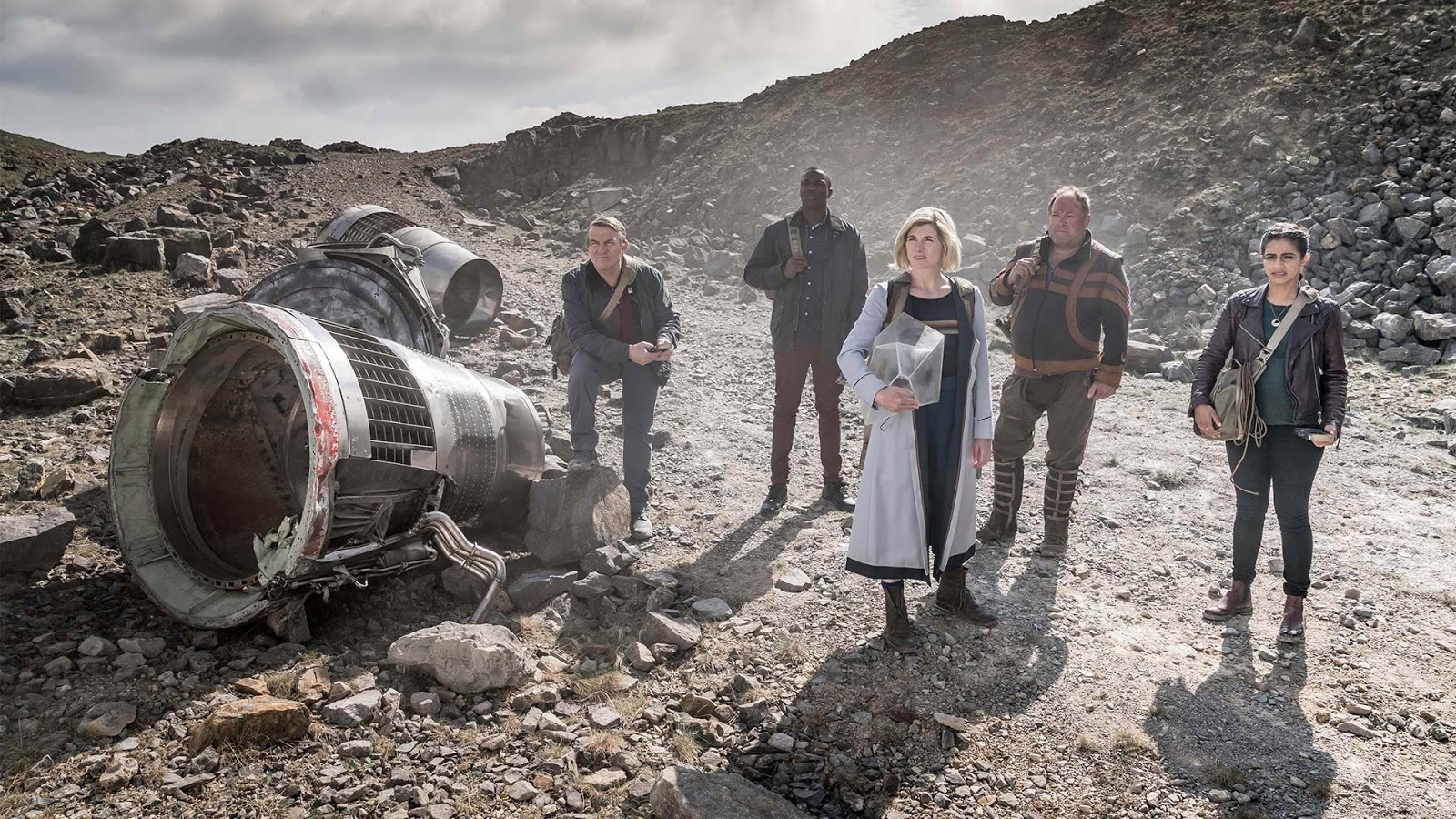
It Takes You Away - So, Doctor Who does Coraline? Why not! The first line (“Nice fjords!”) is entirely accurate: this was yet another extremely beautiful-looking episode, as seen above. Filming in Norway helps. Anyway, this was a rather original, unpredictable episode, which I like; Team TARDIS's first incursion into the Anti-Zone, with the delightfully despicable goblin-man Ribbons, feels nicely mythological, somewhat Wagnerian even. I like that a lot too. Not to mention the emotional moments with Bradley Walsh's Graham.

In the negative, I found the blind girl (Ellie Wallwork)'s performance quite lacking in emotion, and while the final confrontation between the Doctor and the Solitract was very well-acted, the lack of lip-synching on the Solitract's body was extremely distracting. It worked for the Monks, but sorry, Wannabe-Kermit, it don't work for you. 


The Battle of Ranskoor Av Kolor - Not gonna lie: my reaction to the opening scene was: ‘oi, you've gotten some Star Wars - The Last Jedi into my Doctor Who’. And my reaction when we saw what T'zim Sha had become was ‘oi, you've gotten some Darth Vader into my Stenza’. …But aside from that, pretty neat episode.  Bringing back T'zim Sha was certainly a good call. As always, the visuals look fantastic, and Bradley Walsh continues to be one heck of an actor, but I say that every time; our guest actor Mark Addy was also pretty great. Still, a good episode does not a good finale make; this was constructed as a sequel to The Woman Who Fell to Earth but no more, and otherwise feels more like a standalone. And if you were going to bring back one of the monsters from The Ghost Monument, why did it have to be the cookie-cutter Sniperbots, and not the intriguing and original Remnants?  


Twas the Night Before Christmas - Oh, so that's what we get for a Christmas special? One minute? Bah. It looks pretty enough, but aren't we past the 'slightly moving cutouts' level of animation for Doctor Who? I feel like I'm back watching a slightly better-polished version of Death Comes to Time. Mind you, the story itself is fun, short though it may be (it's nice to finally see acknowledgement that Santa Claus is real in the Whoniverse after Last Christmas shed doubt on whether the writing team had tossed out that particular bit of continuity), and Bradley Walsh's narration is nice and warm and everything. Still, it's a bit lot of nothing at the end of the day, compared to what a proper Christmas special should be. Barely one and a half minute long, I ask you!

GENERAL THOUGHTS:

Aside from its famously brilliant cinematography, Series 11 is a frankly bit of a downgrade from its predecessor, which was not itself quite as good as the previous few series. The writing is decent but rarely as witty and crisp as what Steven Moffat could sometimes bring to the table, and that shouldn't be a surprise when the new showrunner's previous episodes were often agreed to be among the worst  (or, worse, the blandest) of the Moffat era; the same goes for the score by Segun Akinola, which has its moments but doesn't quite live up to the glorious operatic feel that Murray Gold could sometimes achieve. I think the series greatly suffered from lack of continuity with its predecessor, in a way that no recent Doctor Who seasons have been (2005's Series 1 anchored itself to the Classic Series via the Daleks; when Series 5 came by, Steven Moffat had already written a number of episodes and introduced River Song). One returning writer, or keeping Bill as a companion, or simply Murray Gold staying for one more season, would have smoothed over the transition much better. 


As concerns the cast, Jodie Whittaker's Thirteenth Doctor is fine as the lead, but she has far too little personality of her own; that is to say, she's good at being the Doctor, though her take on the character doesn't have as much depth beneath the friendly, puckish exterior as other similar Doctors. But she brings little to nothing new to the table. Mix up Troughton, Tennant and Smith's Doctors, and you've basically got her personality — in a way that you simply couldn't derive Tom Baker from blending together William Hartnell, Patrick Troughton and Jon Pertwee. Of course, as the number of previous Doctors increases, being original at all becomes exponentially harder; and perhaps there was a conscious decision to make this Doctor "play it safe" due to a feeling that the changed gender was already risky enough a change. For these two reasons I won't be too hard on Whittaker's Doctor. But at face value, without being a dishonor to her predecessors, she really isn't the second coming of Tom Baker, either — even though, for, I think, much the same reason people heaped praise on Rosa ("I'm not one of those people! I'm inclusive! Look at how progressive I am!"), it's become fashionable to praise the Thirteenth Doctor in similar terms. And what few people don't do that are those who hate her. Well, I'd like to register a polite "I think she's average", please. 


The companions are, similarly, fine, though not my favorite TARDIS team either. Bradley Walsh's Graham is a witty, reliable presence and not without depth, or the ability to be warm and kindly at times (i.e. his talk with Yaz in Punjab) and the clear stand-out out of the three in my book. Mandip Gill's Yaz is very likeable, and introduced in an extremely funny scene, but spends half the season as little more than a wallflower, following the others around without contributing much of anything, either in term of participating in the adventure, or simply of comic relief; she's the most audience-surrogate-y of the three, and perhaps it's no coincidence that (as a young woman) she's the one who most resembles the "stereotypical companion". As for Tosin Cole's Ryan, he kind of has the opposite problem — he starts out with a lot of character and an arc to himself, but it's largely left behind past the first episode, and by the end of the season, after the Yaz situation has been somewhat corrected by Arachnids in the U.K. and Demons of the Punjab's exploration of her background, he's the one who just lumbers around without anything to do. And though he acts fine, Cole is, I find, somewhat lacking in charisma; in particular he does "sullen and frustrated" alright, but can't seem to find a way to be whimsical and giddy; and a Who companion should, at times, be whimsical and giddy, or what are they following the Doctor around to see the wonders of the universe for?

This feels like the right time to note that I'm kinda bummed the rumors of a return to "pure historicals" were unfounded. Demons of the Punjab came close, since its aliens were a misdirection and the actual plot was happening in spite of their interference rather than because of it, but it wasn't it. But aside from that, my final sentence on Doctor Who, Series 11, is: “yeah, it's good, no masterpiece but it's good, looking forward to the next one.” 

And also to the New Year's Special. Seriously, Chibnall. If you don't, episode, Dalek, we, you, burn at the stake. I mean it. 

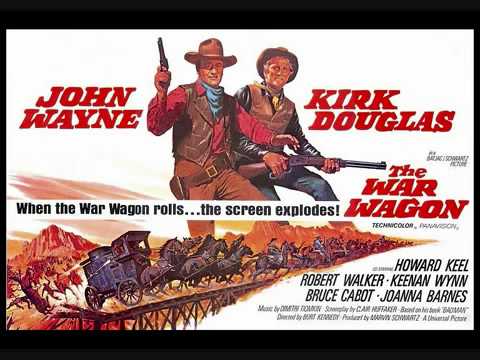
“The War Wagon”

The first thing about the 1967 John Wayne/Kirk Douglas vehicle The War Wagon   (yes, that pun was intentional, thank you)  is that it has o...