Showing posts with label Richard E. Grant. Show all posts

Friday, 19 July 2019

“The Nutcracker and the Four Realms”

Disney are really scrapping the bottom of the barrel of potential live-action remakes with this one, aren't they? Not a bad thing, mind. The Nutcracker Suite sequence in Fantasia was so aggressively impossible to turn into a live-action picture in the copy-and-paste way of Beauty and the Beast or The Lion King that the filmmakers would be forced, not just bound but forced, to come up with some creative ideas, if they had to be dragged there kicking and screaming. 

So I thought going into it.

Well… 

…oh dear. 


The thing with 2018's Nutcracker and the Four Realms is that it looks magnificent, and the world and plot-hooks are quite nice, and original, and all. The biggest complaint I have with it on paper is that the Nutcracker is an utter non-entity, whose meager relevance to the plot does not even remotely warrant his getting first billing in the title. But as a story, it's fine. 

So the synopsis is alright. Clockwork kingdom, key, mice, life-giving machine for turning toys into recognizable British actors, yes, yes, all good. 

But the script… oh, the script… I don't think I've ever seen a script quite this unfathomably incompetent. Every word that comes out of the characters' mouth is beyond clichéd, and that goes double for the "morals" the movie keeps pushing — we are in literal "all that you need is in here… and this box contains only a mirror" is a territory, folks. The pacing's also rubbish. Everything happens far too quickly; things like the Polichinelles are broughtback for the climactic battle in what is clearly meant to be one of these ‘everything from the first half of the movie comes back at the end’ kind of things, except they feel like they've just been introduced five minutes ago. Nothing has weight. Nothing has time to settle in. 

Also, for a movie pompously retitled The Nutcracker and the Four Realms, it is strangely uninterested in exploring said Four Realms; the only one we ever really see outside of brief flashbacks is the derelict Realm of Amusements. 

There is, of course, a twist villain. She's a reasonably good twist villain, mind, as these things go, but I just thought I'd throw this out there. Disney, stop with the twist villains already. That is an order. And while, as I admitted, it is well-executed, the concept of this one is just… really? It thinks it's way cleverer than it is. “Ooh, the Sugar-Plum Fairy is the villain! Betcha didn't see that coming!” Well, no, I didn't, because it's idiotic. God

The cast is a mixed bag. The curiously named Mackenzie Foy is what you expect from the female lead in this sort of movie; perfectly adequate; doesn't make too strong an impression either; but you can't blame her for this because the role is so very very blandly written. Keira Knightley is hammily marvelous as the Esmé Squalor-esque Sugar Plum. Helen Mirren and Morgan Freeman, the two main 'name actors', are given barely enough material to make an impression, but they acquit themselves of it quite well. The same cannot be said of poor Richard E. Grant, whose role would already be a paltry cameo were he not encased in a frankly ludicrous make-up job. Jack Whitehall and Omid Djalili (as the dumbly-named guards Harlequin and Cavalier) are, meanwhile, a wholly unfunny comic duo. 

And as for our very nominal male lead Jayden Fowora-Knight (the Nutcracker, here named Phillip), well, the truth is that he's pretty damn awful. He's blander than the screenplay itself, if that's possible. He's such a forgettable slice of nothing that, as of this writing, despite being the male co-star in a 130-million-dollar Disney extravaganza, he doesn't have a Wikipedia page. There's not even a redlink on the cast list of Wikipedia's page on The Nutcracker, which, for the Wikipedia-illiterate, would indicate that the lack of the relevant page is not unnoticed and will be fixed soon. No. Nothing. No one cares enough.

Add to that the fact that James Newton Howard's score is completely clueless as to how to handle the demand to quote and riff on Tchaikovsky's original ballet suite, and so opts to do it as little as possible. 

Really, the visuals and the cleverness of the concepts (when not too impaired by the daftness of the execution) are the only things the movie can rely on. Fortunately, the concepts are clever, and the visuals are breathtaking, so watching The Nutcracker and the Four Realms is still a mostly positive experience. By God it's infuriating, though. 

Post-Scriptum:
  • I am seriously wondering if they cast Richard E. Grant as the Ice King for no other reason than because they thought it would be funny for an actor famous for his "icy delivery" to play the part. If so… good try, but Steven Moffat got there before you, and did it much better. 
  • The end credits are just Misty Copeland dancing to Tchaikovsky within some fancy (but minimalistic) sets and lighting, and that would have been a way better movie. 

Sunday, 17 February 2019

“Franz Kafka's It's A Wonderful Life”

As a Whovian for whom Peter Capaldi is one of the greatest actors ever to portray the title part on Doctor Who, imagine my surprise and glee when I discovered that Capaldi was also a successful director in his own right; and furthermore, as a fan of Franz Kafka and Frank Capra, imagine my surprise that he had won an Academy Award in 1993 for, well, this. Which, as the icing on the cake, happens to feature great actor (and fellow once-Doctor) Richard E. Grant in the title part of Franz Kafka, which is perhaps the most genius bit of casting I've ever seen in a Kafka movie. 

So how does it hold up, really? Pretty good!


Those accustomed to the endless variations on the “What if you were never born?” sequence of Capra's 1946 picture It's A Wonderful Life will be surprised to note that there isn't really any of that in Capaldi's film; instead, what it takes from the 1946 feature is the general structure of “things are miserable for a self-loathing protagonist who makes it harder on himself, until they are not, as all his gathered friends come together at the end to save both him and the day”. 

What remains is this premise: in a beautifully German-expressionist rendition of Kafka's Czech hometown, the writer is about to begin work on his masterpiece, Die Verwandlung (ye Brits and colonials know this as The Metamorphosis), but can't seem to figure out precisely what it is that Gregor Samsa wakes to find himself transformed into. There are frequent cutaway (as pictured above) to various preposterous options Kafka considers before scrapping them. As the tortured soul tries again and again to fulfill his destiny, and despite the insect imagery constantly staring him in the face, he can't seem to lay a finger on it. What's more, he keeps getting interrupted by various things (a Christmas party going on in the flat below his, a caller come at the wrong address, etc.). 

It is utterly brilliant. 

The thing about Franz Kafka's It's A Wonderful Life is that it's basically the most Kafkayan film I've ever seen, and yes, that includes Orson Welles's outstanding 1962 version of The Trial. Even it didn't quite reach this level of — of — how can I put it? In The Trial, it soon becomes clear that you're in dream logic, with these sprawling vistas of absurdly long corridors and absurdly large halls. In Franz on the other hand, there's nothing explicitly fantastic, or at least, it doesn't seem so until you've finished watching it and reflect back on it. It perfectly channels the weird and unpleasant experience of a bad dream, that cramped feeling, that nagging sensation that none of this is quite right, quite real that you keep mulling over without actually doing anything about it, because you can't. It's what Kafka was a master of turning into words, and Capaldi turned it into film reel. 


And what of the cast? Well, the line of celebrities does not end as Grant & Capaldi, as you'll also recognize Phyllis Logan and Ken Stott in varyingly-incidental parts. But really, a lot of credit must also go to a frightfully young Richard E. Grant, who looks sickly and disturbed without even trying, and without losing the audience's sympathy in the process, which is key to successfully playing a Kafka protagonist. (And to play Franz Kafka in such a picture is to play a Kafka protagonist, since all Kafka protagonists are basically Kafka. The short cleverly spells this point out by having Kafka's neighbors colloquially refer to him as “Mr K.”) This is, perhaps not the part, but certainly one of the parts that Grant was born to play. 

It's also a frightfully witty film, when it's not plunging us in the precise atmosphere of a nightmare; the Capra in its DNA means it has a happy ending and is overall slightly lighter-hearted than a pure Kafka picture, and all the better for it too. I won't spoil too many of the jokes, but perhaps my favorite concerns Franz's timidity about telling the partygoers below to knock it off: after he speaks his mind to the host of said party, the host, who has not lost her smiling demeanor, agrees to yield to his commanding nature, but then asks him “if this is a hypothetical conversation or a real one”. “Hypothetical, of course,” says Kafka. And the host: “Oh, good. Because I'm quite enjoying this party. Goodbye.” She walsk back in, closes the door, and so it's revealed that this scene was all Kafka's fantasy of what he wishes he had the backbone to say. 


Add to this a great visual direction, and music that, while never genius, does its part without distracting for the whole, and you get a real gem of a short film, highly recommended to anyone who enjoys Kafka, Capaldi, Richard E. Grant, or off-kilted filmmaking in general. 

Post-Scriptum:

The underwhelming music aside, I have exactly one (1) issue with the short, and that is that the visual of Samsa-as-Bug we eventually get is pretty bad. Being about pillow-sized, and with spindly long legs, the cockroach-head-thing is nothing like the many-legged pillbug I've always imagined, and nowhere near massive enough. (It is my belief that the creature in which Gregor Samsa was transformed once existed: it is the arthropleura.)

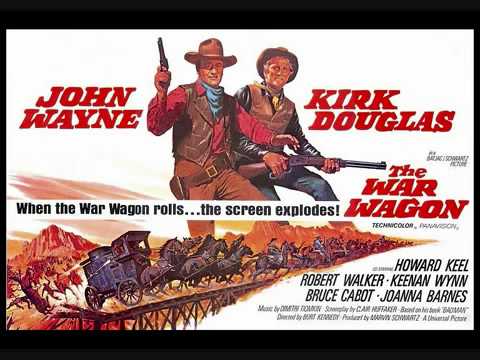
“The War Wagon”

The first thing about the 1967 John Wayne/Kirk Douglas vehicle The War Wagon   (yes, that pun was intentional, thank you)  is that it has o...