Showing posts with label Jodie Whittaker. Show all posts

Monday, 10 June 2019

“Cranford”

Where have I been? I wonder too. But among other things, I've been watching more of those awesome BBC period dramas. Including 2007's Cranford, a mashup adaptation of three of Elizabeth Gaskell's novels, penned by one Heidi Thomas. It was excellent watching, and beyond that, I am fast running out of things to say about BBC period dramas based on A-list 19th century British literature (and Gaskell, from what I've read of her, belongs on the same list as Charles Dickens, in a heartbeat). So let me run through the things I say every time that isn't Vanity Fair:


  • The actors are uniformly excellent and a perfect mix of old and new fances — here we have Imelda Staunton and Michael Gambon in recurring roles, which incidentally fills our “every BBC period drama will have at least one (1) actor with a role in the Harry Potter films” quota, as well as Judi Dench, Jonathan Pryce, Jodie Whittaker, and, of all people, Tom Hiddleston (who's actually quite good); and we have some younger faces who nevertheless succeed at being excellent; and we have old reliables like Jim Carter, Francesca Annis and Julia McKenzie who aren't household names but frankly deserve to be. 
  • The script is full of wit and true human sentiment and neither too slow nor too quick; it bears deep criticial analysis if you care for it (there's very interesting dilemmas there about the coming of modernity) but doesn't beat you over the head with a hammer of moral superiority. It succeeds beautifully in carrying over Gaskell's stunning handle on humanity.
    • [Related: the adaptation is a very clever mix of three different Gaskell novels, and while this does at times jar just a little bit (the medical-drama bits are operating on an entirely different system of priorities from the properly Cranfordian bits; there's more than a bit of whiplash when the stakes of one subplot are life-and-death for a recurring child character who's caught the croup, and the other is whether Judi Dench will swallow her pride and deign set up a tea shop, you know?), you certainly wouldn't guess that those were originally unrelated stories without reading the Wikipedia page]
  • It's beautifully shot. I lack the technical knowledge to go more into detail than that, but it is. The angles, the lighting especially, the choice of locations make it into a marvelous experience on a purely aesthetic level. 
  • The music's quite good, with a theme song that's pleasantly quirky and unhummable. 
Look, there is nothing else to say. Go watch it. Also read the original Cranford if you like, it's a brilliant little book. 

Ye Inevitable Olde Post-Scriptum:
  • The last episode of Return to Cranford (the two-part Christmas-special epilogue in 2009, which I watched alongside the main series and consider more or less of apiece with it) ends with a cameo-ish appearance by… well, I won't spoil it. But the identity of the man, and the circumstances of it, are absolutely the last thing you'd expect as the conclusion of an Elizabeth Gaskell-based BBC Christmas drama, let me tell you. I have no clue how they even got him. He's predictably excellent, mind you, if you can get over the shock of his sheer presence. 
  • Bessie is one of my favorite recurring gags in a BBC period drama, ever. 
  • Oh yeah, Jodie Whittaker's in this, I should probably say something. Well, she's very good at being cute, flustered and slightly out-of-her-depth. I see no evidence that she has in her that which critics keep finding missing in her Doctor, though, namely the slightest drop of toughness. Not that you'd expect it to come out in such a part, you understnad; Peggy Bell shouldn't be in any way, shape, or form, tough. It would go against the whole point of her. But while it confirms that Whittaker is a good actress, it does little convince me that she has very much in the way of range. 

Monday, 8 April 2019

“Resolution”

Alright, so Chris Chibnall promised Daleks, and delivered Daleks, and therefore was not set on fire by the enraged Doctor Who fandom. What else?


A very good episode of Doctor Who, is what else. It does not altogether feel like a “special” in the way the Christmas Specials did (I suppose New Year's is even more of a formality for most people than Christmas; I suppose pledges of doing one's chores are somewhat poorer at stirring the heart than love, family and hot cocoa), but it's quite a good one-shot Dalek episode. The acting from the guest characters is great, Akinola's music is mostly unobjectionable this time around and has a few legitimately great moments (short though they are), the direction is up to the usual Series 11 standards, and… Chris Chibnall turned in a good script.


I know, I know. But it can happen! The Silurian two-parter from Series 5 and Dinosaurs on a Spaceship, for example. And I think Resolution is actually a better than those, even if it still has the Chibnall trademark of a science-fiction story and a relationship-drama story mashed together with a sledge-hammer (one scene from one, cut, one scene from the other) as opposed to actually being welded in any significant way. Resolution, in fact, has got that particular problem more than any of his previous episodes you'd care to name. But perhaps this is in fact a good thing, for it allows each side to stand on its own, leaving one with the somewhat boilerplate, but not really unpleasant, "Ryan's Dad" subplot, on one side, a frankly great Dalek story on the other. 


So the plot: on New Year's Day 2019, two archeologists, an immensely likable pair played by Charlotte Ritchie and Nikesh Patel, who, I'm sorry to say, are a billion times more interesting to watch than Ryan & Yaz for most of the time they're onscreen) dig up an ancient burial site beneath Sheffield — yes, of course it's beneath Sheffield, it's Series 11… or good as. Among the weird things they find is a fragment of a Dalek-creature, who has been buried on Earth since the 9th century, having been one of the first Dalek scouts sent out from the Planet Skaro way back in the day. A veritable army had, at the time, managed to subdue the Dalek and destroy its casing, but even after hacking the mutant blob apart, it still lived and twitched (as per The Witch's Familiar's addition to the Daleks' lore; gotta love that continuity), so they buried the pieces in the far corners of the Earth and founded a secret society (the Order of Custodians) to keep them separate. 

I should hasten to point out that this "buried in the four corners of the Earth", "Order of Custodians" nonsense is of absolutely zero importance to the plot, for the Reconnaissance Dalek promptly puts itself back together through some weird, ill-explained teleportation ability of his,  andwe never meet the Order, nor do they do anything of importance in the backstory that comprises their entire appearance. It's just daft, and probably the writing's capital sin, though it is one that's easily ignored.

“ExterminHEeElLLlllPPpPPP!!!!

On the other hand, I've seen criticism of the idea that any number of 9th century warriors (even an army) would be able to destroy a Dalek's casing — but this is actually a nonissue, for it is the later, Time War Daleks who were practically indestructible, whereas the Reconnaissance Dalek is explicitly "one of the first to leave Skaro", meaning that A) it got there without time travel and B) it is therefore a thousand years older than the relatively-easily-destroyed models from The Dalek Invasion of Earth (who got to Earth in the 22nd century!). Most likely it was basically identical to the original The Daleks Daleks, and those guys could be destroyed by kicking them and making them fall down elevator shafts, or just pushing them against a wall really hard. See above.


So, having pulled itself back together, the Reconnaissance Dalek proceeds to possess Charlotte Ritchie's character (because yes, Dalek creatures can do that now, shaddap) and drive her around like a puppet in an effort to get her to build it a new and improved casing — the whole sequence with single-minded, possessed-Lin is truly glorious, and Nicholas Briggs as the Dalek's voice reaches new heights. The way Lin is made to speak along with it also extremely effective. One is truly saddened when it is over, though the product of Lin's smelting (the parallels to the Doctor's creation of a new Sonic Screwdriver in The Woman Who Fell to Earth are obvious) is quite a sight to; a misshapen, rusty Dalek clearly built out of spare parts, yet still fearsome enough.  


The reconstructed Reconnaissance Dalek has a verbal showdown with the Doctor, as Team TARDIS (who has been frantically tracking the Dalek thus far) finally catch up with it just a moment too late. It's an effective scene, though there's little that makes it stand out from earlier "the Doctor defies a Dalek" moments (the gold standards for those, of course, being Christopher Eccleston's turn in Dalek, which everyone else has just kind of been shamelessly copying). Whittaker's Doctor finally gets to show a bit of menace, an element which many critics agree was missing from her performance thus far. The Doctor has to deserve that “Oncoming Storm” title the Daleks give him/her.

(Speaking of which, if this is truly a pre-Dalek Invasion of Earth Dalek as we're led to believe, it does not entirely make sense that it would so readily recognize the Doctor, for at that point the Daleks had only met Hartnell's Doctor, and presumably didn't know about regeneration. Oh well.)


Unfortunately, this is where things take a turn for the… well, worse, though that's not to say the resolution of Resolution (heh) is bad per se. It soon becomes clear that we're not just trying to stop the Reconnaissance Dalek because the Reconnaissance Dalek might kill people (though it does do that, too, mind you). No, the Reconnaissance Dalek must be stopped before it highjacks all radio-transmitters in Great Britain in order to send a signal to the main Dalek fleet.

Whut? 

There is so much wrong with this idea. For one thing, considering there was an entire Time War in-between the Reconnaissance Dalek's arrival on Earth and the events of Resolution, and the Daleks changed leadership, like, ten times, it is no guarantee the current Daleks would even listen to that half-dead relic of their ancient times. It's a bit like worrying that one of Napoleon's army scouts, cryogentically frozen since 1807, might, if thawed-out today, lead the modern French Army on the warpath overnight if he's allowed to reach a telephone with which to call the French Minister of the Armies. 

Furthermore, the modern Daleks know full well that Earth exists and would be suitable to Dalek conquest. In fact, they've tried. Repeatedly. And the Doctor has stopped them. If he got the Reconnaissance Dalek's message of “I HAVE DISCOVERED A PLANET WE MIGHT CONQUER! IT'S CALLED EARTH! COME DOWN HERE!”, the Dalek Emperor would probably answer, as patiently as he could manage: "YES. WE KNOW EARTH EXISTS. WE KNOW. THERE'S A REASON WE STILL HAVEN'T CONQUERED IT YET; IN FACT, I THINK YOU'VE MET HER. BUT WE KNOW.” Hardly that scary an event.


The Dalek's final defeat (no, don't worry, the above picture isn't it) begins amusingly, but is by the end dull and a little bit confusing. It is praiseworthy that Chibnall tried to involve Ryan's Dad and his microwave-oven into the proceedings, but it only works the first time around; by the time the Dalek has lost its casing again and tries to possess Ryan's Dad, who inexplicably manages to fight it off better than Lin because……the power of love……?……, you just wish the microwave had been enough.

Still, in terms of tone, Resolution is everything you could want, and with strong actors and Series 11's ever-reliable visuals to go along with it, why deny yourself? It's one of the best Chibnall-era stories yet in my book, though perhaps not the best (I think I'd still rank Demons of the Punjab and Kerblam! above it, not necessarily in that order).

Post-Scriptum:
  • Dear entertainment industry, could we just stop defeating bad guys by judicious opening of airlocks? Or other "irresistible sucking force" plot devices? Doctor Who, you, in particular, already played that card in Doomsday, and much more impressively than here. So enough.


Monday, 24 December 2018

“Doctor Who” - Series 11

I have neither the time nor energy to make full-scale reviews of the individual episodes of Series 11 of Doctor Who — or, for those of us who still bemoan Russel T. Davies's 2005 clerical error and try to reinstate the real numbering, Season 37 — but I do still want to say something about it. 


Hence, I'll make this catch-all review, not including the yet-to-air holiday special (Resolution, a.k.a. The One That Promised Us Daleks And Had Better Have Daleks Or Else The Fandom Will Literally Set Chris Chibnall On Fire). First I'll briefly review each episode, then I'll write up general thoughts about the series.

INDIVIDUAL MINIREVIEWS:


The Woman Who Fell to Earth - Sets up a nice sense of mystery and is as good an introduction to a new Doctor and companions as anything. Very efficient climax. The vlog framing device is gratuitous and annoying, however (a series opener should know better than to recall so heavily a one of the most hated episodes of modern Who), and as effectice a surprise as Grace's death is, it's also a darn shame, as an older woman is not something we've had as a companion before and might have been brilliant. As for the monsters? Middling average, I guess. T'zim-Sha is imposing enough, with just enough complexity to work, and the Datacoil is successfully scary and a creative sci-fic concept. But I could have done without the "teeth" gimmick, which is squickier than it is anything else, and overall this ain't exactly the new Daleks. The cinematography's nice, the effects are great, everyone's acting gets the job done, and can I just say that I kinda like the Thirteenth Doctor in the torn, loose-fitting Twelfth Doctor costume than in the more "cookie-cutter" attire she later picks out as "her" outfit? Maybe it's because it reminds me of the sorely-underappreciated Second Doctor's look. 


The Ghost Monument - Has the good sense to spoil its big reveal towards the beginning; it was rather obvious and a whole episode of building up to it would have been extremely obnoxious. The Race is a nice hook for a story, and Desolation is just brilliant as a setting. Unfortunately, the guest characters are unbearably cliché — the tough cynical guy whose cynicism goes back to textbook Freudian trauma, the scrappy racer of poor background who wants the money so she can support her family, blah blah blah, yeah, yeah, whatever. The Remnants are creative (if confusingly named) monsters, but are given far too little screen time compared to the stupid cookie-cutter "Sniper-Bots". …Oh, the ending scene where they find the TARDIS is suitably squee-inducing, I suppose. Not anything special, but neat. I do like this TARDIS design — that is to say I like the interior; the exterior is not nearly blue enough. 


Rosa - If Doctor Who was to return to its primitive “educational show for young audiences” aspect (…why?), this episode takes a decent stab at doing that by teaching kids about the Rosa Parks story. Certainly, a time-traveling villain who's trying to change a flurry of tiny details in order to prevent the event from happening, forcing the heroes to gather all knowledge they can about how things really happened to make sure they do happen that way, is a clever way to work the educational element into the time-travel story. Unfortunately, the episode undoes that very clever concept for "fun learning" with its incredibly clumsy ending which sees the Doctor just kind of monologue about the rest of Rosa Parks's life like she's the narrator of an abridged biopic for kids. Bluh. Combine that with the most laughably heavy-handed depiction of racism in 20th-century America you've ever seen (and I get that the show has its heart in the right place; it's just… when literally the first thing that happens stepping into 1950's Alabama is a white-skinned jerk punching your black character, you might want to crank up the subtlety just a bit), and the most uncharismatic villain this side of the Abzorbaloff, and you have a very, very mixed bag. Oh well. I wouldn't be in quite so much of a huff about this, except that (no doubt to make sure to telegraph to the world that they are of course very progressive and antiracist) a crushing majority of people gave the episode glowing reviews it simply doesn't deserve, and that irks me. 


Arachnids in the U.K. - It pains me that some of the spiders in this episode hardly look any better than those of Planet of the Spiders several decades ago. Aside from that… an entertaining enough adventure, and I'll give it that it has a very strong setpiece in the cobweb-covered apartment. Things kind of go downhill from there, however. As I said the effects are wonky; the plot is very thin in places; the well-acted but lazy Trump parody is nothing more than a lazy Trump parody, and will just serve to make future viewers wince in embarrassment twenty years from now; the episode ignores the square-cube law (which, fine, if you must have giant spiders you might as well), then suddenly decides that it doesn't and has its resolution hinge on it; the way the spiders are lured into the Doctor's trap is one the stupidest way to defeat a monster in the history of television. 

Also, the episode seems very confused on the "moral dilemma" it tries to present at the end. We're meant to side with the Doctor when she chides Not-Donald-Trump for wanting to shoot the mother spider and says the creatures deserve to "die with dignity". I have a feeling the episode got too caught up in lampooning Americans' "have you tried shooting it with a gun?" attitude to problem-solving, and didn't stop to consider that a quick painless death by gunshot to the brain is what is usually understood by "helping an animal die with dignity" when it's already fatally wounded. This is especially puzzling when the only other way for the spiders to die if Not-Donald-Trump doesn't interfere is to slowly suffocate to death, which the episode just pointed out is a miserable and painful way to die, like, a minute ago. What the heck? 


The Tsuranga Conundrum - Silly and confused in all the wrong ways, despite some cool ideas here and there. The Pting feels more like an idea than a fully-realized concept, though it has a certain silly charm. The idea of setting the action on a hospital ship isn't really used to a meaningful degree outside of the alien giving birth to amp the drama at one point. It feels like we're going to get a bit of an arc for the Doctor, who has to learn to sometimes not try to take charge and leave it to the actual professionals; that's certainly what the beginning of the episode seems to be building towards; but… nope. This episode is a big bubble of nothing with only the cinematography to recommend it, and even that (one of Series 11's strongest points overall) is stifled by the enclosed setting. 


Demons of the Punjab - Wherein the characters take a trip to the past of the forebears of the female companion, promising not to interfere, then proceed to interfere, mostly because they hadn't even begun to plan a shred of a cover story. Buh. …But, oh, I shouldn't gripe. Punjab may Rosa's flaw of being much too heavy-handed in tugging at its audience's heartstrings, but it looks very beautiful and has a number of nice moments, with good to great acting from everyone involved, and some of the best music in the series (even if I still think Murray Gold was an overall superior composer, Akinola has several great moments in this one). What's more, it approaches its historical subject matter… not perfectly, but certainly with more tact and nuance than Rosa did. 

I do think it was a bit early after Twice Upon a Time to pull another "the time-traveling humanoid monsters may look scary but they're actually nice, and visiting the times of people's death for entirely selfless reasons" twist, and now I can't help but imagine the comedy sketch that would result from a lingering 'Demon' to bump into an early-bird Testimony, but after all, not repeating itself has never been one of Doctor Who's strengths. Also: the glorious moment of the Doctor being too focused on the readings of the ubiquituous Sonic Screwdriver and missing the giant spaceship right there at her feet. Gotta love that. 


Kerblam! - My, do I ever approve of the Doctor wearing a fez. Please let her keep the fez for once, please please pl-nope, of course not. (Sigh.) Anyway. This is a very good episode. Well-shot as always, it is also well-acted; aside from the regulars, Julie Hesmondhalgh's highly energetic performance is a highlight, similar to fan-favorite Harriet Jones without feeling like a cheap copycat; Claudia Jessie's Kira Arlo is a veritable ball of charm wrapped in lovable sweetness; and Leo Flanagan is convincing both at face value, and following the twist about his true motivation (though I kind of bemoan the existence of said twist considering how charming face-value-Charlie was). And it famously hass creative plot-points and twists; this is certainly the first story I know to make bubblewrap a major plot element, let alone scary. The dialogue is probably the snappiest in the series. 

The situation of the conflict doesn't fully make sense to me — it's a future with human-level, or even superior, artificial intelligence and robots; so what hopelessly broken economy produces a world where people still need to have jobs, to the point that there are protests about it, and you solve this problem with regulations forcing companies to use fewer robots? DOES NOT COMPUTE. But then, Doctor Who's glimpses of future Earth history are rarely if ever convincing as actual speculative futurology. Few science-fiction shows have ever been more zeerusty than Doctor Who. (See, for example, The Happiness Patrol and The Long Game.) So this didn't bother too much. Oh, and in term sof monsters, the Kerblam-Men are probably the best-designed creatures in the series, even if I do wish the episode would clarify whether they're sentient, or just drones controlled by the main System's intelligence (Twirly certainly seems to have a lot of character, and, indeed, we see that a lot of the robots have names; but if the robots are sentient, then why is the System being sentient too such a revelation? and why does it control them at will?). All-around great episode!


The Witchfinders - Great actors (everyone agrees Cummings as King James is a treat of hamminess, and yes, he is — though he doesn't entirely befit the tone of the episode at large),  and the visuals are, as always, great. But as for the rest… The story, however, is a little… tepid, somehow; it's not that it's slow, not at all, but it was surprisingly hard to get invested in the proceedings. Maybe it's my aversion to the general "the heroes pretend to be something they're obviously not in front of the villains, who are inexplicably taken in despite a dozen close calls" trope. The monsters are creepy, in fairness, but not particularly appealing or well-explained. Oh, and… I was kind of hoping that Willa might become a companion, unlikely though it was. It's been far too long since we've had a non-contemporary-Earth-based companion. 


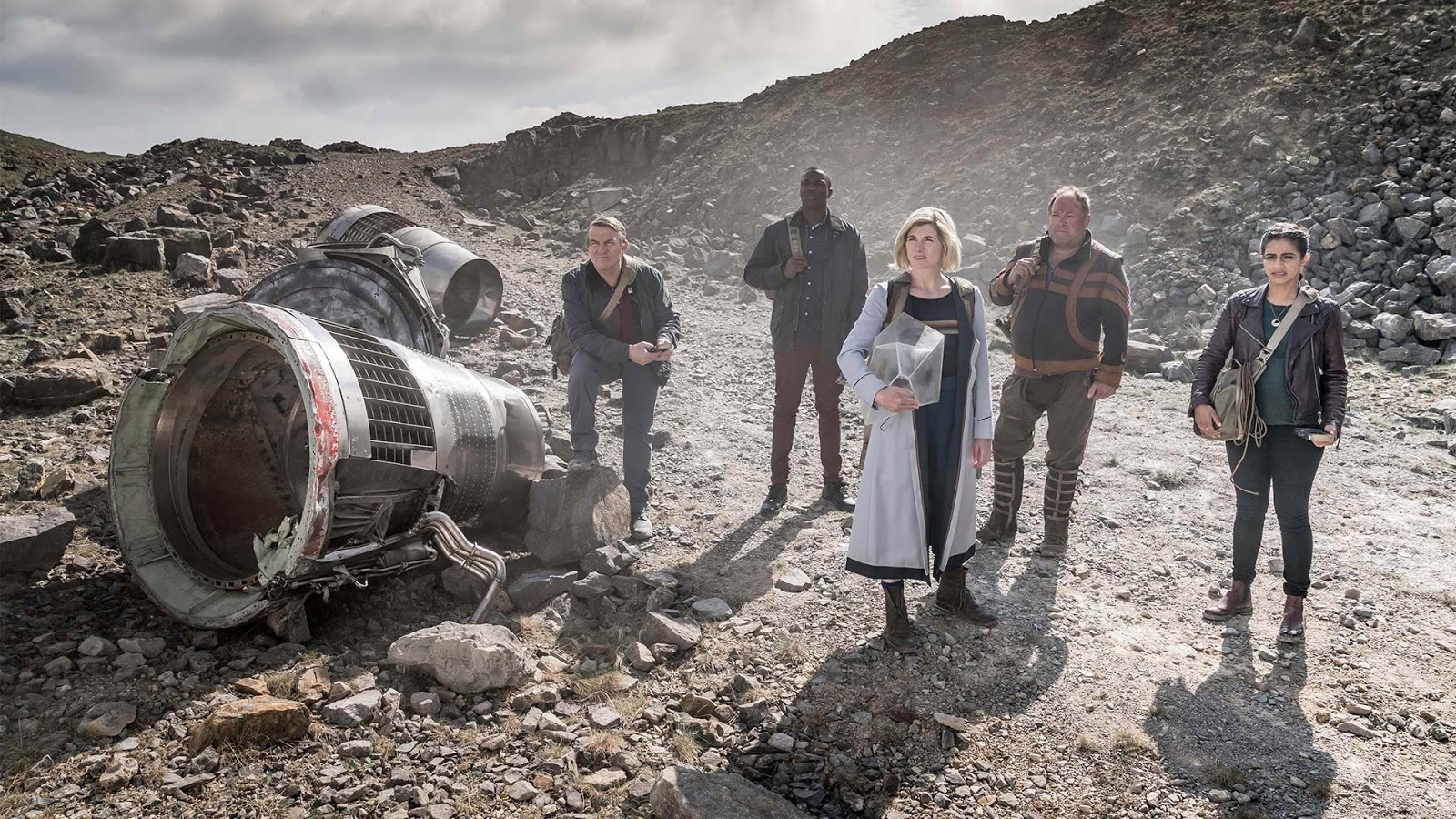
It Takes You Away - So, Doctor Who does Coraline? Why not! The first line (“Nice fjords!”) is entirely accurate: this was yet another extremely beautiful-looking episode, as seen above. Filming in Norway helps. Anyway, this was a rather original, unpredictable episode, which I like; Team TARDIS's first incursion into the Anti-Zone, with the delightfully despicable goblin-man Ribbons, feels nicely mythological, somewhat Wagnerian even. I like that a lot too. Not to mention the emotional moments with Bradley Walsh's Graham.

In the negative, I found the blind girl (Ellie Wallwork)'s performance quite lacking in emotion, and while the final confrontation between the Doctor and the Solitract was very well-acted, the lack of lip-synching on the Solitract's body was extremely distracting. It worked for the Monks, but sorry, Wannabe-Kermit, it don't work for you. 


The Battle of Ranskoor Av Kolor - Not gonna lie: my reaction to the opening scene was: ‘oi, you've gotten some Star Wars - The Last Jedi into my Doctor Who’. And my reaction when we saw what T'zim Sha had become was ‘oi, you've gotten some Darth Vader into my Stenza’. …But aside from that, pretty neat episode.  Bringing back T'zim Sha was certainly a good call. As always, the visuals look fantastic, and Bradley Walsh continues to be one heck of an actor, but I say that every time; our guest actor Mark Addy was also pretty great. Still, a good episode does not a good finale make; this was constructed as a sequel to The Woman Who Fell to Earth but no more, and otherwise feels more like a standalone. And if you were going to bring back one of the monsters from The Ghost Monument, why did it have to be the cookie-cutter Sniperbots, and not the intriguing and original Remnants?  


Twas the Night Before Christmas - Oh, so that's what we get for a Christmas special? One minute? Bah. It looks pretty enough, but aren't we past the 'slightly moving cutouts' level of animation for Doctor Who? I feel like I'm back watching a slightly better-polished version of Death Comes to Time. Mind you, the story itself is fun, short though it may be (it's nice to finally see acknowledgement that Santa Claus is real in the Whoniverse after Last Christmas shed doubt on whether the writing team had tossed out that particular bit of continuity), and Bradley Walsh's narration is nice and warm and everything. Still, it's a bit lot of nothing at the end of the day, compared to what a proper Christmas special should be. Barely one and a half minute long, I ask you!

GENERAL THOUGHTS:

Aside from its famously brilliant cinematography, Series 11 is a frankly bit of a downgrade from its predecessor, which was not itself quite as good as the previous few series. The writing is decent but rarely as witty and crisp as what Steven Moffat could sometimes bring to the table, and that shouldn't be a surprise when the new showrunner's previous episodes were often agreed to be among the worst  (or, worse, the blandest) of the Moffat era; the same goes for the score by Segun Akinola, which has its moments but doesn't quite live up to the glorious operatic feel that Murray Gold could sometimes achieve. I think the series greatly suffered from lack of continuity with its predecessor, in a way that no recent Doctor Who seasons have been (2005's Series 1 anchored itself to the Classic Series via the Daleks; when Series 5 came by, Steven Moffat had already written a number of episodes and introduced River Song). One returning writer, or keeping Bill as a companion, or simply Murray Gold staying for one more season, would have smoothed over the transition much better. 


As concerns the cast, Jodie Whittaker's Thirteenth Doctor is fine as the lead, but she has far too little personality of her own; that is to say, she's good at being the Doctor, though her take on the character doesn't have as much depth beneath the friendly, puckish exterior as other similar Doctors. But she brings little to nothing new to the table. Mix up Troughton, Tennant and Smith's Doctors, and you've basically got her personality — in a way that you simply couldn't derive Tom Baker from blending together William Hartnell, Patrick Troughton and Jon Pertwee. Of course, as the number of previous Doctors increases, being original at all becomes exponentially harder; and perhaps there was a conscious decision to make this Doctor "play it safe" due to a feeling that the changed gender was already risky enough a change. For these two reasons I won't be too hard on Whittaker's Doctor. But at face value, without being a dishonor to her predecessors, she really isn't the second coming of Tom Baker, either — even though, for, I think, much the same reason people heaped praise on Rosa ("I'm not one of those people! I'm inclusive! Look at how progressive I am!"), it's become fashionable to praise the Thirteenth Doctor in similar terms. And what few people don't do that are those who hate her. Well, I'd like to register a polite "I think she's average", please. 


The companions are, similarly, fine, though not my favorite TARDIS team either. Bradley Walsh's Graham is a witty, reliable presence and not without depth, or the ability to be warm and kindly at times (i.e. his talk with Yaz in Punjab) and the clear stand-out out of the three in my book. Mandip Gill's Yaz is very likeable, and introduced in an extremely funny scene, but spends half the season as little more than a wallflower, following the others around without contributing much of anything, either in term of participating in the adventure, or simply of comic relief; she's the most audience-surrogate-y of the three, and perhaps it's no coincidence that (as a young woman) she's the one who most resembles the "stereotypical companion". As for Tosin Cole's Ryan, he kind of has the opposite problem — he starts out with a lot of character and an arc to himself, but it's largely left behind past the first episode, and by the end of the season, after the Yaz situation has been somewhat corrected by Arachnids in the U.K. and Demons of the Punjab's exploration of her background, he's the one who just lumbers around without anything to do. And though he acts fine, Cole is, I find, somewhat lacking in charisma; in particular he does "sullen and frustrated" alright, but can't seem to find a way to be whimsical and giddy; and a Who companion should, at times, be whimsical and giddy, or what are they following the Doctor around to see the wonders of the universe for?

This feels like the right time to note that I'm kinda bummed the rumors of a return to "pure historicals" were unfounded. Demons of the Punjab came close, since its aliens were a misdirection and the actual plot was happening in spite of their interference rather than because of it, but it wasn't it. But aside from that, my final sentence on Doctor Who, Series 11, is: “yeah, it's good, no masterpiece but it's good, looking forward to the next one.” 

And also to the New Year's Special. Seriously, Chibnall. If you don't, episode, Dalek, we, you, burn at the stake. I mean it. 

Tuesday, 11 December 2018

“Frontier in Space”

As you may know, I am greatly fond of Doctor Who; not particularly of the season that wrapped up last Sunday, but of Who in general, certainly — whether classic or modern. The 1973 six-part serial Frontier in Space, which I have just finished watching, strikes me as one of the most excellent examples of Classic Who and of Jon Pertwee's Doctor, so let's examin exactly how.


Story. Frontier is a clever little science-fiction tale, not without its wisdom. The setpiece is the year 4500 or thereabouts, where Earth's space empire has come to an uneasy truce with another, the Draconian. The modern Earth is a nuanced and interesting portrayal of the future, neither a utopia (the Doctor gets an unpleasant trip to a penal colony on the Moon for political opponent) nor an all-out dictatorship (the President of Earth is obviously well-meaning; she is, incidentally, a woman, which should alone put an end to recent media's unfair claims that classic Who contained old-fashioned sexism in spades, a blatant untruth meant to make the casting of Whittaker as the Doctor more interesting). 

The plot sees the Doctor's old enemy the Master (more about him later) is conspiring to bring the two empires at war with one another, for the sake of a fourth party in whose interest it is to see them weakened by renewed hostilities. To do so, the Master uses the clever science-fiction device of a hypnotic ray that makes you see whoever is in front of you as your worst fear, exploiting it to make Draconians think humans (“Earth-men”, as they are stubbornly called) are attacking their ships, and vice-versa. 

The Doctor, accidentally landing inside one of the attacked ships alongside Jo Grant, suffers much trials and tribulations as he is captured by one Empire and the next and interrogated as a spy, fruitlessly trying to convince both that they're being tricked. By Episode 5, our heroes are aware of the presence of the Master (who makes a fruitless attempt to rectify the situation by imprisoning them himself, and shoots himself in the foot instead), and manage to convince the Draconian Emperor of the truth. But just as it seems like the serial is wrapping up, the true masterminds who employed the Master are revealed; and they're…


Though war between Earth and the Draconians is of course avoided, the Daleks are not foiled altogether, and so Episode 6 of Frontier in Space leads directly into the next serial, Planet of the Daleks. That is in itself a point in favor of Frontier's story; arc structures weren't as established in 1970's Doctor Who as they have been since 2005, but this is quite close to it and I like it. 


Humor. From the First Doctor's inability to keep his words straight (an amusing quirk that modern audiences have often, unfairly, reduced to William Hartnell simply flubbing that many lines accidentally; but it is generally agreed among Whovians that it happens too often to have been wholly uninentional) to the Twelfth Doctor's pretending to enter the TARDIS for the first timeDoctor Who has always included a decent dose of good humor, and while Frontier in Space is hardly The Husbands of River Song, it gets its fair amount of chuckles. Most are owed to our two rival Time Lords; the anecdotes Pertwee's Doctor tells to Jo to cheer her up are simply charming, and Delgado's Master occasionally lapses into cartoony villainy to hilarious results ("Don't you want to kill him?" "Of course I do!… It's just… long-range rocket missiles… it feels like it lacks that personal touch"). 

Villains. It is notorious that Doctor Who would have been cancelled before the end of its first season, all the way back in 1963, if not for the Daleks; ever since, alien monsters and well-acted villains have been staples of the show and one of its greatest draws. Indeed, it's the weakness of many too pedestrian villains such as Josh Bowman's Krasko that has been the greatest flaw of the current series, in my opinion. 

A very appropriate choice of reading. 

Frontier in Space on the other hand is lucky enough to have two great Doctor Who villains in one story, plus secondary one-shots. The first is Roger Delgado's Master, a wonderful evil counterpart to Jon Pertwee's Doctor, refined and unapologetic in his foulness, relishing any time he's on top just as the audience relishes any time he's on screen. Sadly, due to a car accident some few months after the end of shooting, this would be Delgado's last turn as the evil Time Lord; his being a Time Lord allowed the show to bring back the character with new faces, and I absolutely love the Master's portrayals by Anthony Ainley or Michelle Gomez later on, but just like no Doctors can be quite alike, no posterior Master ever recaptured quite the same spirit as Delgado's. 

The second are Doctor Who's iconic evil tin-cans, the Daleks, who are entirely themselves and manage to pose a real threat despite their inherent goofiness. It's not the Daleks' finest turn — if nothing else, their “metal parrot” voices lack the stunning range that Nicholas Briggs would later bring to them — but it is nearly impossible for a halfway-decent Who writer to go completely wrong with the Daleks, and I think we've established that Malcolm Hulke is more than decent a writer, on the faith of this episode alone.

In terms of secondary villains, I will give special recognition to Michael Hawkins as the warmongering General Williams, whose voice is consistently full of gravitas and seems to me to have been a great inspiration for Timothy Dalton's iconic portrayal of Rassilon in The End of Time. Speaking of great actors, John Woodnutt as the Draconian Emperor is also worthy of praise, though the Emperor isn't actually a villain; and as Pertwee himself would remark, the make-up on the Draconians is probably as good as alien makeup got in the Classic Series; it's hardly more rubbery than the very similar Silurians in The Hungry Earth forty years later. 


The most unremarkable creation of the serial would have to be the Ogrons, the Master and Daleks' extraterrestrial grunts, who are little more than their name suggests — ugly, ogre-like space Orcs of limited intelligence. They're never scary, and they're only amusing because of the superintelligent Master's frustration with their stupidity, rather than because of anything about themselves. Their design is woefully uninspired. Still, they're not meant to be the memorable part of the episode, and so one shouldn't be surprised that they're not. 

Frontier in Space is all in all an extremely pleasant Doctor Who experience, highly recommended to anyone with an interest in the series, or just looking to have a good sci-fi time. 

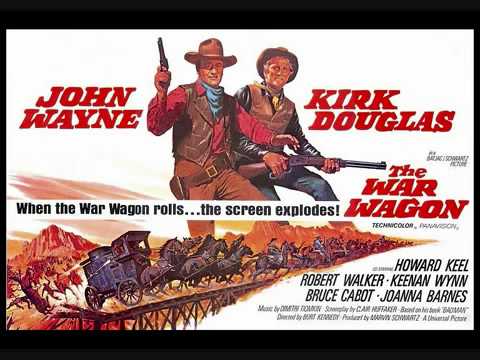
“The War Wagon”

The first thing about the 1967 John Wayne/Kirk Douglas vehicle The War Wagon   (yes, that pun was intentional, thank you)  is that it has o...