Showing posts with label Andrew Davies. Show all posts

Wednesday, 17 April 2019

“Vanity Fair” (1998)

The 1998 adaptation of W. L. Thackeray's Vanity Fair is the latest in the series of BBC adaptations of classic literature that I have been devouring; its script was produced by the selfsame Andrew Davies who adapted that Middlemarch I reviewed earlier, though in truth this couldn't be more different from that, in terms of tone. 


For true to the book, Vanity Fair is a satire, or at least it is for its first two episodes; the last two fall more on the side of drama as Becky Sharp's schemes finally lead to grim consequences for everyone involved, her included, as the life she built for herself out of lies and manipulation starts to crumble — and the middle two episodes, therefore, fall somewhere in-between. A satire it is, and Marc Munden directs it as quite broad; he is unafraid to be vulgar (the first shot is of a woman picking her nose, for Rassilon's sake), and while I do not like this, I understand where he's coming from. Similarly, there's lots of unattractive close-up, and violent, fast-paced editing, and so on; the message is clear that this isn't one of yer well-polished pieces of Victoriana. I do think the viewing experience would be improved if this were toned down, but that does not mean it's done artlessly, nor that it makes the viewing truly unpleasant at all; everything else is plenty enough to carry the picture. 


The cast, as always in these things, is superb. Natasha Little as Rebecca “Becky” Sharp herself is a stellar effort, sufficiently charismatic to carry the series without compromising the fact that when push comes to shove, she is a very nasty piece of work underneath the varnish. I could go on and on about how well-cast and well-acted everyone is; I'll be content to mention David Bradley (Sir Pitt Crawley) and Jeremy Swift (Jos Sedley), for I had seen them both in other things before, and therefore I can appreciate that both show much more range than these previous outings of theirs led me to believe. It genuinely took me a moment to realize the coarse, warm-yet-threatening, grotesque Sir Pitt was the selfsame David Bradley whom I had seen as the distant, airheaded old scientist he played in Doctor Who and An Adventure in Space and Time; though it is closer to his bit part as Argus Filch in the Harry Potter pictures (and there's out quota of there being at least one HP actor in any given 1990's BBC production, by the way).


What else is there to mention? One thing, and one I am sorry to say it, but I must. The music is by Murray Gold, in one of his earlier efforts; Murray Gold, whose work on Doctor Who is among my favorite television soundtracks of the modern era, whose leitmotifs are ever so memorable and charming and fitting. It is also utterly dire. Only in very few (and uninspired) moments does Gold remember there are other instruments in the orchestra than brasses; and the rest of the time, he rehashes one endless, tango-esque theme that has bugger-all to do with the 1810's time period, and which one truly comes to loathe by the end of those punishing five-and-a-half hours of ear torture, for not only does it only very rarely fit the tone of what is onscreen, but the orchestra blares it out in a shrieking and utterly wretched fashion; it's badly-designed and that is one thing, but there is also the fact that it's very, very badly played. No hard feelings, Murray, I hope, but this is quite horrible. 

And I felt I had to tell the world, because Wikipedia informs me that some-ruddy-how, this aural hell of a soundtrack got nominated for a B.A.F.T.A. award back then. (Only nominated, thank the Nimon.)


Still, even Gold at his worst can't spoil a jolly solid piece of television; as a certain amusing, though sometimes unfair, video channel likes to repeat, “no movie is without sin”. All in all, I can but recommend the 1998 Vanity Fair, if you care to check it out. Just be warned that the music may not be everything one hopes for, and the direction takes some getting used-to. 

Post-Scriptum:
  • It too took some getting used-to, but I can safely say in hindsight that I quite like the way this series does credits. It's very good for bingewatchers like myself, and saves us the agony of a few minutes of pure Bad Murray Gold. 

Tuesday, 12 March 2019

“Middlemarch” (1994)

This review will be a little special, for the reason that I do not feel qualified to talk about the BBC's 1993 Middlemarch miniseries at length, not nearly. For one thing, I have not read the classic George Eliot novel on which it is based; by all accounts this is a fairly accurate adaptation, but it could be that some key detail (or, more insidiously, the general tone) has been drastically altered, and I wouldn't know; and I would feel pretty bad if that were the case. So what I do is I'll lay off talking about the plot and the tone; both seemed very good to this phillistine, I'll leave it at that.

Nevertheless: Middlemarch. I have seen it, and as a piece of television it is truly marvelous. 


This treatment of Eliot's story was written by Andrew Davies (I want to say skillfully; but again I lack the knowledge to say whether it was a skillful adaptation; I can but say that it is a skillful screenplay, and that is undeniable), whom the cover of the DVD box set on which I watched it loudly hailed as the writer of some other thing I haven't watched. I found that fact rather peculiar. How often is the big name-pull in a project like this the adapter? Is there such a thing as a celebrity adapter? Well, there is now. The direction, meanwhile, is the work of Anthony Page, one of the myriad surprisingly competent unknowns that the BBC is apparently bursting with at all times. The direction in Middlemarch isn't anything special, but there's a great many nice shots and well-edited moments; and that's all it needs. Likewise the production and costume design is very good without being so stunning as to lead you to notice it; not the stuff of awards, but it's not trying to be, and what it is trying to do it does superbly. The music is extremely pleasant, between the title theme by the great Stanley Myers and the incidental instrumental score by the alsl-great Christopher Gunning (of Poirot fame, among others). I read the latter received an award for this, and he totally deserved it.


The true stand-out, though, is the cast; both main and supporting, they are truly excellent. Of Juliet Aubrey (Dorothea “Dodo” Brooke, our kind-of-protagonist, though Middlemarch isn't really concerned with having a ‘main character’), Patrick Malahide (grim-faced scholar, and careless husband of the former Edward Casaubon) and Douglas Hodge (Dr Tertius Lydgate, our other kind-of-main-protagonist), I have only to say: that they play their roles to perfection, and (but this is incredibly flimsy and superficial, I know; I'm putting out there anyway, because, one, my blog, and two, said blog does have 'random' right there in the title) that their general demeanors reminded me, respectively, of Allison Williams's Kit Snicket, Richard E. Grant's Doctor Simeon, and Colin Baker's Sixth Doctor. 


Jonathan Firth manages to make the audience care about Fred Vincy from the beginning, which is no mince feat; Trevyn McDowell is likewise a pretty good Rosamund Vincy. She does at least look gorgeously. I must give also give massive props to John Savident (you may recognize him from his minor part in A Clockwork Orange) as a delightfully loathsome, scummy John Raffles who reminds me of nothing more than Timothy Spall's Peter Pettigrew if were more expansive and less cowardly. As for Rufus Sewell's Will Ladislaw — well — everything about him is designed to make the female fanbase fancy him (or male, if so inclined, of course, but he feels particularly fangirl-oriented), but that aside he too does very honorably. 


As the stern, complex, very realistic Scrooge-like figure of Nicholas Bulstrode, we find none other than Peter Jeffrey, whom we left back in 1971 unraveling a series of fiendish Biblical murders. And no matter what a fun presence Jeffrey was in Phibes, there is no denying that he's given many more things, and more interesting things at that, to do here as an actor. By god he pulls it off, too.


And lastly I want to talk about the late, great Robert Hardy, here as the hopeless, but endlessly, thoughtlessly optimistic wannabe-politician Arthur Brooke. The world will remember him mostly for his take on Minister Cornelius Fudge in the Harry Potter movies, because the Harry Potter movies strived on sucking the reputation of esteemed British actors like some sort of fame-vampire, leaving them puppets to its own growing fame forevermore (poor Michael Gambon, poor Jim Broadbent, poor John Hurt). He is quite good at it mind you; we'll get to that whenever I get around to reviewing the Harry Potter movies. 

But oh, that he should be famous for that bit part when this exists as a more fleshed-out, fully realized version of more or less the same character (Fudge is somewhat older than Brooke, but it hardly matters). He feels, like every other Middlemarch character to the possible exception of Ladislaw, like a real, fully-realized human personality; and at the same time he is a fascinatingly good comic relief, the only real full-on comic relief in the entire series. I knew already that Hardy was one heck of an actor, for having seen his take on Shakespeare's Sir Toby Belch in a televised Twelfth Night, but this seals him as one of my favorite lesser-known English actors altogether. Really, really quite good.


So all in all, obviously, I highly recommend Middlemarch to any prospective watchers; it's a very rewarding experience. As to telling any great enhtusiasts of the book whether it's a worthy adaptation of it, I can make no definitive pronouncements. Nevertheless, again: it's very very good. 

Post-Scriptum: 
  • Why yes, I do like, and review, “serious” things as well as wacky pulpy stuff. Have I not warned you that I contained multitudes? MWA HAH HAH. You have no idea. 
  • There is one thing “wrong” — or at least something weird — about this excellent miniseries, and it is that at the end of the last episode, we are treated to a ‘where are they now?’ voice-over, which the credits tell us is supposed to be spoken by George Eliot herself. It's read by Judi Dench, which is nice and all (way to cram one more big British name in there!), but there has not been one minute of narration at any time prior, and it just starts abruptly. It's a bit jarring is what it is. This is a pet peeve I have with movies: either you have a narrator or you don't. Pick one.


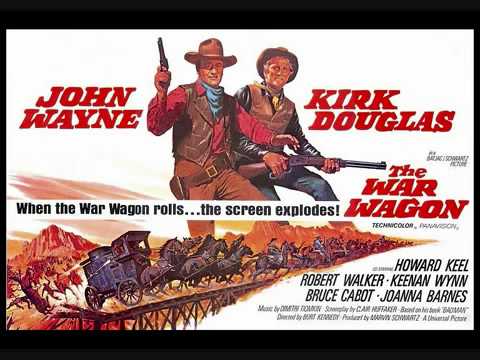
“The War Wagon”

The first thing about the 1967 John Wayne/Kirk Douglas vehicle The War Wagon   (yes, that pun was intentional, thank you)  is that it has o...