Wednesday, 20 March 2019

“Fun? What's That?”

Carl Barks! The Good Duck Artist! I like him. Not as stratospherically as some people — I admire his influence on Disney comics at large, and I don't deny that he's a good writer and good artist, but he's not my favorite Disney author in either capacity. Still! A master of his craft he was, and having particularly liked a random story of his when I reread it yesterday, I thought to myself, Aristide, the world must know. Or at least I thought something vaguely in that direction. 


This is Fun? What's That?, from 1959, one of 'em short-form Scrooge/Gyro team-ups. Scrooge/Gyro isn't a very common ‘pairing’, but here and elsewhere it works rather well; showing that this is Barks and not some less ‘involved’ writer, Fun? What's That? is particularly concerned with drawing parallels between Scrooge & Gyro, implicitly justifying putting them in a story together. 

The concept of the story, as a seasoned reader could arguably deduce from the title alone, is that Scrooge and Gyro half-heartedly attempt to “have fun” the way normal people do, forbidden from inventing/doing money-related things. This is as the case may be prompted by an amusing misunderstanding at Dr Quacker's (Dr Quacker is a dognose, not an anthropomorphic duck, which feels a bit odd when he's got ‘Quack’ in his name; could Barks really have chosen a 'Quack' name purely based on the slang meaning, without taking a step back to consider that this was a duck story?), where he accidentally hears the Little Helper's buzzing instead of Gyro's heartbeat, and concludes that poor Gyro has ‘Puckeritis of the Pipeline’. He proceeds to send him off to the countryside, considering it his only chance. (I wonder, did the writer of the DuckTales Classic episode Scrooge's Last Adventure have this story in mind?)


Scrooge, who in a brilliant cheapness gag had been waiting for someone with the same symptoms as him (in this case, Gyro) to come along and pay for a consultation so he doesn't have to, tags along. Various sequences ensue (beach, bowling alley, and finally camping trip), during which Gyro and Scrooge can barely stop themselves from inventing things and counting things, respectively. The characterization of Scrooge as borderline-OCD like this is a bit odd, but kinda charming. 


(By the way, did you notice that Yogi Wisenik here — ah, Barks and the naming of incidental characters — is a human? The female fortune tellers in You Can't Guess and The Dainty Daredevil are also humans, which suggests that for some reason, the publisher's ban on human characters didn't extend to soothsayers. Huh. Wonder why.)

Barks appears to be treating the story as a Gyro one where Scrooge happens to tag along as a sidekick, and Barks Gyro story means background gags with the Little Helper. Those are always charming and endearing; you can see an example of the usual fare in the ‘yogi’ panel above. But it's more than background gags here: the Helper ends up playing a rather big role in the camping sequence. For example, Scrooge puts him to rather undignified use cooking sourdough biscuits (incidentally letting us readers know that the Helper's bulb-head produces signifcant heat; every day, something new!):


(I love, love, love this sequence more than I can articulate, with Scrooge's casual, cheerful abuse of the Helper, and the Helper's private grumbling, which I'll note is not enough to overwhelm his sense of duty about Being Helpful: note that despite the ‘Gripe, Gripe’-ing, he makes no attempts to extract himself from the dough.)

There's also his displaying the ability to flash brighter than usual at will, an ability he uses to chase all sorts of creatures out of the cave where Scrooge and Gyro are spending the night, and though I'm not convinced either by the idea that half these creatures would be sleeping together in the same cave, or the idea that bright lights would be enough to scare some of these off, it too is very charming.


He displays the same ability again after being, I kid you not, swallowed by a goddamn bear, and it goes from charming to surrealistically awesome. 


I'm not usually that much of a fan of whenever Barks drags bears into his stories — the way he draws them is always slightly unappealing to me — and somehow, that bear on the right, above, still looks more like an overweight wolf to me than a bear — but this sequence is nevertheless extremely funny to me. Don't know about you lot. 

Anyway, of course, they eventually decide “screw this, we're going back to work” (this makes more sense for Scrooge than it does for Gyro, who is still, by the story's logic, under the impression that he's suffering from a potentially-fatal heart disease; but oh well). All in good fun. 

So all in all, the story is predictable in concept and 'plot', from start to finish; but the execution, owing to Barks's talent, makes it into an extremely entertaining read, with a choice part for the Little Helper (always a plus) and an interesting, if not super-complex, venture into Scrooge and Gyro's psychologies. I fully recommend it. 

Post-Scriptum:
  • This is the panel where Scrooge and Gyro decide to go back to work. Focus on Gyro's line — is this all secretly a prequel to Picnic? Well… not quite, obviously. But you gotta figure that Gyro's attempts to improve camping will go significantly like his attempts to improve picnics in that other great Barks story. 


Monday, 18 March 2019

“The Addams Family” (1991)

Being a great enthusiast for the “spooky comedies” subgenre (The Haunted Mansion, and the great art to be found there, whether concept- or fan-, are what got me into it; Vincent Price is largely what made me stay), I easily let myself be persuaded by my sister to watch the 1991 big-screen The Addams Family feature last weekend. At the very least I would then finally discover the context of the large amounts of gifs that Tumblr has wrung out of that poor sod of a movie. Like a distressing number of 1990's movies, you'd be forgiven, judging from Tumblr, for thinking that half this films's dialogue consists of lines designed specifically to be quoted later at comically-appropriate times.

After watching it in earnest, I can testify that, unlike with most of the 1990's movies which get this treatment on the Internet, this sentiment would be entirely accurate. 


But let it be said that those are some damn fine quips, too! Let not the above jaded opening give you the impression that I disliked the movie; forsooth, I liked it quite a bit.

I scarcely think that there is much cause to explain a fairly self-explanatory premise: the titular Family are a jolly ol'bunch of grotesques enjoying the “end-of-the-rope Bela Lugosi who dressed and lived like Dracula” lifestyle to the fullest, and not caring one bit that everyone else finds them utterly creepy. Less straightforward is the plot of the attempt to bring it to the big screen, a rather confused affair of mistaken identity centering on the figure of the Nosferatu-like Uncle Fester. But of course, it is no more confusing, nor farther-fetched, than a lot of Shakespeare plots; if you can sort-of-buy Twelfth Night, you can sort-of-buy this too. The place of the Bard in the realm of literary posterity suggests most people can indeed sort-of-buy Twelfth Night. So, let's move on. 


This Fester character is here played with marvelous, inventive twitchiness by the great Christopher Lloyd. (I have not seen many films with the man; I have not even seen any of those Back to the Future films everyone kept banging on about three years ago. But I have seen Who Framed Roger Rabbit? and Don Bluth's animated Anastasia, and that would be sufficient data to declare Lloyd a great actor, in the over-the-top category, whether or not the Internet was already screaming at me that he is one of the greats. Which it is, very loudly too.) Fester spends most of the movie as an amnesiac impersonating himself at the behest of a mother who adopted him in his 50's — don't worry, it makes just as much sense in context — so as to serve as our introductory “viewpoint character”. And — it's not that it doesn't work — but I'm not entirely certain we needed a viewpoint character. Designed for nigh-worldess newspaper cartoons first, and a 1960's sitcom later, the Addams Family are an extremely self-explanatory bunch; in truth, by the time Fester comes in, we already have a pretty solid idea who the Addamses are and what the tone of the film is going to be.


Though Lloyd is the “big name carrying the movie with a daringly different reinterpretation of one of the franchise's originals” (this is a trick that would be tried again with other fun-gothic films of this movie's generation: it sort-of-worked with Jim Carrey as Count Olaf in the 2003 Lemony Snicket flick, and failed horribly in the Haunted Mansion feature the same year), the rest of the cast is pretty uniformly stellar, from child actress Christina Ricci as the memed-to-death, but truly very entertaining, Wedsneday Addams, to Elizabeth Wilson as our villain, the Mme-de-Tremaine-esque Mrs Abigail Craven. (Craven not a very interesting villain, more as a result of with who and wirth what she's sharing the movie; Joan Cussack in the movie's sequel was dealt a much better deal with not a doubt. But Wilson plays her quite well still.) Anjelica Huston and Raúl Juliá as Morticia and Gomez Addams, in particular — I cannot judge them in comparsion to the televised originals, for I have not watched the TV series; but on their own terms, it is glaringly obvious that they are the most perfect realizations imaginable of what they are trying to be. 


The plot may be a little meandering, but that's never been a problem in a comedy so long as the meat is peppered with enough jokes at a good enough pace; The Addams Family does that. It has the good sense to borrow a fair few of its jokes from Charles Addams's original cartoons, and the rest are very successfully funny too; it also sometimes leaves the funny actors to do their funny things, and they do that very well too. There are a couple of jokes that don't land, or at least not with me (sadly, the last joke in the film is one of them), but aren't there always? 


The direction was handily recognizable as Barry Sonnenfeld to me, from his work on the 2017 Series of Unfortunate Events television series, and Sonnenfeld definitely knows what he's doing, creating a nice tone in almost every scene. The set design in which he's playing around is frequently gorgeous, though some bits of the Addams Mansion are a bit too much of a “boilerplate haunted house”. (There is one other exception I'll save for the post-scriptum.)


The Addams Family is also, of course, an effects picture; so I suppose I am expected to make a statement about those special effects. Well, the most obvious show of said SFX is ‘Thing’ the disembodied hand (it wasn't actually a disembodied hand in the source material, but rather a creature who was so hideous that we could only ever see its hand, the rest being too horrible; this is a vastly more creative concept than "disembodied hand"; but I shan't blame the movie overmuch for that, as that ship had long sailed by the time the movie rolled round, with numerous jokes back in the television series revolving around Thing's hand-ness). It works in most of its scenes, though it feels oddly weightless whenever it's crawling about; there is one exception of terrible greenscreenery, and that is that brief sequence in the climax where it's searching the swamps. But it lasts barely five seconds, so I'll excuse it. Similarly, of all the non-Thing effect, there is one laughably bad one, a computer-generated fire effect supposed to burn down a wooden statue in a few seconds. But it's a brief cutaway gag. 


All in all, it's not perfect, but I solidly recommend it. I look forward to watching the sequel, the amusingly-titled Addams Family Values, next weekend; I don't know if I'll have enough material for another review (we'll see), but for now I'd tacitly recommend it based on the quality of its predecessor and the presence of the great Joan Cussack in it (I know and love her from that other Sonnenfeld project, the Lemony Snicket televisions series). 

Post-Scriptum: 
  • So what is up with the Addams Family Graveyard, anyway? Not only are the statues in a weird, 20th-century-ish style that would scream “Anachronism!” if it had working lungs, but most of the tombs inexplicably bear the sole name of Addams. Guys, sorry to break it to you, but again… this is the Addams family plot. You're not actually telling passersby a whole lot by labeling the tombstones with their occupant's last name. This is one respect in which the Gracey Family Plot in The Haunted Mansion (ride, not film, of course) is indubitably superior, as it instead features first names to the exclusion of last names. 
          (Oh, well. It's a nice enough setpiece to look at, at least; reminded me a bit of Phibes's lair.)

Friday, 15 March 2019

“Do You Have a Licence to Save This Planet?”

Back in Doctor Who's Wilderness Years, there was a substrate of the (adult) fandom who decided to start taking advantage of the quaint way copyright of British television works: individual writers retain full rights to the scripts they wrote and characters therein introduced. 

And this meant that the enthusiastic fans could dig up the geriatric genius who'd written the first story with Sontarans or Autons in it, and persuade him to give them the rights to make an Sontaran/Auton/whatever television story. Of course, they couldn't use those elements of Who owned by the BBC (the Doctor himself, the TARDIS, the theme song, the Daleks), but that didn't stop a wave of spinoffs — which were, in essence, licensed fanfilms; certainly, there's no doubt that the type of fellow who do today's best fanfilms would have been doing these spin-offs at the time — from being released on home video. 

Sometimes, they would also persuade one of the iconic Who actors to lend a hand; they played their original part if rights were available, and if not,… they made the film anyway and changed a few cosmetic details to placate BBC lawyers. For example, there was a whole series of direct-to-video films starring Colin Baker, who was obviously playing the Sixth Doctor, except he was only ever referred to as “the Stranger”, he didn't have the patchwork coat, and the camera cut away whenever he and his friendly female companion headed for their perpetually-offscreen time machine. They occasionally used this same trick for the monsters whose rights they couldn't scrounge up; there was a series of films featuring the Cyberons, metallic, emotionless alien cyborgs who are so very obviously the Cybermen, except without the handlebars. 

They made a book about this stuff, of which this is
the cover illustration, bringing together a bunch of “licensed fanfilm”
 characters; front-and-center and from left to right are the retired Brigadier Lethbridge-Stewart
played by Nicholas Courtney in Downtime, a Cyberon, Sophie Aldred as not-Ace,
and Sylvester McCoy as Totally-Not-The-Seventh-Doctor-We-Swear. 

A lot of these 'DTV spin-offs' were produced by the comically-titled BBV Productions (nothing to do with the BBC: the BBV stands for Bill & Brenda's Videotapes, y'see, Bill and Brenda Baggs being the daring entrepreneurs behind the whole thing). And in 2001, shortly before they went out of business (Bill Baggs went on to become a health guru, of all things, I am told), BBV produced a very odd, 30-minutes-long, home-video-released self-parody by the title of Do You Have a Licence to Save This Planet?


The story brought together the licensed Autons and Sontarans, and the unlicensed Cyberons, all chasing after Sylvester McCoy in a patchwork coat he'd curiously go on to wear in a 2004 reprise of the Seventh Doctor character, though here the conceit is that he's not dressed as the 7th Doctor, which just goes to show how flimsy these “no, we're not in breach of copyright, what on Earth are you talking about?” arguments usually were. 


Thing is, as the title might have clued you in already, this is precisely what DYHALTSTP? is all about. See, McCoy is here playing “the Chiropodist” (or “Foot Doctor” for philistines), a “Chrono-Duke” hwo travels around the universe in a time-traveling washing machine, and fights evil with his “sonic spoons”. Due to being “unlicensed”, he is under hot pursuit by “the Licensor” (Nigel Fairs), an incredibly campy Master parody who is head of the Licensed Reality CorporationTM. The Foot Doctor is helped by an enthusiastic chap going by “the Salesman” (Mark Donovan), who came to him under the belief that he was the real Doctor wanting to become his new companion. He is noticeably disappointed when he realizes that the Foot Doctor “is BBV” (yes, they actually say that) but stays anyway, and explains that he sells hackneyed plot devices, of which he packs a whole suitcase.


Not factoring into anything to any real degree except to pad out the runtime and add a few gags are a duo of Cyberons who have infiltrated Earth and are now living in a house. They interact with their human neighbors a little bit and moan about not haveing “ears” (=Cybermen handles) like they would do if they were licensed. There is also a Sontaran, the reason for the presence of whom is never made entirely clear; unlike the Cyberons, he's explicitly not in the Licensor's employ. I dunno. 


So is it any good? Ah, hm, well, about that. See, this metafictional gag-filled romp packed full of easter eggs and references is supposed to be just the kind of thing I like, and make no mistake, Paul Ebbs & Gareth Preston (both pull double-duties, as the stuntmen in the Cyberon and Auton costumes, a trapping so very typical of fanfilms today) turned in a very solid script. With the exception of a couple of dubious bits with the Sontaran, and one or two of the Cyberon gags, it is a masterful parody. The intent that this be a kind of “Monty Python does Doctor Who” thing is very clear, and the presence of a (terrible) animation interlude with Rassilon only adds to that feeling. I also feel like Nigel Fairs in his second part (the Cyberon's human neighbor Geoff) is pulling a rather poor Graham Chapman impression, but I could be wrong about that. (It is at the very least a poor performance, that much is certain.)


As for the actors, they too aren't to blame. Sylvester McCoy is Sylvester McCoy, and therefore a joy to watch, though he flip-flops between just playing the damn Seventh Doctor, and returning to the exaggerated pantomime of the early days of his pre-Who career; he's great at both but it can be a bit jarring. Nigel Fairs is pretty excruciating as Geoff, but it's a noble failure in trying to be funny, not the wooden acting of an amateur; his Licensor is a much better turn — he's a lot of fun to watch. Not quite as fun as Jonathan Pryce's equivalent character in The Curse of Fatal Death, of course; nothing can top that. And even at self-proclaimed “top-campiness”, Fairs's Licensor isn't actually quite as hammy as the fully-canonical Soldeed from The Horns of Nimon. Still, if we had to judge every hammy parody villain by the standards of Graham Crowden and Jonathan Pryce, there are precious few who could be called hammy at all. The other actors are good without being stand-outs (Rupert Booth, a noted fanfilm Doctor, here plays a Sontaran; he is as far as I know the only other actor aside from McCoy who's somehow “notable”.) The effects, surprisingly, aren't too bad either. There's some pretty good CGI by early-2000's-home-video standards in there. Nothing fancy, but it works well enough. 


No, the one, glaring, fatal flaw of DYHALTSTP? is the direction and editing. It is simply wretched, and I can't conceive of how Bill Baggs ever thought he could get away with — that. Incompetent editing that doesn't even have most fanfilms' decency to stick to long, basic shots and instead tries to frequently shift angles is the plague of this movie, mangling joke after joke and sucking anything like comedy timing out of something that could not possibly survive without it. The simple, funny idea that as he steps out of his washing-machine TARDIS, the Chiropodist is sprayed with clean laundry, is rendered almost incomprehensible to the watcher by some of the poorest intercutting of shots in the history of cinema. Bah! Bah! And bah! 


Of course, there are gags which even incompetent editing and sound design cannot bungle, and there are some sequences where the film rises to the levels of competency. It's not unwatchable — just nowhere near as funny as it could have been with better direction. 


In the end, I would say that I do recommend DYHALTSTP? to Who fans, especially if they're at least mildly aware of BBV. It's a good chance to see Sylvester McCoy do his thing once more, in a less bleak context than the latter half of his televised tenure, and also to play a fun game of ‘Spot the Reference’. Just don't go in expecting the Douglas Adams-level sci-fi gigglefest that summaries (and, indeed, the DVD backcover blurb) might lead you to believe it is… even though it was this close to being precisely that. Oh well. In the words of disappointed Doctor Who fans everywhere (and everywhen), there's always Big Finish. 

Post-Scriptum:

Also, I kinda like the theme song. It's obviously meant to remind you of the official Who tune, but I quite like it in its own right. Gets stuck in your head just as well as the real thing, too. 


Tuesday, 12 March 2019

“Middlemarch” (1994)

This review will be a little special, for the reason that I do not feel qualified to talk about the BBC's 1993 Middlemarch miniseries at length, not nearly. For one thing, I have not read the classic George Eliot novel on which it is based; by all accounts this is a fairly accurate adaptation, but it could be that some key detail (or, more insidiously, the general tone) has been drastically altered, and I wouldn't know; and I would feel pretty bad if that were the case. So what I do is I'll lay off talking about the plot and the tone; both seemed very good to this phillistine, I'll leave it at that.

Nevertheless: Middlemarch. I have seen it, and as a piece of television it is truly marvelous. 


This treatment of Eliot's story was written by Andrew Davies (I want to say skillfully; but again I lack the knowledge to say whether it was a skillful adaptation; I can but say that it is a skillful screenplay, and that is undeniable), whom the cover of the DVD box set on which I watched it loudly hailed as the writer of some other thing I haven't watched. I found that fact rather peculiar. How often is the big name-pull in a project like this the adapter? Is there such a thing as a celebrity adapter? Well, there is now. The direction, meanwhile, is the work of Anthony Page, one of the myriad surprisingly competent unknowns that the BBC is apparently bursting with at all times. The direction in Middlemarch isn't anything special, but there's a great many nice shots and well-edited moments; and that's all it needs. Likewise the production and costume design is very good without being so stunning as to lead you to notice it; not the stuff of awards, but it's not trying to be, and what it is trying to do it does superbly. The music is extremely pleasant, between the title theme by the great Stanley Myers and the incidental instrumental score by the alsl-great Christopher Gunning (of Poirot fame, among others). I read the latter received an award for this, and he totally deserved it.


The true stand-out, though, is the cast; both main and supporting, they are truly excellent. Of Juliet Aubrey (Dorothea “Dodo” Brooke, our kind-of-protagonist, though Middlemarch isn't really concerned with having a ‘main character’), Patrick Malahide (grim-faced scholar, and careless husband of the former Edward Casaubon) and Douglas Hodge (Dr Tertius Lydgate, our other kind-of-main-protagonist), I have only to say: that they play their roles to perfection, and (but this is incredibly flimsy and superficial, I know; I'm putting out there anyway, because, one, my blog, and two, said blog does have 'random' right there in the title) that their general demeanors reminded me, respectively, of Allison Williams's Kit Snicket, Richard E. Grant's Doctor Simeon, and Colin Baker's Sixth Doctor. 


Jonathan Firth manages to make the audience care about Fred Vincy from the beginning, which is no mince feat; Trevyn McDowell is likewise a pretty good Rosamund Vincy. She does at least look gorgeously. I must give also give massive props to John Savident (you may recognize him from his minor part in A Clockwork Orange) as a delightfully loathsome, scummy John Raffles who reminds me of nothing more than Timothy Spall's Peter Pettigrew if were more expansive and less cowardly. As for Rufus Sewell's Will Ladislaw — well — everything about him is designed to make the female fanbase fancy him (or male, if so inclined, of course, but he feels particularly fangirl-oriented), but that aside he too does very honorably. 


As the stern, complex, very realistic Scrooge-like figure of Nicholas Bulstrode, we find none other than Peter Jeffrey, whom we left back in 1971 unraveling a series of fiendish Biblical murders. And no matter what a fun presence Jeffrey was in Phibes, there is no denying that he's given many more things, and more interesting things at that, to do here as an actor. By god he pulls it off, too.


And lastly I want to talk about the late, great Robert Hardy, here as the hopeless, but endlessly, thoughtlessly optimistic wannabe-politician Arthur Brooke. The world will remember him mostly for his take on Minister Cornelius Fudge in the Harry Potter movies, because the Harry Potter movies strived on sucking the reputation of esteemed British actors like some sort of fame-vampire, leaving them puppets to its own growing fame forevermore (poor Michael Gambon, poor Jim Broadbent, poor John Hurt). He is quite good at it mind you; we'll get to that whenever I get around to reviewing the Harry Potter movies. 

But oh, that he should be famous for that bit part when this exists as a more fleshed-out, fully realized version of more or less the same character (Fudge is somewhat older than Brooke, but it hardly matters). He feels, like every other Middlemarch character to the possible exception of Ladislaw, like a real, fully-realized human personality; and at the same time he is a fascinatingly good comic relief, the only real full-on comic relief in the entire series. I knew already that Hardy was one heck of an actor, for having seen his take on Shakespeare's Sir Toby Belch in a televised Twelfth Night, but this seals him as one of my favorite lesser-known English actors altogether. Really, really quite good.


So all in all, obviously, I highly recommend Middlemarch to any prospective watchers; it's a very rewarding experience. As to telling any great enhtusiasts of the book whether it's a worthy adaptation of it, I can make no definitive pronouncements. Nevertheless, again: it's very very good. 

Post-Scriptum: 
  • Why yes, I do like, and review, “serious” things as well as wacky pulpy stuff. Have I not warned you that I contained multitudes? MWA HAH HAH. You have no idea. 
  • There is one thing “wrong” — or at least something weird — about this excellent miniseries, and it is that at the end of the last episode, we are treated to a ‘where are they now?’ voice-over, which the credits tell us is supposed to be spoken by George Eliot herself. It's read by Judi Dench, which is nice and all (way to cram one more big British name in there!), but there has not been one minute of narration at any time prior, and it just starts abruptly. It's a bit jarring is what it is. This is a pet peeve I have with movies: either you have a narrator or you don't. Pick one.


Saturday, 2 March 2019

“The Woes of a Shopping Supervillain”

So is this the “much better Disney comic than My Second Million” that I mentioned in that review? Eh… maybe. To be honest, when I wrote that promise into the post, I had made a resolve to review some good Disney comic, just to wash the foul taste off my mouth; I didn't have any particular story in mind. This will do. (The title is mine, and more of a placeholder than anything else. I know it's not that good, okay? Still, it, too, will do. …I have to think up a lot of these not-too-awful titles when I create pages for untitled stories on the $crooge McDuck Wiki, so let's all hope I'm not too terrible at it as I feel like I am.)

This is, more than anything else, a reaction to GeoX's year-and-a-half-years-old review of Romano Scarpa's The Blot's Double Mystery, where he contrasted Scarpa's “dignified” treatment of Merril De Marris and Floyd Gottfredson's hooded mastermind with the supposedly slapdash, devil-may-care attitude of American comics in the same period. To this end, he called up this one-pager. 


Now, that one-pager is, yes, freaking awful for a Phantom Blot story. The Blot is supposed to be a sinister criminal mastermind with inscrutable motives. None of that comes across above; the joke would be fine with most any other Disney comic villain (though it would work best, in my opinion, if it was Pete trying to imitate Mickey), but A), the Blot is not some insecure shmuck who'd have to prove ot himself that he can whirl a lasso as well as a random cowboy just because he came across said cowboy in the street; B), the Blot is scarily competent at everything he does, and it goes against everything that makes him memorable for him to be done in by his own clumsiness. 

But I think GeoX cherry-picked his example very egregiously. First, it's kind of sneaky to pick an inside-cover one-pager, since even Carl Barks's Scrooge inside-cover-one-pagers often do things with everyone's favorite feathered plutocrat that don't quite gel with his usual characterization. But even setting that aside… sure, few of the vintage American PB comics were masterpieces, but they were usually much better than this. 

Therefore I call to the stand another more-or-less-randomly-selected PB one-pager (this is from Issue 6 of his solo comic series from the 1960's). 


First things first, it's funny; certainly funnier than the earlier story, because the moment you bring a lasso into a slapstick one-pager, you kinda know what's gonna happen, whereas here—testing pens? Huh? The page really can keep you guessing. So the punchline works more smoothly. 

And it also demonstrates a much better grasp of the Blot and his personal mythos: the conceit of the gag is in fact to wonder precisely how it is that the Blot produces those splotches of ink that form his calling card, since getting a pen to blot in real life on purpose isn't all that easy. Though I imagine it might be somewhat funny, in an absurd way, to someone who only knows that the Phantom Blot's nickname is “the Blot”, it really draws most of its comic effect from knowledge of the Blot's calling card, which isn't restated here. Therefore, hurrah for continuity! 

Furthermore, while the Blot's peculiar manners are essential to the comedy, this doesn't come at the cost of making him bumbling and incompetent, as in the previous one-pager — though it'd be a stretch to call his presence here “threatening”. After all, his demand seems incomprehensible to the salesperson above, but it's not actually stupid or insane from the reader's point of view, since we know precisely why the Blot would need such a thing. So, hurrah again, this time for not making your criminal mastermind an idiot!

Add to this some lovely art from Paul Murry (I.N.D.U.C.K.S. sadly does not know who wrote the thing), and you have proof positive that even in comedic one-pagers, the Americans of yore absolutely could get the Blot right and maintain his dignity. I'll grant you that Darkenblot or The Big Fall, this is not. But that doesn't mean it's not a lot of fun to read. 

Post-Scriptum: 
  • Reading this, I come to realize how good a pastiche Joe Torcivia's childhood-fancomic-turned-background-gag, where the Blot, robbing a museum, ended up lingering too long in front of an exhibit of Victorian Ink Blots and getting nabbed by Chief O'Hara as a result, and which he imagined as another inside-cover one-pager for The Phantom Blot, would have been. It was already a pretty neat gag in itself, but further kudos still, Joe!
  • Did you notice the saleswoman is a human? Albeit a four-fingered one. You rarely see those in Mouse Disney comic, unless they're a “crossover character” like Madam Mim or Grimhilde. 
  • Why yes, the above coloring of the (originally black-and-white) one-pager is by me. Never say I am not devoted to giving the readers of this blog a thorough, lush artistic experience. 

Sunday, 17 February 2019

“Franz Kafka's It's A Wonderful Life”

As a Whovian for whom Peter Capaldi is one of the greatest actors ever to portray the title part on Doctor Who, imagine my surprise and glee when I discovered that Capaldi was also a successful director in his own right; and furthermore, as a fan of Franz Kafka and Frank Capra, imagine my surprise that he had won an Academy Award in 1993 for, well, this. Which, as the icing on the cake, happens to feature great actor (and fellow once-Doctor) Richard E. Grant in the title part of Franz Kafka, which is perhaps the most genius bit of casting I've ever seen in a Kafka movie. 

So how does it hold up, really? Pretty good!


Those accustomed to the endless variations on the “What if you were never born?” sequence of Capra's 1946 picture It's A Wonderful Life will be surprised to note that there isn't really any of that in Capaldi's film; instead, what it takes from the 1946 feature is the general structure of “things are miserable for a self-loathing protagonist who makes it harder on himself, until they are not, as all his gathered friends come together at the end to save both him and the day”. 

What remains is this premise: in a beautifully German-expressionist rendition of Kafka's Czech hometown, the writer is about to begin work on his masterpiece, Die Verwandlung (ye Brits and colonials know this as The Metamorphosis), but can't seem to figure out precisely what it is that Gregor Samsa wakes to find himself transformed into. There are frequent cutaway (as pictured above) to various preposterous options Kafka considers before scrapping them. As the tortured soul tries again and again to fulfill his destiny, and despite the insect imagery constantly staring him in the face, he can't seem to lay a finger on it. What's more, he keeps getting interrupted by various things (a Christmas party going on in the flat below his, a caller come at the wrong address, etc.). 

It is utterly brilliant. 

The thing about Franz Kafka's It's A Wonderful Life is that it's basically the most Kafkayan film I've ever seen, and yes, that includes Orson Welles's outstanding 1962 version of The Trial. Even it didn't quite reach this level of — of — how can I put it? In The Trial, it soon becomes clear that you're in dream logic, with these sprawling vistas of absurdly long corridors and absurdly large halls. In Franz on the other hand, there's nothing explicitly fantastic, or at least, it doesn't seem so until you've finished watching it and reflect back on it. It perfectly channels the weird and unpleasant experience of a bad dream, that cramped feeling, that nagging sensation that none of this is quite right, quite real that you keep mulling over without actually doing anything about it, because you can't. It's what Kafka was a master of turning into words, and Capaldi turned it into film reel. 


And what of the cast? Well, the line of celebrities does not end as Grant & Capaldi, as you'll also recognize Phyllis Logan and Ken Stott in varyingly-incidental parts. But really, a lot of credit must also go to a frightfully young Richard E. Grant, who looks sickly and disturbed without even trying, and without losing the audience's sympathy in the process, which is key to successfully playing a Kafka protagonist. (And to play Franz Kafka in such a picture is to play a Kafka protagonist, since all Kafka protagonists are basically Kafka. The short cleverly spells this point out by having Kafka's neighbors colloquially refer to him as “Mr K.”) This is, perhaps not the part, but certainly one of the parts that Grant was born to play. 

It's also a frightfully witty film, when it's not plunging us in the precise atmosphere of a nightmare; the Capra in its DNA means it has a happy ending and is overall slightly lighter-hearted than a pure Kafka picture, and all the better for it too. I won't spoil too many of the jokes, but perhaps my favorite concerns Franz's timidity about telling the partygoers below to knock it off: after he speaks his mind to the host of said party, the host, who has not lost her smiling demeanor, agrees to yield to his commanding nature, but then asks him “if this is a hypothetical conversation or a real one”. “Hypothetical, of course,” says Kafka. And the host: “Oh, good. Because I'm quite enjoying this party. Goodbye.” She walsk back in, closes the door, and so it's revealed that this scene was all Kafka's fantasy of what he wishes he had the backbone to say. 


Add to this a great visual direction, and music that, while never genius, does its part without distracting for the whole, and you get a real gem of a short film, highly recommended to anyone who enjoys Kafka, Capaldi, Richard E. Grant, or off-kilted filmmaking in general. 

Post-Scriptum:

The underwhelming music aside, I have exactly one (1) issue with the short, and that is that the visual of Samsa-as-Bug we eventually get is pretty bad. Being about pillow-sized, and with spindly long legs, the cockroach-head-thing is nothing like the many-legged pillbug I've always imagined, and nowhere near massive enough. (It is my belief that the creature in which Gregor Samsa was transformed once existed: it is the arthropleura.)

Monday, 4 February 2019

“Born Again”

Fanfiction and fanfilms existed even before the Internet and have become a simple fact of life ever since its inception. Yet not all fan works are apiece. Where a fanfiction, say, of DuckTales, is just that, there are some franchises that have spawned such fandom that fan works based on them have begun a genre of their own, with their recurring themes and their codes, to the extent that you can find people who forego the original completely and are a fan of the fanworks. The incommensurably gigantic Harry Potter fanfiction community is the quintessential example, but Britons don't stop at that; they have a cinematic equivalent too. And that is Doctor Who fanfilm.

Ranging anywhere from children dressing up in their parents' jackets (and being very charming too!) to productions of truly professional quality — and let's not talk about the odd aberration that are fanfilms to whom the official actors contributed, just for the heck of it! — Doctor Who fanfilms are astonishing, frequently awful, and sometimes superior to many televised episodes I could name. I love them dearly and regularly enter ‘Doctor Who fanfilm’ into YouTube's search bar just to see if any new nice ones have popped up.

And just two days ago, well fancy that.


Born Again, the work of Paris Freeman (who also plays the Doctor and directs this first episode; this is very common in fanfilms, for obvious reasons), is the first episode of a new fanfilm series which transparently comes to fill the power vacuum left by the DW2012 series, the ten-year-spanning, four-seasons œuvre of Luke Newman, another fan turned writer-director-Doctor. (If you want proof of Freeman's obvious intention to be the next Newman, look no further than the name of the YouTube channel now hosting his first attempt, TimeLord2016.)

The DW2012 series was not the best fanfilm series by far, not even the best one on YouTube; some of its stories flirted with the downright imbecilic, and it had all the wobbly cardboard sets, tinfoil monsters, barely-pubescent actors and reused sountracks cribbed from the official show that are the hallmarks of cheap YouTube fanfilms everywhere. Yet it had proven to be the most popular, perhaps through sheer tenacity (ten years and four seasons is more than most halfway-competent fanfilmmakers can boast), perhaps also thanks to Newman's extremely likable, hearfelt, original take on the character of the Doctor, far more than the cheap Matt Smith impression you usually get in these things. Not that Newman isn't very Smith-esque, of course.

But we're not here to talk about the DW2012 series; we're here to talk about Born Again. How does it hold up? Averagely, is my cop-out answer. Though it commits the sin of having one of the most boilerplate pilot titles imaginable, it's off to a very strong start as we watch the Doctor regenerate into a still very harried Paris Freeman and frantically try to steer the crashing TARDIS.


It's a very strong start, full of action and moody lighting and good acting. The effects work, by fanfilm standards, is pretty amazing, and will remain so for the duration of the entire episode (not that it's a feature film, not anywhere close; it's a tight 20 minutes or so). This is, no joke, probably the best regeneration effect and in-flight TARDIS I've ever seen in a fanfilm, and still pictures wouldn't do it justice; whether or not you meant to watch the whole thing, I definitely urge you to follow my earlier link and just watch the first few minutes and the opening credits sequence. And — oh — the opening credits sequence — that too is a thing of beauty. It has nothing to be ashamed of when viewed back-to-back with the intro used in Peter Capaldi's last official season, and I daresay I prefer it to the more understated affair of Series 11, though I'm not quite sold on the creative rearrangement of the iconic opening tune, which is as far removed from Murray Gold's 2010's version as even Gold's 2005 version was from the 1963 Ron Grainer classic, and that is perhaps one step removed too many. 


Unfortunately, things rather quickly go downhill from there as Paris Freeman's Doctor crashes into an American girl's back yard, and the girl, though wary of him, ends up cooking for him, and finding herself believing that he is an alien after all, and finding herself drawn in even though she is less than impressed by some of his idiosyncrasies, and… and right about now you're probably realizing that this is just Amy Pond, except without any of the interesting bits. A common ailment in fanfilm companions, sadly. Complain all you like about the blandness and interchangeability of the official onscreen companions, but you ain't seen nothing yet.


But stuck we are with Nicole Williamson (I'll give the film that this is pleasantly sounds like an American name without being a caricature of one). The fact that she is as basic a fanmade companion as they get would be bad enough, but she is portrayed with frigidly wooden acting and a gratingly monotone voice by Gabrielle Wright.

And I realize that it is unfair to pick on fanfilm actors, who are by definition doing a labor of love with an amateur background, but I hope that the TimeLord2016 folks take this as the backhanded compliment that it is: it is only because you got so close to letting me forget this is a fan production that this acting (well, lack thereof) sticks out like a sore thumb. 

But if the companion's a dud, at least the Doctor has to be okay, right? Well, mostly, yeah.


The bad first: past the opening scene where a certain amount of harried slurriness was expected, I slowly came to notice, with not inconsiderable dismay, that Paris Freeman mumbles half his lines instead of saying them. When he does say them he does it well enough, and his American accent isn't nearly as noticeable a 'flaw' as you might think, but this is certainly not a Doctor I'd listen to in Big Finish audios. In totally unrelated matters, I won't speculate on Freeman's exact age, but there is the unavoidable fact that he looks strikingly boyish. Not in itself damning for a Doctor (Matt Smith and Peter Davison were certainly very boyish-looking), except that Freeman doesn't seem to realize quite the extent of his own boyishness. His portrayal seems to befit a considerably more mature Doctor than what we're looking at; it's telling that the feel of his costume, and the music used in his very first scene, are both clearly inspired by Peter Capaldi's Twelfth Doctor.

But those are minor problems. In a world where otherwise-great fanfilms are marred by leads who Just. Can't. Act, Freeman yields a perfectly acceptable, even entertaining performance. He's certainly no worse than Luke Newman was in his Doctorish debut (where Freeman now mumbles, Newman once muttered); he's confident and charismatic in his portrayal, though not as much so as a professional actor might perhaps be in his place. If there is one easily-fixed flaw in the Paris Freeman Doctor, it is more with the writing than the acting, and it is that he hasn't really had a chance to be funny yet. Genial, yes, but I'm still waiting for a moment of outright daffiness for him to call his own.

All in all, Freeman delivers a perfectly serviceable fanfilm Doctor — of the breed who would be a travesty if actually cast as the Doctor on actual television, unlike, say, Bryan McCormack, but who by YouTube amateur standards deserve more encouragement than criticism.


Okay, so we've got our Doctor and our companion, what of the villain/monster? Ah, I thought you might ask. Well. Again, it's complicated. 

Surprisingly for a fanfilm, where it's usually the opposite, what we have here is a stunningly-realized concept that, as a concept, really doesn't hold much water. Perhaps it might make more snese in a more polished script, but the Stratagem… let me try to sum them up for you: the Stratagem is an alien hive mind remotely controlling a robot body trying to coerce the Doctor into teaching them how to steer a time machine with which they are accidentally opening gaps in the fabric of space-time, which may destroy Earth given time. All this in the space of — well, of ten minutes, really, allowing for the opening and sequences and the half of the actual screentime that is devoted to the tepid spectacle of the Doctor meeting, and bonding with, Nicole.

By contrast, the Daleks are angry dustbins who want to kill people.

But let's not be too hard on the Stratagem; as I said, where the concept is lacking and overconvoluted, the execution is very effective. The robot body is as real-looking and imposing as any pre-2005 Cyberman, that is to say, pretty damn much for something which inescapably looks first and foremost like a chrome-painted costume; Andrew Dillon does a good job of making it move in stilted, economically jittery littlemovements, withou nary any corpsing. Dillon also provides it with a shrill, monotone voice the — the filter used on it sounds a little too much like a Dalek voice, perhaps, but that doesn't have to be a bad thing. All in all it does a very good job of making you forget that strictly all it does for all of its screentime is stand around in one place.

Also: next to the Stratagem in all of its shots is a round mechanical energy-wheel-thingy (see above) which serves as its time machine's power source, and it's such a little thing, but the effect on it is really, really good. Doesn't at all feel like tacked-on CGI. The light even seems to reflect on the Stratagem's outer plating. Congratulations.


Speaking of props and effects, I earlier congratulated the CGI, in-flight TARDIS. Well, the physical one ain't no slouch, either. Its control room is made of deep brown, well-polished wood, with a particular clever bit of set design in the panels on the hexagonal console (hexagonal, like the classic hexagonal things on the wall) which can be opened to reveal the switches and buttons and levers. Now, this hexagonal console lacks a moving, vertical column-thing (what true Whovians know to be called a “Time Rotor”), and compared to the official televised ones it is really quite a small thing, like the room itself, for that matter. But it matters not — an actual control room it is, as opposed to some unconvincing greenscreen hocus-pocus such as I have encountered in the past, and quite a delightfully-designed one. And did I mention they have an actual physical TARDIS prop for outside shots? Full props to the props department.


All in all Born Again does not transcend the genre of Doctor Who fanfilms, but it is a very fine example of the form, and if they heed the quibbles earlier outlined, I have very high hopes for TimeLord2016's fanfilm series. Let us hope it will enjoy as much of a bright future as DW2012 did!

And for our Post-Scriptum, appropriately enough, I urge you, if you do watch Born Again for yourself, to watch its end credits too. They, also, are gorgeous. 

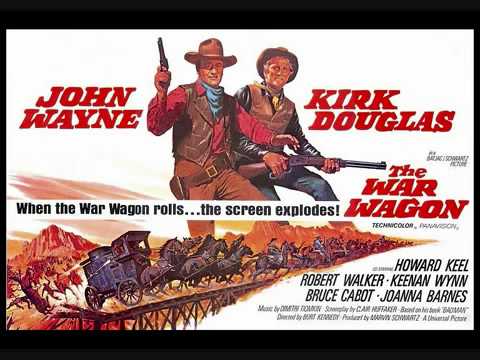
“The War Wagon”

The first thing about the 1967 John Wayne/Kirk Douglas vehicle The War Wagon   (yes, that pun was intentional, thank you)  is that it has o...